
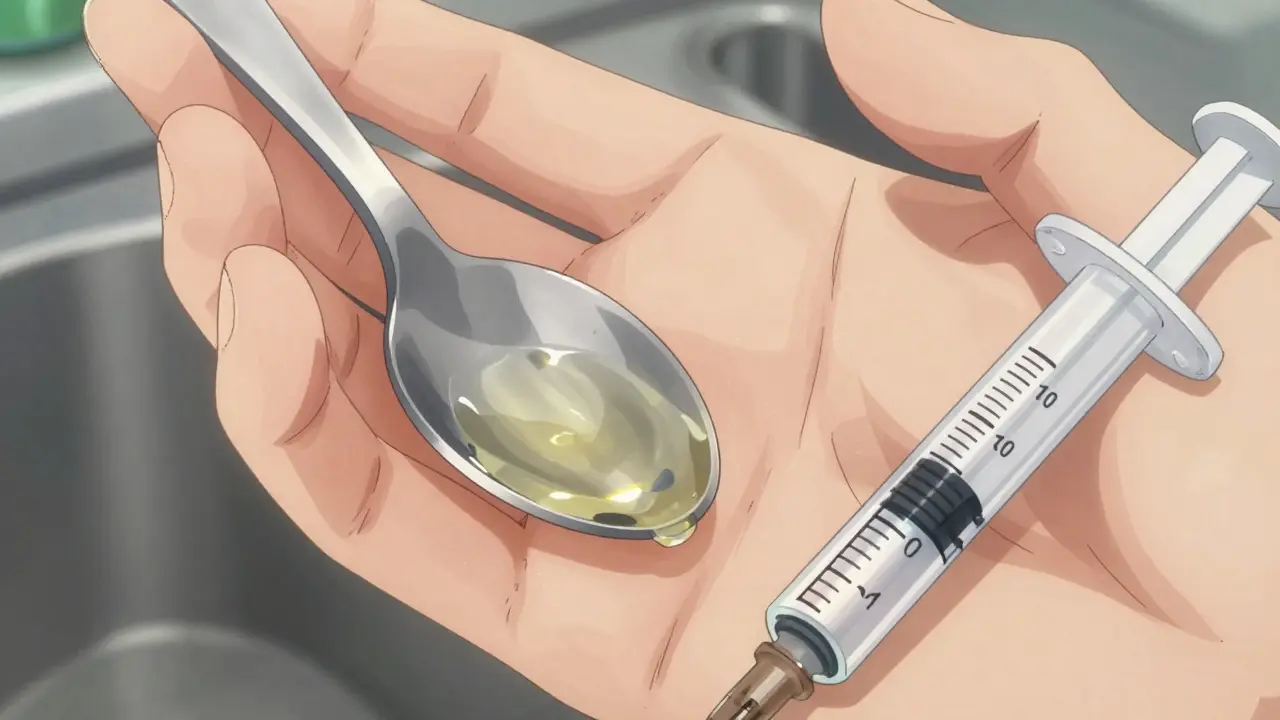
Liquid prescription labels are the printed details on medication containers that specify dosage instructions and other critical details for safe administration.
Every year, thousands of people accidentally take wrong doses of liquid medicine because they misread the label. In the US alone, medication errors from liquid prescriptions cause over 1.3 million injuries annually. But you don’t need to be a doctor to read these labels correctly. Here’s how.
Why metric units are used
Millilitres (mL) are the standard unit for liquid medication measurements. The FDA and MHRA mandate this to ensure accuracy. Household spoons like teaspoons and tablespoons vary widely in size. For example, a teaspoon can hold anywhere from 2.5 mL to 7.5 mL. Using these inconsistent units leads to dangerous dosing errors. A study by the National Council for Prescription Drug Programs (NCPDP) found that parents using non-metric measurements were twice as likely to give incorrect doses compared to those using mL-only devices.
Breaking down the prescription label
Here’s what to look for on a liquid prescription label:
- Concentration: Written as "X mg per Y mL" (e.g., "120 mg/5 mL"). This means each 5 mL contains 120 mg of the medicine.
- Total container volume: Usually printed near the top (e.g., "100 mL"). This is the total amount in the bottle, not the dose.
- Dosage instructions: Like "Take 10 mL twice daily". Always check this against the concentration to calculate the correct amount.
Confusing the total volume with the concentration is a common mistake. For example, if the bottle says "240 mg/5 mL" and the total volume is "100 mL", the dose is based on the concentration, not the total amount.
How to measure correctly
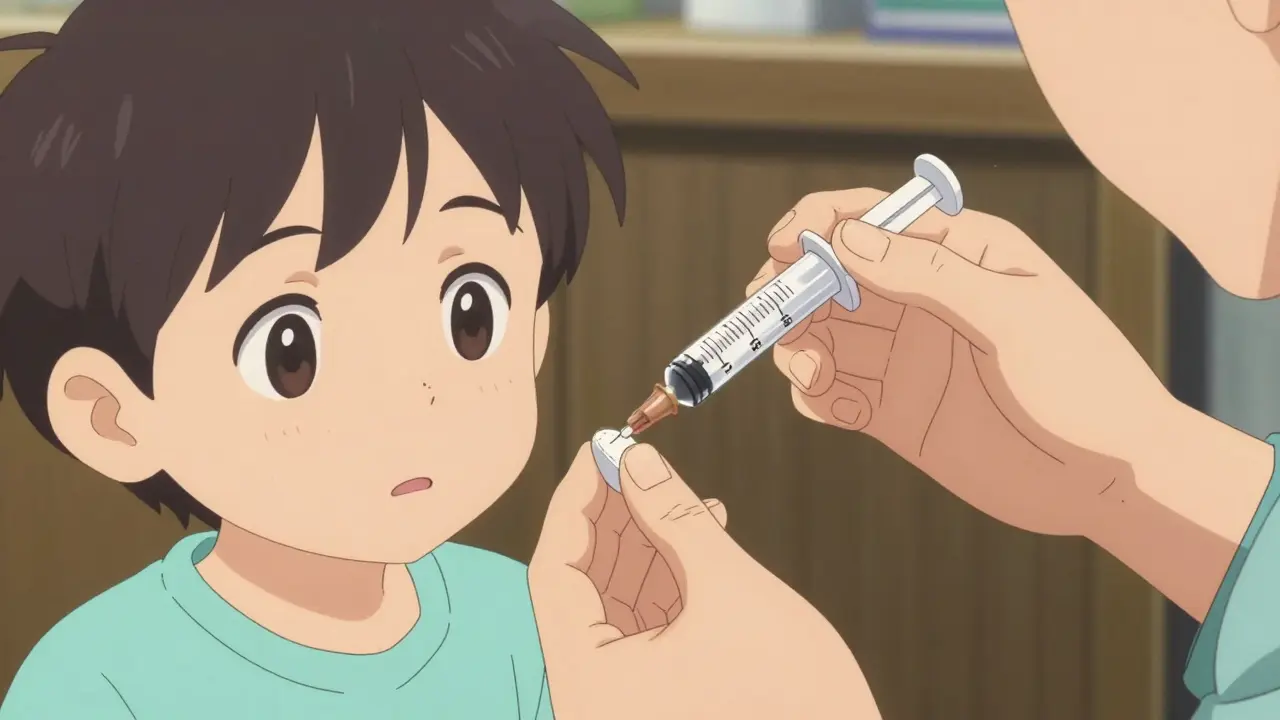
Always use the measuring device provided with the medicine-never a kitchen spoon. Most pharmacies include a syringe or dosing cup with mL markings. These tools are precise and eliminate guesswork.
For instance, if the prescription says "5 mL", use the syringe to draw up to the 5 mL line. If it’s "2.5 mL", use the half-way mark. Always check the units: "mL" not "tsp" or "tbsp".

Common mistakes and how to avoid them
Here are frequent errors and solutions:
- Decimal point confusion: "0.5 mL" vs. ".5 mL". Always look for the leading zero (0.5) to avoid mistakes.
- Household spoon use: Kitchen spoons vary in size. A tablespoon can hold 5-20 mL. Use the provided measuring device instead.
- Confusing concentration with volume: The bottle may say "240 mg/5 mL" but the total volume is "100 mL". The dose is based on the concentration, not the total amount.
Practical tips for parents and caregivers
- Double-check the prescription with the pharmacist when picking up medicine.
- Ask for a demonstration of proper measuring techniques.
- Store the measuring device with the medicine and keep it clean.
- If unsure, contact your healthcare provider immediately-never guess.
Comparison of metric and household measuring units
| Unit | Millilitres (mL) | Household Variation |
|---|---|---|
| Teaspoon (tsp) | 5 mL | 2.5 mL to 7.5 mL |
| Tablespoon (tbsp) | 15 mL | 5 mL to 20 mL |
| Half-teaspoon | 2.5 mL | 1.25 mL to 3.75 mL |
| Half-tablespoon | 7.5 mL | 2.5 mL to 10 mL |
Frequently Asked Questions
Can I use a kitchen spoon if I don’t have a measuring device?
No. Household spoons vary significantly in size. A teaspoon can hold anywhere from 2.5 mL to 7.5 mL, and a tablespoon from 5 mL to 20 mL. Using them can lead to dangerous overdoses or underdoses. Always use the measuring device provided with the medicine.
What does "240 mg/5 mL" mean on the label?
This means that every 5 millilitres of medicine contains 240 milligrams of the active ingredient. If your dose is 120 mg, you need to take 2.5 mL. Always check the concentration before measuring.
Why do liquid prescription labels use millilitres instead of teaspoons?
Millilitres (mL) are a precise metric unit, while teaspoons vary in size. Using mL ensures accurate dosing, especially for children who need precise measurements. The FDA and MHRA mandate mL as the standard unit to reduce medication errors.
What should I do if I’m unsure about the dose?
Contact your pharmacist or healthcare provider immediately. They can clarify the instructions and show you how to measure correctly. Never guess-incorrect doses can be dangerous.
Are there any visual aids to help read the label?
Some newer labels include pictograms or QR codes that link to video instructions. However, always rely on the written instructions and the measuring device provided. If you’re still unsure, ask for help.
Reading liquid prescription labels correctly is simple once you know what to look for. Always use metric units, double-check with your pharmacist, and never guess. Your safety-and your child’s-depends on it.
 Medications
Tehya Wilson
February 4, 2026 AT 20:19Always use metric units never kitchen spoons
Nancy Maneely
February 5, 2026 AT 16:12People still use teaspoons which is dangerous. We should use metric everywhere. FDA says so. Sum countries are behind.
Katharine Meiler
February 7, 2026 AT 00:44The concentration ratio is critical for accurate dosing. Misinterpreting mg per mL can lead to significant deviations. Always verify the concentration against the prescribed dose to ensure safety.
Danielle Vila
February 7, 2026 AT 22:55This is a total conspiracy! The government's pushing mL to brainwash us. Trust me, I know what's up. You need to measure with your own cups, not theirs!
Thorben Westerhuys
February 8, 2026 AT 18:23Oh my goodness! It's so important to use mL! I can't believe people use teaspoons! It's dangerous! Please, please, please use the right tool! It's life-saving!
Laissa Peixoto
February 10, 2026 AT 02:31Understanding the metric system isn't just about numbers-it's about responsibility. Many overlook this, but it's crucial for safety. Always double-check with your pharmacist.
Lana Younis
February 10, 2026 AT 09:02Different countries use different units but metric is universal. It's easy to get confused but the measuring cup is key. Always check the concentration. Teh bottle says 240mg/5mL so 120mg is 2.5mL. Simple!
Matthew Morales
February 11, 2026 AT 18:23I always use the syringe. Its more accurate. Sometimes I mix up but I double check. :)