
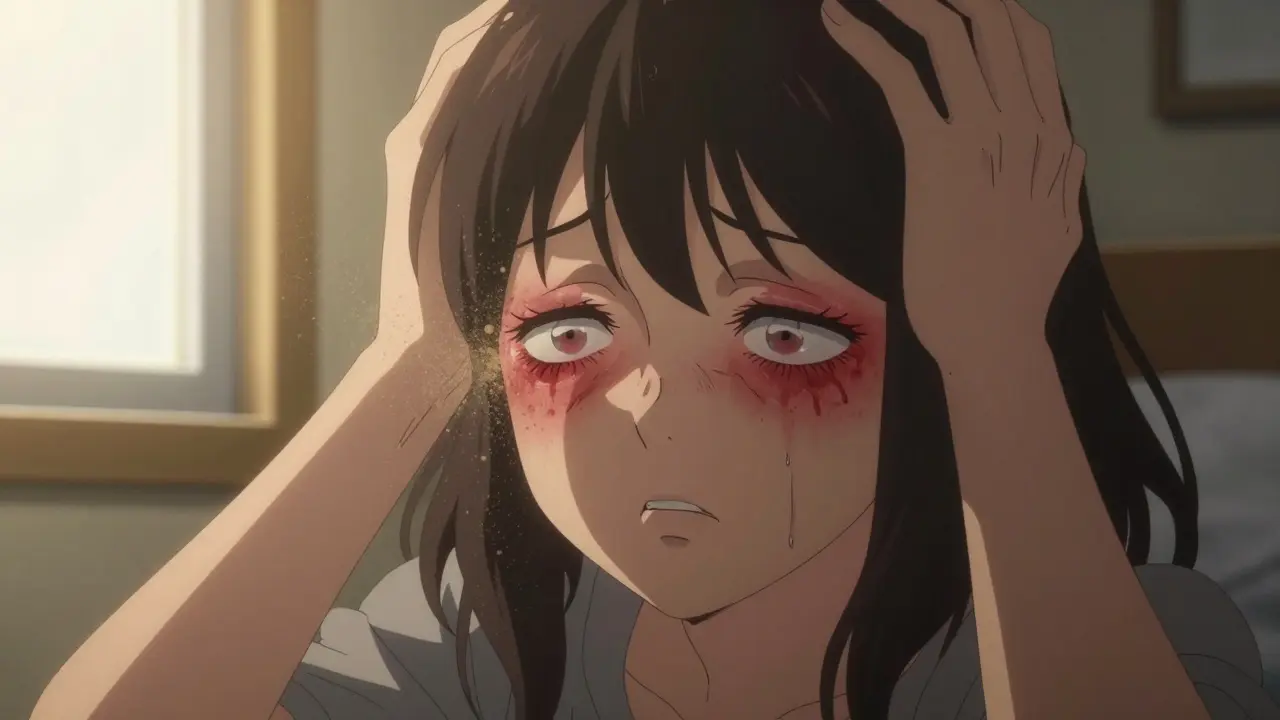
Thyroid Eye Disease (TED) isn’t just about dry eyes or puffy eyelids. It’s an autoimmune condition that attacks the tissue behind your eyes, causing swelling, pain, and sometimes vision loss. If you’ve been diagnosed with Graves’ disease-or even if your thyroid levels are normal-you could still be at risk. About half of people with Graves’ develop TED, and it can happen at any point, even years after thyroid treatment. The good news? We now have better tools than ever to stop it before it causes permanent damage.
What Does Thyroid Eye Disease Actually Feel Like?
Most people don’t realize TED starts subtly. You might think it’s allergies or tired eyes. But if you’re getting a gritty, sandy feeling in your eyes-especially when blinking-or if your eyelids feel swollen or red, that’s a red flag. Light sensitivity is common, too. You might find yourself wearing sunglasses indoors. Pain behind the eyes, especially when you move them, is another key sign. About 52% of patients report this.
Forward bulging of the eyes (proptosis) affects about 31% of people with moderate-to-severe TED. Double vision isn’t rare either-it shows up in nearly 1 in 4 cases. These symptoms usually hit both eyes, though 11% of people have them in just one. The worst part? These aren’t just cosmetic. When the muscles behind the eye swell, they press on the optic nerve. That’s when vision loss becomes a real risk.
Doctors use something called the Clinical Activity Score (CAS) to measure how active the disease is. A score of 3 or higher means inflammation is still going strong-and that’s the window to act. Once the inflammation settles, the damage can become permanent. That’s why timing matters more than you think.
Why Steroids Are Still the First Line of Defense
For decades, steroids have been the go-to treatment for active TED. The goal isn’t to cure it-it’s to calm the immune system before it destroys eye tissue. The most effective method? Intravenous (IV) methylprednisolone. This isn’t your typical oral pill. It’s given as a high-dose infusion once a week, usually for 12 weeks total: 500 mg for six weeks, then 250 mg for six more.
Studies show this approach works in 60 to 70% of patients. It reduces swelling, eases pain, and improves double vision. But it’s not without risks. About 18% of people develop glucose intolerance-some even get prediabetes. Weight gain is common, averaging 8.2 kg. Osteoporosis is a concern for long-term users. That’s why doctors limit the total dose to 4.5-5.0 grams to protect the liver.
Oral prednisone is cheaper and easier to get, but it’s less effective and harder to tolerate. About 25-30% of patients relapse after stopping it. Plus, the side effects hit harder and faster. For most people with moderate-to-severe TED, IV steroids are still the standard. But they’re not the whole story.
The Biologic Revolution: Teprotumumab Changes Everything
In 2020, the FDA approved teprotumumab (Tepezza®), and everything changed. This isn’t just another steroid. It’s a targeted therapy that blocks the IGF-1 receptor-the exact protein driving inflammation in TED. For the first time, we’re treating the root cause, not just the symptoms.
The OPTIC trial showed staggering results: 71% of patients had a 2 mm or greater reduction in eye bulging after eight infusions, compared to just 20% on placebo. Double vision improved in 59% of those on teprotumumab versus 26% on placebo. These aren’t small gains-they’re life-changing. One patient in Glasgow reduced her proptosis from 24mm to 20mm after treatment. She could finally drive again without double vision.
The treatment schedule is simple: eight infusions, given every three weeks. But the cost? It’s brutal. In the U.S., a full course runs around $360,000. Even with insurance, many patients face $5,000 per infusion. Insurance denials are common-42% of patients report delays or rejections. In the UK, access is better but still uneven. NHS approval can take months, and not all hospitals offer it.
Side effects? Muscle spasms (24%), hearing changes (11%), and high blood sugar (8%) are the most common. The FDA added a boxed warning for these in 2021. But for many, these are worth it compared to the long-term damage steroids can cause.
What About Other Biologics?
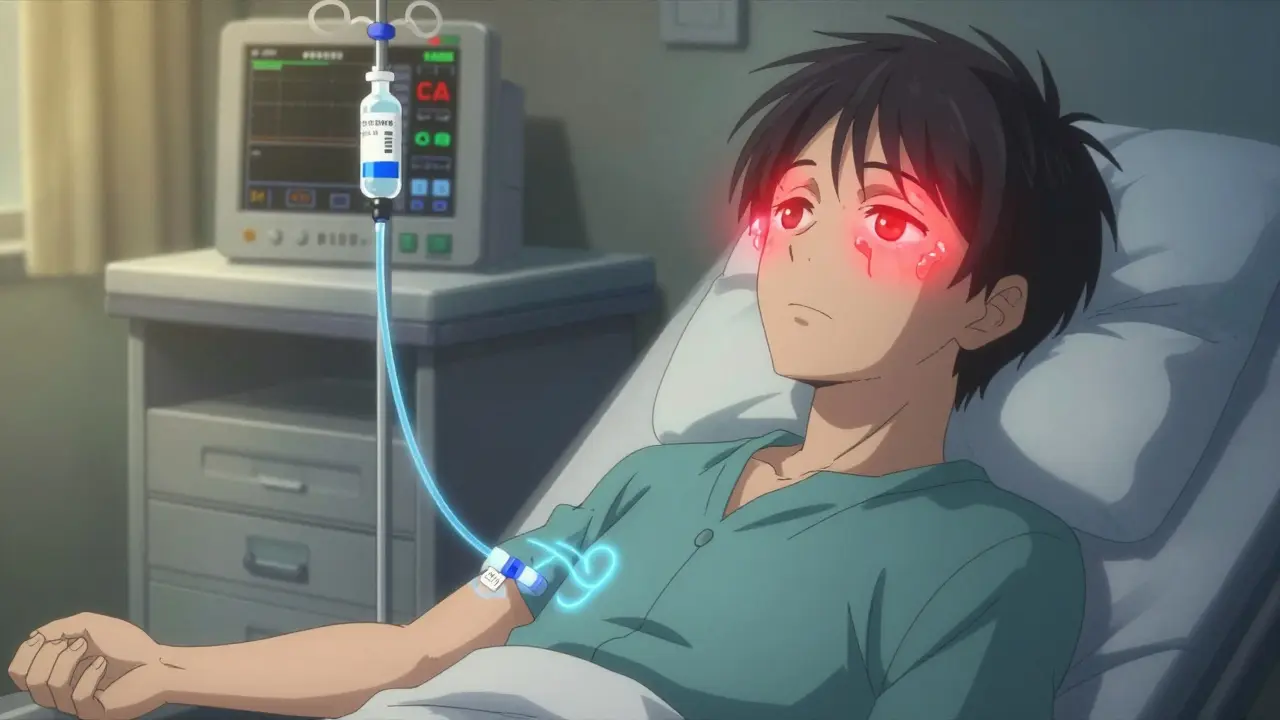
Teprotumumab isn’t the only option on the horizon. Satralizumab (Enspryng®), approved in 2023, is a subcutaneous injection that blocks IL-6, another key player in TED inflammation. Early data shows a 54% response rate for eye bulging. It’s easier to administer than IV infusions and may be cheaper long-term.
Rituximab and tocilizumab have been tried too, but the evidence is weaker. They’re used mostly when teprotumumab fails or isn’t available. A new trial in the UK called TOPAZ is testing whether adding selenium to teprotumumab boosts results. Early numbers show an 82% response rate-higher than either treatment alone.
The market is shifting fast. Amgen bought Horizon Therapeutics in 2023 for $28 billion, mostly because of Tepezza’s $2.1 billion in 2022 sales. A biosimilar version is expected by 2025, which could cut costs by 30-40%. That could make treatment accessible to far more people.
When Surgery Comes In-and When It Doesn’t
Surgery isn’t the first step. It’s the last. Orbital decompression, eye muscle surgery, and eyelid surgery are only done after the disease has been inactive for at least 6 months. That’s because if you operate while inflammation is still active, you risk making things worse.
Decompression surgery removes bone behind the eye to create space, reducing bulging by 2-5 mm. But 15% of patients develop new or worse double vision afterward. Sinus infections happen in 8%, and vision loss-though rare-is still a risk at 0.5%. Strabismus surgery fixes misaligned eyes, but only if muscle movement is limited by less than 15 prism diopters. Beyond that, it’s unreliable.
Prisms in glasses help 60% of people with double vision. But they’re a band-aid. If the muscles are too stiff or swollen, prisms won’t work. That’s why treating the inflammation early is so critical. You don’t want to end up needing surgery just because you waited too long.
What You Can Do Right Now
If you suspect TED, don’t wait. See an endocrinologist and an ophthalmologist who specialize in thyroid eye disease. Get a CT or MRI scan to check for muscle enlargement. Test your TRAb levels-if they’re above 15 IU/L, your risk is high.
Stop smoking. It’s the biggest modifiable risk factor. Smokers are nearly eight times more likely to develop severe TED. Even if you’ve smoked for years, quitting now can still reduce your risk of progression.
For mild cases, preservative-free artificial tears help. Selenium supplements (200 mcg daily) show modest benefits-about a 23% improvement in quality of life, according to Cochrane. It’s not a cure, but it’s safe and cheap.
And if you have moderate-to-severe disease? Don’t delay. Start treatment within two weeks of symptoms. Every week you wait lowers your chance of a full recovery. IV steroids or teprotumumab can prevent blindness, double vision, and permanent disfigurement.
What’s Next for TED Treatment?
The future is personalized. Researchers are looking at genetic markers that predict who’s most likely to develop TED and who will respond best to which drug. Within five years, we may be able to test your DNA and know whether you need biologics, steroids, or just watchful waiting.
Long-term data is still limited. The OPTIC trial’s 4-year follow-up results are expected in mid-2024. We need to know if teprotumumab’s benefits last-or if the disease comes back. But for now, it’s the most effective treatment we’ve ever had.
Thyroid Eye Disease used to be something you lived with. Now, it’s something you can treat-before it changes your life forever. The tools are here. The question is: are you getting the right care at the right time?
 Medications
Sarah Mailloux
January 14, 2026 AT 19:12Just got diagnosed with TED last month and this post saved my sanity. I thought it was just dry eyes from staring at screens all day. Turns out I’ve been blinking like a confused owl for months. Time to call my endo and get that MRI ASAP.
Crystel Ann
January 15, 2026 AT 06:19I’ve been on selenium for 6 months. Not a miracle, but my eyes don’t feel like sandpaper anymore. Worth a shot if you’re in the mild zone.
Jan Hess
January 16, 2026 AT 13:11Stop smoking. I know it’s hard but if you’re serious about keeping your vision you’ve got to do it. My cousin quit cold turkey after her TED diagnosis and her TRAb levels dropped 40% in 8 months. No joke.
Iona Jane
January 17, 2026 AT 11:04Tepezza costs $360k? Of course it does. Big Pharma’s just milking the autoimmune market like it’s a cash cow. They’ll charge you for oxygen next. And don’t get me started on how the FDA greenlit it without long-term data.
Amy Vickberg
January 19, 2026 AT 03:51I’m a nurse who’s seen this play out in clinic. The window for treatment is narrow and people keep waiting for ‘it to get worse’ before acting. It’s heartbreaking. One woman waited a year because she thought it was just allergies. By the time she got IV steroids, she’d lost peripheral vision in one eye. Don’t be that person.
Jaspreet Kaur Chana
January 20, 2026 AT 09:55Coming from India where Tepezza is basically a fantasy, I’m glad to see this info. We rely on steroids and selenium here. I’ve had patients who got better with 200 mcg selenium daily - not cured, but stable. And yes, quitting smoking made the biggest difference. Even in rural areas, people are starting to understand now. It’s slow, but progress.
Nilesh Khedekar
January 22, 2026 AT 03:37Of course the FDA approved it - but did you see how fast Horizon got bought by Amgen? $28 billion? That’s not science, that’s a takeover. And now we’re stuck with a drug that’s basically a luxury item. Meanwhile, in countries without insurance, people are going blind because they can’t afford a treatment that was developed with taxpayer-funded research. This isn’t medicine - it’s capitalism with a stethoscope.
Sohan Jindal
January 22, 2026 AT 11:14They say smoking causes it but what about the 5G towers near hospitals? I know a guy whose thyroid went nuts after they installed a new cell tower next to the clinic. They’re hiding the truth. Steroids are just a cover. The real cause is government mind control through thyroid meds.
Frank Geurts
January 22, 2026 AT 16:09It is of paramount importance to underscore that the clinical activity score, as delineated in the current literature, remains the most robust metric for determining therapeutic intervention timing. Failure to act within the inflammatory window, as evidenced by CAS ≥3, precipitates irreversible structural damage to the orbital tissues. This is not merely a clinical observation - it is a biologically deterministic imperative.
Jami Reynolds
January 23, 2026 AT 00:44Did you know that the FDA approved teprotumumab after only one small trial? And that the manufacturer paid for the researchers? And that the 71% improvement rate is based on a subjective measurement? This is how they get away with selling snake oil. The real cure? A ketogenic diet and magnesium. But you won’t hear that from the pharmaceutical ads.
Haley Graves
January 23, 2026 AT 09:18If you’re reading this and you’re on the fence about starting treatment - just do it. I waited six months after my diagnosis because I was scared. I regret every day of that delay. I got Tepezza last year. My proptosis went from 22mm to 17mm. I can see my own face in the mirror again. You’re not being dramatic. This matters.
RUTH DE OLIVEIRA ALVES
January 23, 2026 AT 18:12While the advent of teprotumumab represents a significant therapeutic advancement, one must not overlook the foundational role of multidisciplinary care. Endocrinological stabilization, ophthalmological monitoring, and behavioral interventions - particularly smoking cessation - remain indispensable components of optimal outcomes. The pharmacological innovation, while laudable, is not a substitute for comprehensive patient management.
Diane Hendriks
January 24, 2026 AT 14:50Tepezza works because it’s American science. In Europe, they’re still stuck on steroids and selenium. That’s why their TED patients are worse off. We lead the world in medical innovation - and we should be proud. The rest of the world can catch up when they stop whining about cost and start thinking like winners.