
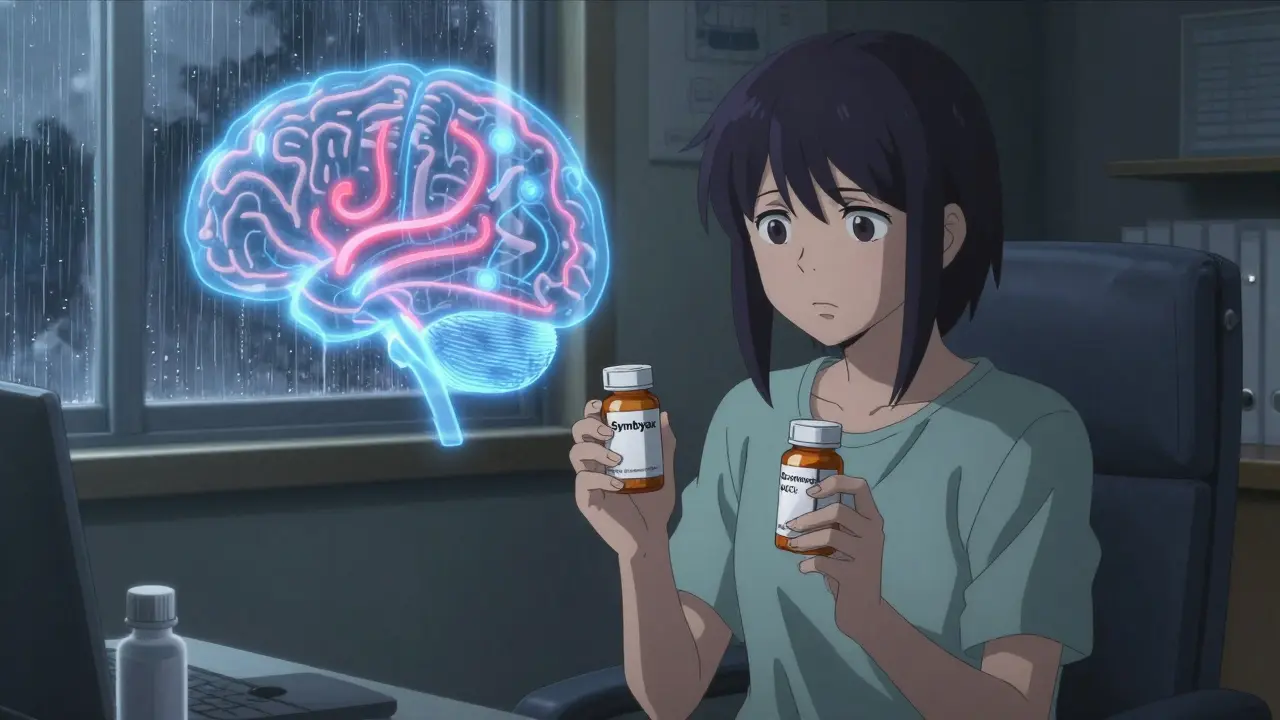
When a single psychiatric medication doesn’t do the job, doctors often add another. This isn’t experimental-it’s standard practice. About 1 in 3 people with depression don’t respond to their first antidepressant. That’s why psychiatric medication combinations are used: an SSRI like sertraline paired with a low-dose antipsychotic like aripiprazole, or fluoxetine combined with olanzapine in a single pill called Symbyax. These combinations aren’t random. They’re backed by years of clinical trials and real-world use. But here’s the catch: when you switch from brand-name drugs to generics, things can go wrong-fast.
Why Combine Medications in the First Place?
Combination therapy isn’t about over-treating. It’s about precision. For someone with treatment-resistant depression, adding a low dose of aripiprazole to an SSRI can push remission rates from 11% to nearly 25%. That’s not a small gain-it’s life-changing. The same goes for bipolar disorder, where lithium or valproate is paired with an antipsychotic to control mood swings. Even anxiety disorders benefit: adding buspirone to an SSRI tackles lingering worry without the dependency risks of benzodiazepines. These combinations are carefully balanced. Each drug targets a different pathway. Too little, and symptoms return. Too much, and side effects overwhelm.
The FDA approved these combinations for a reason. Aripiprazole’s approval as an add-on to antidepressants in 2014 came after trials showed clear improvement in patients who had failed multiple treatments. Symbyax, approved in 2003, was one of the first fixed-dose combinations designed specifically to simplify treatment. But these successes rely on consistency. The exact amount of active ingredient, how slowly it’s released, even the shape of the pill’s coating-all matter.
Generic Substitution: The Hidden Risk
The FDA says generics are interchangeable. They must contain the same active ingredient and be 80-125% as bioavailable as the brand. Sounds fair. But for psychiatric drugs, that 45% window is a minefield. Think of it like this: if your blood pressure medication needs to stay within 10 points, and a generic can vary by 45 points, you’re gambling with your stability.
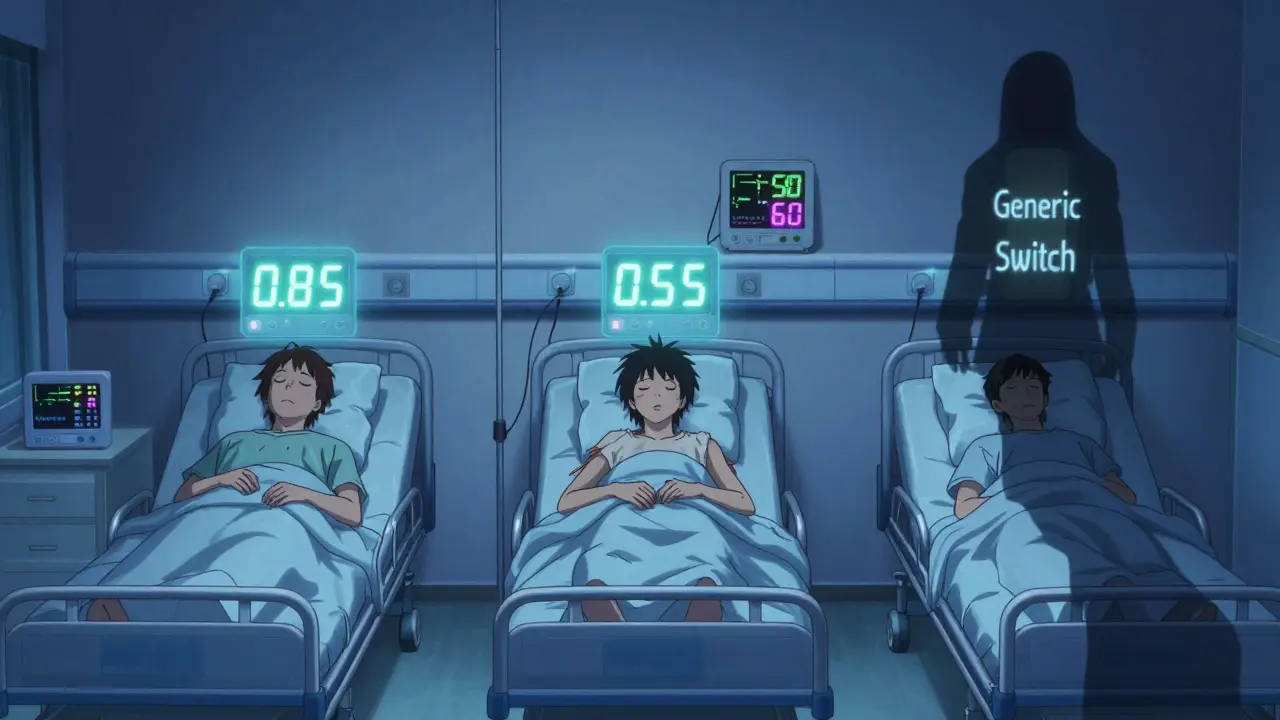
A 2019 study of nearly 28,500 patients found that switching from brand-name SSRIs to generics led to a 22.3% higher chance of treatment failure. That’s not a fluke. It’s a pattern. In one case series from the University of British Columbia, three bipolar patients went from stable to manic within two weeks of switching from brand-name lithium to a generic. Their blood levels dropped from 0.85 to 0.55 mmol/L-even though the dose didn’t change. Lithium’s therapeutic window is razor-thin: 0.6 to 1.2 mmol/L. A 0.3 drop isn’t just a number-it’s a relapse waiting to happen.
It’s not just lithium. Generic bupropion XL, the extended-release version of Wellbutrin, has been flagged by the FDA since 2012. Thirteen hundred adverse event reports detail mood crashes, panic attacks, and sudden anxiety after switching to certain generic versions. Why? The release mechanism is different. Brand-name Wellbutrin XL uses a precise osmotic system. Some generics use cheaper, inconsistent bead technology. The result? A patient gets too much drug too fast one day, too little the next. That’s not a difference. That’s instability.
Combination Therapy Makes It Worse
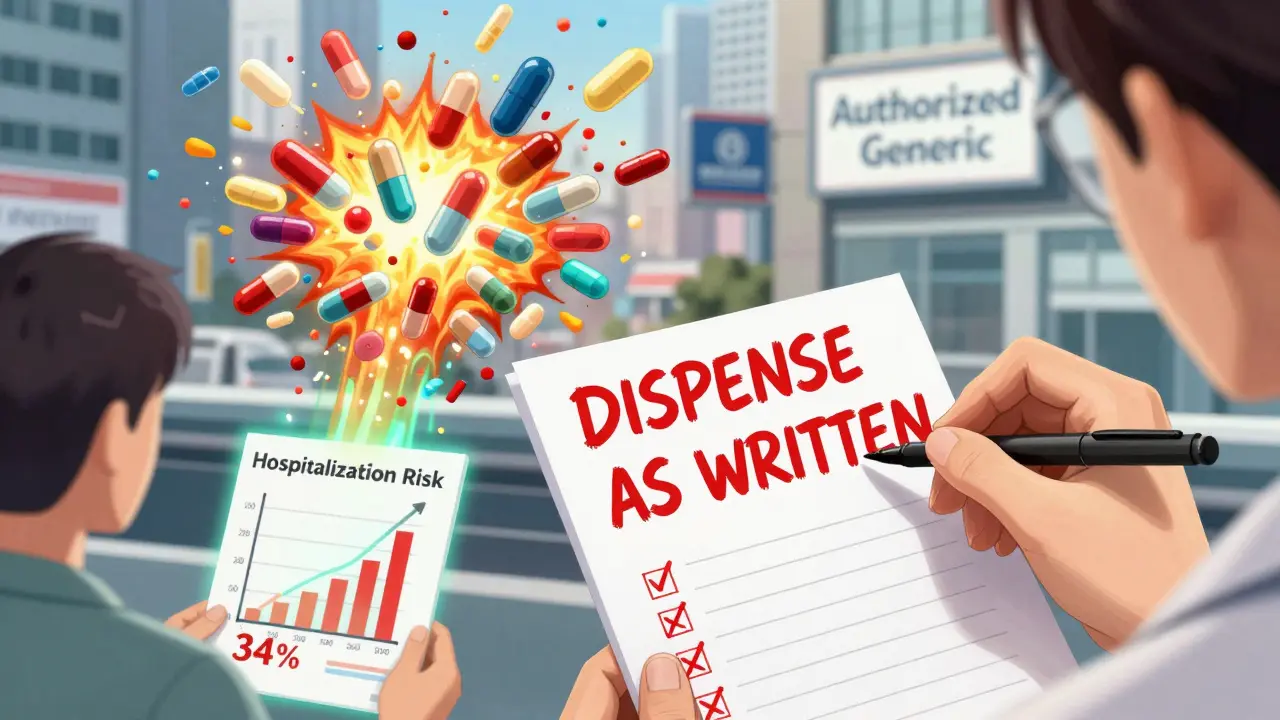
Here’s the real problem: combinations multiply the risk. If you’re on two drugs, and one of them has a 7% chance of causing a problem after a generic switch, you’re not just at 7%. You’re at higher risk because both drugs are now unpredictable. A 2020 study found that patients on combination therapy with lithium had a 34% higher chance of hospitalization after switching to a generic version. That’s not a coincidence. It’s a cascade.
Venlafaxine ER (Effexor XR) is another example. It works by balancing serotonin and norepinephrine in a 2:1 ratio. But different generic manufacturers use different bead systems. One might release serotonin faster. Another might delay norepinephrine. That changes the ratio. For someone on venlafaxine plus buspirone, even a small shift can undo months of progress. Patients report sudden irritability, sleeplessness, or worsening anxiety-symptoms that look like relapse, but are really just a bad generic.
Online communities are full of these stories. On Reddit’s r/depression, a top thread titled “Generic switch ruined my med cocktail” had over 1,200 upvotes. Users wrote about their Abilify stopping working after switching to a generic, or their Lamictal losing its effect. On PatientsLikeMe, 38.7% of people on combination therapy reported worsening symptoms after a generic switch-nearly three times higher than those on single drugs.
What Doctors Are Doing About It
Many clinicians are pushing back. The American Psychiatric Association’s 2022 guidelines say: “Switching between generic manufacturers may be as problematic as switching from brand to generic.” That’s bold. It means they’re not just warning-they’re advising against automatic substitution.
Hospitals like Massachusetts General and the University of Toronto have created tools to help. One tool scores risk based on three things: whether the drug has a narrow therapeutic index (3 points), if it’s part of a combination (2 points), and if the patient had a bad reaction to generics before (4 points). A score of 6 or higher? The system flags it. The prescriber gets a notification. No automatic switch.
Documentation matters too. Some psychiatrists now write the manufacturer and lot number on prescriptions. Why? Because in one 2021 case, a patient on lithium and carbamazepine had unexplained toxicity. The problem? A switch from Aurobindo to Mylan. The two generics had different absorption rates. The doctor knew because they’d recorded the manufacturer. Without that, it would’ve been impossible to trace.
The Cost vs. Safety Debate
Generics save money. In 2022, 89% of psychiatric prescriptions were generic. That’s $18.7 billion in savings. But what’s the hidden cost? A 2023 Congressional Budget Office report estimates that without changes, generic-related psychiatric hospitalizations will cost the system $2.4 billion annually by 2027. That’s more than the savings.
Some experts, like Dr. G. Caleb Alexander, argue that for most antidepressants, the risk is low. But even he admits: “Specific high-risk combinations, particularly those involving lithium or clozapine, warrant closer monitoring.” That’s the key. Not all drugs are equal. Not all substitutions are safe.
Insurance companies push for generics. Pharmacists are required to substitute unless the doctor says “do not substitute.” But what if the doctor doesn’t know? What if the patient doesn’t understand? The system is built for volume, not precision.
What You Can Do
If you’re on a combination therapy, here’s what matters:
- Ask your doctor: Is your medication on the list of high-risk generics? (Lithium, lamotrigine, bupropion XL, venlafaxine ER, carbamazepine)
- Check the pharmacy label: Look for the manufacturer name. If it changes unexpectedly, call your prescriber.
- Track your symptoms: Keep a simple log. Sleep? Mood? Energy? Irritability? A change in the first 10 days after a switch is a red flag.
- Request brand-name if needed: If you’re stable, ask for a “dispense as written” prescription. It’s legal. It’s your right.
Some pharmacies now offer authorized generics-brand-name drugs sold without the brand name at generic prices. Symbyax has one. So do a few other combinations. They’re not always cheaper, but they’re more consistent.
The Future Is Personalized
Things are changing. The FDA is drafting new rules: for combination drugs, they’re considering narrowing the bioequivalence range from 80-125% to 90-111%. That’s a big step. The Department of Veterans Affairs now requires patients on combination therapy to stay with the same generic manufacturer for at least a year. Preliminary data shows a nearly 19% drop in hospitalizations.
Long-term, pharmacogenetic testing could help. If your body metabolizes drugs a certain way, you might be told: “Stick with Aurobindo. Avoid Mylan.” That’s not science fiction-it’s coming by 2027. Until then, the safest approach is simple: if it works, don’t change it. And if you must change it, do it slowly, with eyes wide open.
 Medications
Alex Ogle
February 8, 2026 AT 01:36So let me get this straight - we’re telling people on life-saving meds that it’s fine to swap out their pills like they’re trading baseball cards? I’ve seen this firsthand. My cousin was stable on Effexor XR + Lamictal for three years. Then her insurance forced a switch to a generic. Two weeks later, she was in the ER with panic attacks and insomnia. They thought it was a relapse. It wasn’t. It was a bad batch of beads. The drug company didn’t even know which manufacturer their generic came from. How is that acceptable? We’re not talking about aspirin here. We’re talking about brains that are already fragile. And yet, the system treats this like a cost-cutting spreadsheet instead of a human life.
It’s not about being anti-generic. It’s about being pro-stability. If your medication keeps you alive, why risk it? The FDA’s 80-125% window is a joke. Imagine if your insulin could vary that much. You’d be dead in a week. But for psychiatric meds? Meh. We’ll just chalk it up to ‘individual variation.’
Ken Cooper
February 8, 2026 AT 13:34okay so like… i just got switched to a generic abilify last month and i swear i felt like a zombie for two weeks. like, i couldnt even make coffee without forgetting what i was doing. my doc said ‘it’s probably all in your head’ but nope. i checked the bottle. it was a different maker. called ‘teva’ instead of ‘ovi’ or whatever. called the pharmacy. they said ‘oh yeah we switch all the time’ like it’s no big deal. but when your brain’s already on a tightrope, even a 5% difference feels like a cliff. i went back to brand. insurance screamed. i screamed louder. worth it. dont let them fool you. this stuff is not interchangeable. period.
ps. if you’re on combo therapy? you’re basically playing russian roulette with your mood. and the gun’s loaded with generics.
Karianne Jackson
February 10, 2026 AT 08:52OMG YES. I had the same thing happen. I was on lithium + sertraline. Switched to generic lithium. One week later I was crying in the shower for no reason. Then I screamed at my cat. Then I called 911 because I thought my apartment was on fire. It wasn’t. I just lost my mind. Turns out my blood level dropped from 0.8 to 0.5. That’s not a ‘little change.’ That’s a crash. I’m never switching again. I don’t care if it costs $500 a month. I need to stay alive.
John McDonald
February 10, 2026 AT 13:26This is such an important thread. I want to add that the real tragedy isn’t just the medical risk - it’s the emotional toll. People who are stable feel like they’re crazy when they start having side effects. They blame themselves. ‘Maybe I’m just not trying hard enough.’ ‘Maybe I’m weak.’ But it’s not you. It’s the system. I’ve worked in mental health for 15 years. I’ve seen too many people lose their progress because of a pharmacy substitution they never even knew was happening. We need mandatory disclosure - like food labels. ‘Manufactured by: [Company] - May affect absorption.’ Simple. Clear. Human.
And doctors - we need to stop assuming patients know what’s in their pills. Most don’t. They trust us. We owe them better.
Chelsea Cook
February 11, 2026 AT 03:21Wow. So let me get this straight - the same people who tell us ‘all meds are the same’ are the ones who also think generic toilet paper is fine for your butt? 😂
Here’s the truth: if you’re on combo therapy, your brain is a precision instrument. Not a toaster. You wouldn’t swap your Tesla engine for a junkyard part and say ‘eh, it’s still a car.’ Why do it with your neurochemistry? And don’t even get me started on how insurance companies treat mental health like a discount bin at Walmart. ‘Oh, you’re depressed? Here’s a $3 pill. Go forth and be happy!’
Also - who approved this system? A robot? A politician? A guy who’s never taken a psychiatric med? I need answers.
Andy Cortez
February 12, 2026 AT 19:46lol this whole thing is a scam. the real problem? people are too weak to handle their own meds. if you can’t handle a generic switch, maybe you shouldn’t be on meds at all. also - lithium? really? that’s your thing? you’re telling me the entire mental health industry is collapsing because of a 0.3 mmol/L difference? that’s not science. that’s fearmongering. i’ve been on 6 different generics over 12 years. never had a problem. maybe you’re just sensitive? or maybe you’re just looking for drama.
ps. also - the fda is not your enemy. they’re trying to save money. you should be grateful we even have generics. in china, you’d be lucky to get any pill at all.
Jacob den Hollander
February 14, 2026 AT 18:24I just want to say - thank you for writing this. I’m a father of a 22-year-old with bipolar disorder. She was stable for 18 months on lithium + lamotrigine. Then, last winter, the pharmacy switched her lithium to a different generic. Within 10 days, she stopped sleeping, started talking to strangers on the street, and said she was ‘the chosen one.’ We rushed her to the hospital. She was manic. The blood test showed her lithium level at 0.52. Normal range: 0.6–1.2. She’d been on 0.85 for a year.
Doctors didn’t know. Pharmacist didn’t care. Insurance didn’t care. I had to call the manufacturer. Found out they changed the coating formula. No one told us. No one warned us. We’re lucky she didn’t jump off a bridge.
This isn’t politics. It’s not about money. It’s about trust. When you’re on these meds, you trust your doctor. Your pharmacist. The system. And when that trust breaks - it doesn’t just break your mood. It breaks your soul.
Andrew Jackson
February 15, 2026 AT 13:44It is an undeniable fact that the erosion of pharmaceutical integrity in the United States represents a catastrophic failure of governance, moral fortitude, and national responsibility. The FDA’s permissive stance on bioequivalence - permitting a 45% variance in drug absorption - is not merely negligent; it is an act of systemic malfeasance against the citizenry. We have allowed the commodification of human neurochemistry to proceed under the banner of ‘cost efficiency,’ while the most vulnerable among us are sacrificed on the altar of corporate profit.
It is no coincidence that the nation with the highest per capita antidepressant use also has the highest rate of psychiatric hospitalizations. This is not coincidence - it is consequence. The American healthcare system, in its current form, is not designed to heal. It is designed to extract. And until we restore the sanctity of the physician-patient relationship - and outlaw automatic substitution without explicit, documented consent - we are complicit in a national tragedy of epic proportions.
Randy Harkins
February 17, 2026 AT 13:12Thank you for this. 🙏 I’ve been on Abilify + Zoloft for 5 years. Last year, my pharmacy switched the Abilify to a generic. I didn’t notice at first. Then I started having these weird emotional spikes - like I’d cry for 20 minutes over a commercial. Then I’d feel nothing for days. I kept a journal. Took it to my doc. We switched back. Cost me $400. Worth every penny.
Also - if you’re on combo therapy? Ask for the ‘authorized generic.’ It’s the same as brand, just without the logo. Symbyax has one. So does Wellbutrin XL. They’re not always cheaper, but they’re way more stable. And if your doc says ‘it’s fine’ - ask them to check the manufacturer. If they don’t know? Find a new one. Your brain matters.
Chima Ifeanyi
February 19, 2026 AT 05:20Let’s deconstruct this narrative. The data cited is cherry-picked. The 22.3% increase in treatment failure? That’s a correlation, not causation. Confounding variables: adherence, comorbid substance use, socioeconomic stressors. Also - the FDA’s bioequivalence standard is validated across 10,000+ drugs. If psychiatric meds are outliers, why not study the pharmacokinetics of the specific excipients? Why not analyze the dissolution profiles? This is not a ‘generic crisis.’ It’s a failure of clinical monitoring. Patients need better education. Not fear. Not sensationalism. Science.
Also - if you can’t afford brand-name meds, you shouldn’t be on them. Period. Mental health isn’t a luxury. It’s a responsibility. And responsibility requires adaptation. Not privilege.
Tori Thenazi
February 20, 2026 AT 08:18Okay but have you heard about the secret government program that controls the generic drug manufacturers? They’re using microchips in the pill coating to track your mood. I saw it on a documentary. The same company that makes the lithium generics also makes the flu vaccines. Coincidence? I don’t think so. And why do you think they want us unstable? So we’ll buy more meds. Or so we’ll be too distracted to notice the drones. I’ve been on the same brand for 8 years. I’m the only one who knows the truth. They tried to switch me last month. I called the FDA. They hung up. That’s how you know they’re guilty.
Also - my neighbor’s dog got sick after eating a generic pill. Coincidence? I think not.
Monica Warnick
February 20, 2026 AT 12:25I don’t usually comment. But this… this hit me. I’ve been on lamotrigine + sertraline for 7 years. I’ve never had a relapse. Never. Then last year, my pharmacy switched the lamotrigine. I didn’t notice until I started having these weird electric zaps in my head. Like, literally - I’d feel a shock when I turned my head. I thought I was having mini-seizures. I went to the ER. They said ‘probably nothing.’ I went back to my psych. He looked at the bottle. Said, ‘Oh. That’s the Mylan version.’ He called the pharmacy. They said, ‘We switch all the time.’
I’ve been stable for 7 years. I didn’t ask for this. I didn’t want to be a guinea pig. I just wanted to live. Now I’m scared to even refill my script. What if next time it’s worse? What if next time I don’t recover?