
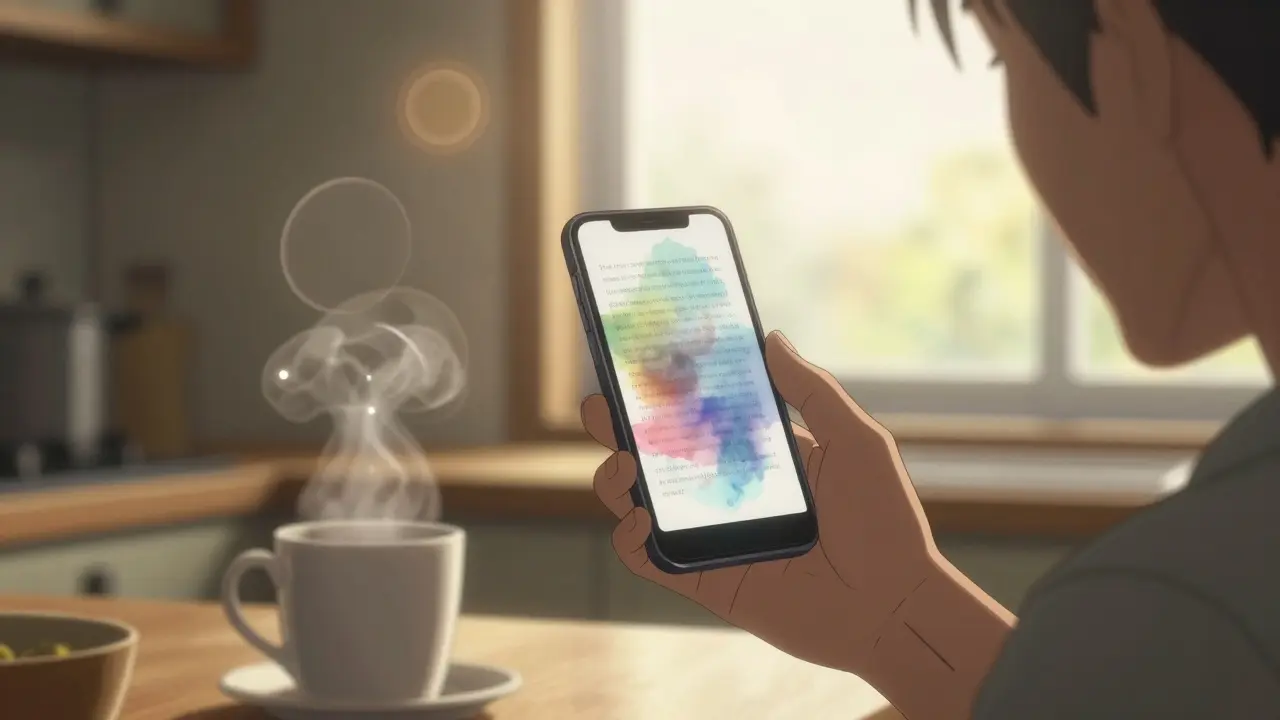
By your mid-40s, you start holding your phone farther away to read the text. The menu at dinner looks blurry. You squint at the microwave clock. It’s not stress. It’s not bad lighting. It’s presbyopia-a normal, unavoidable part of aging that affects every single person on Earth. Unlike cataracts or glaucoma, presbyopia isn’t a disease. It’s just your eyes growing older, like gray hair or wrinkles. And if you’re reading this, chances are you’re either experiencing it right now or will soon.
What Exactly Is Presbyopia?
Presbyopia happens because the lens inside your eye gets stiffer over time. When you were young, that lens was flexible-like a rubber band. It could change shape instantly to focus on things close up, whether it was a book, a phone, or your toddler’s face across the room. By age 10, your eyes could focus on something just 7 centimeters away. By 60? That distance stretches to over 100 centimeters. You’re literally losing the ability to bring near objects into focus. This isn’t caused by weak eye muscles. It’s not from too much screen time. It’s not even from poor diet. The lens simply hardens and thickens as new layers build up over decades, like rings on a tree. This process starts early but doesn’t become noticeable until your 40s. The National Eye Institute confirms that nearly everyone experiences it by age 45. There’s no way to prevent it. No eye exercises, no supplements, no special diets will stop it. As Dr. Emily Chew from the NEI put it: “It’s as inevitable as gray hair.”How Do You Know You Have It?
The signs are simple and unmistakable:- You need more light to read, even when it’s bright outside.
- You hold books, phones, or menus at arm’s length to see clearly.
- Small print on medicine bottles or price tags looks fuzzy.
- Your eyes feel tired or strained after reading for more than 10 minutes.
- You get headaches after close-up work, especially on screens.
Reading Glasses: The Simple Fix
The easiest solution? Reading glasses. They’re cheap, widely available, and work instantly. You can buy them at any pharmacy, supermarket, or online for under $20. Most come in strengths from +0.75 to +3.50 diopters, in 0.25 increments. If you’re just starting out, most people begin with +1.00 or +1.25. You can test them in-store by reading a newspaper or phone screen. If the text looks clear at about 35-40 cm away, you’ve got the right strength. But here’s the catch: over-the-counter readers aren’t tailored to you. They assume both eyes need the same correction. Many people have different vision in each eye, or need astigmatism correction. If you’re using off-the-shelf glasses and still struggling-especially with computer work or driving at night-you might need a prescription. A 2023 Optometry Times study found that 35% of people buy the wrong strength, leading to eye strain and headaches. Also, reading glasses only help with near vision. You’ll need to take them off to see the TV, drive, or recognize someone across the street. For many, that’s fine. For others, it’s a hassle.
Progressive Lenses: The Seamless Alternative
If you already wear glasses for distance, progressives are the most popular upgrade. These lenses have three zones in one: distance at the top, intermediate (like computer screens) in the middle, and near at the bottom. No visible lines. No switching glasses. Just move your eyes up and down. They’re not perfect. The first two to four weeks can feel strange. Peripheral vision gets distorted, especially on the sides. You might feel like you’re walking through a funhouse mirror. That’s normal. Your brain needs time to adapt. Many people give up too soon. Goodeyes.com’s clinical data shows 75% of users are satisfied after six weeks if they stick with it. Progressives cost more-$250 to $450 depending on the brand and material. Brands like EssilorLuxottica’s Eyezen 2.0 and Johnson & Johnson’s Acuvue Oasys Multifocal have improved the design significantly since 2023, widening the near zone by 30% to reduce eye movement. Still, about 25% of first-time wearers report discomfort with side vision, especially when walking down stairs or turning quickly.Bifocals vs. Progressives: What’s the Difference?
Bifocals have a clear line separating the distance and reading portions. The reading segment is usually a small half-moon at the bottom. They’re cheaper-$200 to $350-and easier to adapt to than progressives. But the line is visible, and the transition between distance and near is abrupt. If you’re working at a computer, your head has to tilt down to see the screen, which can cause neck strain. Progressives eliminate the line and offer a smoother transition. They’re better for modern life-typing, driving, talking to people, reading. But they require a more precise fit. Your optometrist needs to measure your pupillary distance (within 0.5mm), how far the lenses sit from your eyes, and the angle of the frame. A bad fit can make them unusable.Contacts and Surgery: More Advanced Options
If you hate wearing glasses, contact lenses are an option. Monovision contacts correct one eye for distance and the other for near. About 80% of people adapt well. But 15% lose depth perception, making tasks like parking or catching a ball harder. It’s not ideal for athletes or drivers who need sharp 3D vision. Surgical options exist too. LASIK monovision reshapes the cornea to create the same one-eye-distant, one-eye-near effect. It costs $2,000 to $4,000 per eye, with 85% satisfaction rates. But 10-15% need a touch-up within five years, and 35% develop dry eyes. For those ready for a permanent fix, refractive lens exchange replaces your natural lens with a multifocal artificial one-same as cataract surgery. It costs $3,500 to $5,000 per eye. It eliminates presbyopia and prevents future cataracts. But you might notice halos around lights at night (25% of patients) or reduced contrast in low light (15%). It’s a big decision, and not for everyone.
What’s New in 2026?
The field is evolving. In early 2023, the FDA approved a new contact lens called Acuvue Oasys Multifocal with “Enhanced Near Technology”-it improved near vision success to 89% in trials. EssilorLuxottica’s Eyezen 2.0 lenses now use AI-driven data from 10,000 wearers to optimize the reading zone. Even more exciting? Eye drops. Researchers at the National Eye Institute are testing VP-025, a topical solution that temporarily makes the pupil smaller, improving near focus. In Phase 1 trials, it boosted near vision by 1.0 to 1.5 diopters for up to six hours. It’s not a cure, but it could mean fewer glasses for occasional use. Meanwhile, tiny corneal implants like Presbia’s Flexivue Microlens (approved in Europe in 2022) are showing promise. Inserted in the cornea, it improves near vision without removing the natural lens. Early results show 78% of patients achieved 20/25 near vision after a year.What Should You Do Now?
If you’re noticing trouble with close-up vision:- Get a comprehensive eye exam. Don’t wait until it’s annoying. The American Academy of Ophthalmology recommends a full eye check starting at age 40.
- Ask for a cycloplegic refraction. This test uses drops to relax your eye muscles and gives the most accurate reading of your true need for correction.
- Start with reading glasses if you don’t already wear distance glasses. Try +1.00 or +1.25. If they help, great. If not, see an optometrist.
- If you already wear glasses, talk to your eye doctor about progressives. Ask for a trial frame if the clinic offers one.
- Avoid buying readers online without testing them first. Many cheap pairs have poor optical quality and cause headaches.
Final Thought: It’s Not a Problem-It’s a Normal Step
Presbyopia doesn’t mean your eyes are failing. It means they’ve done their job for decades. You’ve read books, watched sunsets, seen your kids grow up-all because your eyes worked perfectly. Now, they’re just changing. And that’s okay. You don’t need to be embarrassed. You don’t need to fight it. You just need the right tool. Whether it’s a $10 pair of readers or a custom progressive lens, the goal isn’t to reverse aging. It’s to keep living fully. To read the label. To see your grandchild’s smile. To enjoy the words on the page. You’re not losing your vision. You’re gaining the wisdom to choose the right way to keep seeing clearly.At what age does presbyopia usually start?
Most people start noticing symptoms between ages 40 and 45. The lens begins hardening in your 30s, but it’s not until your 40s that the change becomes noticeable enough to interfere with daily tasks like reading or using a phone. By age 50, nearly everyone needs some form of near-vision correction.
Can presbyopia be prevented with eye exercises or diet?
No. Despite claims online, there is no scientific evidence that eye exercises, vitamins, or supplements can prevent or reverse presbyopia. The condition is caused by the natural hardening of the lens over time, a biological process that affects every human being. The National Eye Institute confirms that it’s as inevitable as gray hair.
Are over-the-counter reading glasses safe to use long-term?
They’re safe to use occasionally, but not ideal for daily or prolonged use. Off-the-shelf readers assume both eyes have the same prescription and don’t correct for astigmatism or different strengths between eyes. Using the wrong power can cause eye strain, headaches, and blurred vision. If you need them regularly, a prescription from an optometrist is better.
How often do I need to change my reading glasses?
Your near-vision needs typically increase every 2 to 3 years between ages 45 and 65. The lens keeps hardening, so your add power usually rises from +1.00 to +2.50 or higher. Most people need to update their glasses at least once in their 50s and again in their 60s. Annual eye exams after 40 help track these changes.
Do progressive lenses work well for computer use?
Yes, but not all progressives are created equal. Standard progressives optimize for distance and reading, with a narrow intermediate zone. For computer users, occupational progressives are better-they widen the middle zone for screens (usually 40-70 cm away) and reduce the distance zone. These are often called “office progressives” and are ideal for people who spend most of their day on computers.
Is surgery for presbyopia worth it?
It depends on your lifestyle and expectations. Surgery like refractive lens exchange eliminates the need for glasses permanently but carries risks like halos, glare, and reduced contrast sensitivity. LASIK monovision works well for some but reduces depth perception. Most eye doctors recommend optical solutions first. Surgery is best for people who are already considering cataract surgery or who strongly dislike wearing glasses.
Why do my eyes feel tired when I read with my new glasses?
If you just got progressives, it’s likely because your brain is still learning how to use them. The distortion in the sides takes 2-4 weeks to adjust to. If you’re using over-the-counter readers, the prescription might be too strong or too weak. If the tiredness lasts longer than a month, go back to your optometrist. You may need a different add power or lens design.
 Medications
Luke Davidson
January 25, 2026 AT 04:11Jenna Allison
January 27, 2026 AT 03:30Phil Maxwell
January 28, 2026 AT 22:58Darren Links
January 29, 2026 AT 11:17Helen Leite
January 30, 2026 AT 00:19Elizabeth Cannon
January 30, 2026 AT 04:38Karen Conlin
January 30, 2026 AT 21:42asa MNG
January 31, 2026 AT 20:40Patrick Gornik
February 2, 2026 AT 01:07venkatesh karumanchi
February 3, 2026 AT 13:50Sushrita Chakraborty
February 3, 2026 AT 15:02Tommy Sandri
February 3, 2026 AT 20:12Heather McCubbin
February 5, 2026 AT 11:38Josh McEvoy
February 5, 2026 AT 17:22