

Switching from a brand-name drug to a generic can feel like a leap into the unknown. You’ve been taking the same pill for years - same color, same shape, same name on the bottle. Then one day, your pharmacist hands you a different one. Smaller. Cheaper. Maybe even a different color. Your heart sinks. Generic medications work the same way, right? Or are you just being used as a cost-cutting experiment?
You’re not alone. Millions of people feel this way. And for many, the fear isn’t about the science - it’s about the silence. No one talks about what it’s really like to switch. Will your headaches come back? Will your blood pressure spike? Will you feel like a different person? That’s where patient support groups step in. Not as clinics. Not as ads. But as real people sharing real stories.
Why Do People Doubt Generic Medications?
The FDA says generics are bioequivalent. That means they deliver the same active ingredient, in the same amount, at the same rate as the brand-name version. The law requires them to be within 80-125% of the original’s absorption. That’s not a guess. That’s science. But science doesn’t always calm fear.
People report side effects after switching. Fatigue. Dizziness. Worse mood. Worse pain. Sometimes, these are real. But often, they’re not caused by the drug itself. They’re caused by expectation. A 2009 study found nearly 30% of patients switching from brand to generic epilepsy drugs thought they were getting worse - even when blood tests showed no change. That’s the nocebo effect: the mind expecting harm, and the body responding accordingly.
And then there’s the cost. Generics save patients $313 billion a year in the U.S. alone. But when your out-of-pocket drops from $120 to $12, it’s hard not to wonder: “Is this really the same thing?”
How Support Groups Actually Help
Unlike brochures or website pages, support groups don’t just give facts. They give context. They give stories. They give someone who’s been there.
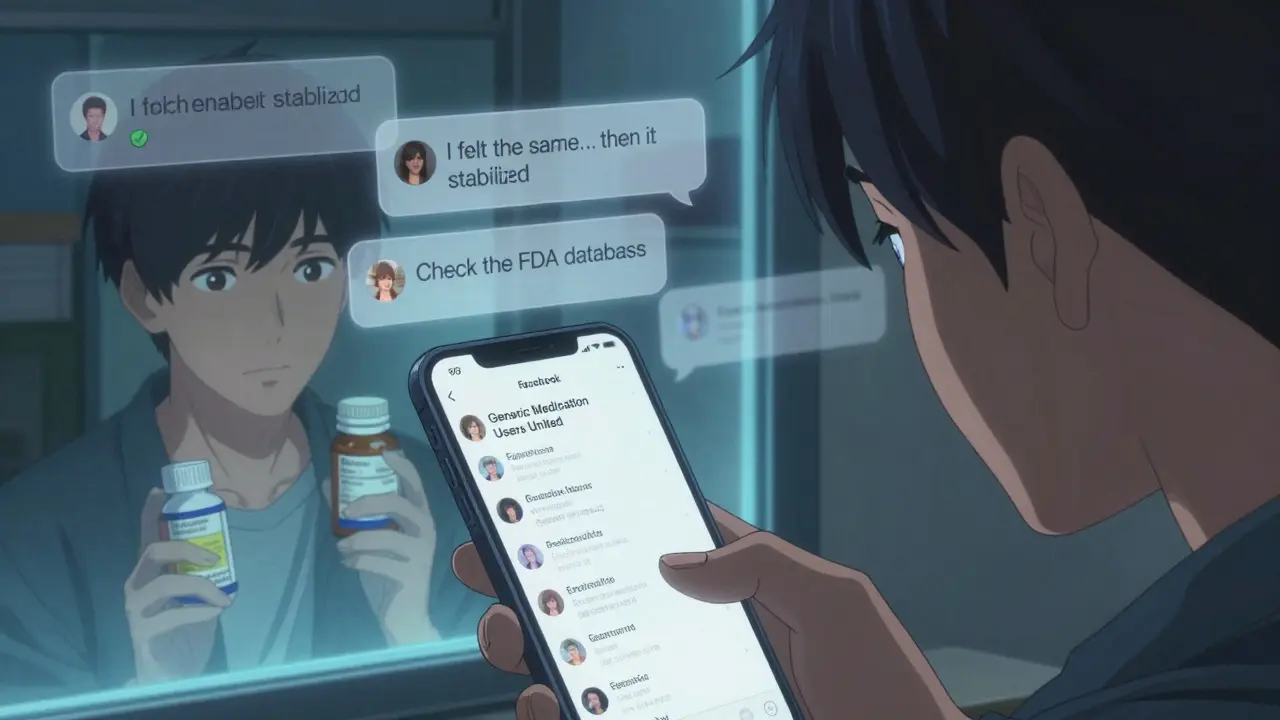
On Facebook, there’s a group called “Generic Medication Users United” with over 14,000 members. New members often post: “I switched to generic lisinopril and felt like I was dying. Am I crazy?” Within hours, replies flood in. “I felt the same. Took two weeks. Then my blood pressure stabilized.” “My pharmacist checked the FDA database with me - it’s the same active ingredient.” “I switched three times. This one’s fine. Try a different brand.”
That’s the magic. It’s not just reassurance. It’s validation. You’re not crazy. You’re not weak. You’re not the only one. And you’re not alone in figuring it out.
Studies show patients in these groups are 27% more confident in generics. And when confidence rises, adherence rises too. The FDA found patients on generics had 15-20% better adherence than those on brand names - not because generics work better, but because people stick with them. Lower cost helps. But knowing someone else made it through? That’s what keeps people taking their pills.
Where to Find Real Support Groups
Not all groups are created equal. Some are full of rumors. Others are run by people with no medical training. The best ones have structure.
Online groups: Look for ones with active moderation. Reddit’s r/Pharmacy has a thread every week where pharmacists answer questions. Facebook groups like “Generic Medication Users United” have volunteer moderators who flag misinformation. The Association for Accessible Medicines is launching a verified directory in early 2024 - keep an eye out for that.
In-person groups: Community health centers, especially in rural areas, often host monthly meetings. The CDC found these groups are especially effective where people can’t easily get to a doctor. Pharmacies like Howard’s in Chicago run diabetes support groups where members swap stories and learn how to switch to biosimilars - saving $327 a month on insulin.
Healthcare-linked groups: Some hospitals and clinics now refer patients to support groups as part of chronic care. The American College of Physicians found that when doctors mention these groups, generic prescribing rates go up by 18%. That’s because patients trust their doctor - and if their doctor says, “There’s a group where people talk about this,” they’re more likely to join.
What Makes a Good Support Group?
Not every group helps. Some make things worse. Here’s how to tell the difference:
- Professional oversight: Are pharmacists or nurses involved? Groups that include even occasional professional input cut misinformation by 75%. A 2009 study found 34% of unmoderated online posts had false claims. With a pharmacist checking posts? That drops to 8%.
- Focus on experience, not fear: Good groups don’t just say, “Don’t panic.” They say, “Here’s what I felt. Here’s how long it lasted. Here’s what I did.” That’s actionable. That’s real.
- Verified facts: The best groups link to FDA data, peer-reviewed studies, or pharmacy resources. They don’t just say “I read online.” They say, “I checked the FDA’s bioequivalence database - this generic is approved for the same use.”
- Long-term focus: These groups work best for chronic conditions - high blood pressure, diabetes, depression, thyroid issues. They’re less useful for short-term meds like antibiotics.
A bad group? One where someone says, “Generic statins caused my heart attack.” No proof. No data. Just fear. That’s the kind of post that gets flagged - or should.
What You Can Do Right Now
You don’t need to wait for a formal group. Start small.
- Ask your pharmacist: “Do you have a group where people talk about switching to generics?” Most pharmacists know of one.
- Search Facebook: Type “[Your medication] generic support group.” Look for groups with over 1,000 members and recent posts.
- Join one thread: Don’t post right away. Read for a week. See how people talk. Notice who answers questions. Who’s calm? Who’s angry? Who shares data?
- Share your own story: After a month, post: “I switched to generic metformin. First week, I felt tired. Second week, better. Now I’m saving $90 a month. Anyone else?” You’ll be surprised how many respond.
The goal isn’t to convince everyone generics are perfect. It’s to make sure no one feels alone when they’re trying to make a smart, cost-saving choice.

The Bigger Picture: Why This Matters
Right now, 90% of prescriptions in the U.S. are generics. But only 87% of eligible patients actually take them. That’s 13% of people not getting the full benefit - not because the drugs don’t work, but because they’re afraid.
That’s $271 million in wasted savings for Medicaid alone. It’s $4 billion in potential savings across the system by 2027, according to ASPE. But numbers don’t change minds. Stories do.
When patients share their experiences, they don’t just help themselves. They help doctors. They help pharmacists. They help policymakers. The FDA now calls patient stories “real-world evidence.” That means your experience - your fatigue, your relief, your confusion - is being used to shape how drugs are approved and prescribed.
Dr. Vineet Arora from the University of Chicago calls it “the quiet revolution.” Not in labs. Not in boardrooms. But in online forums and community centers, where people talk about their pills - and in doing so, change how medicine works.
What to Do If You’re Still Unsure
It’s okay to be cautious. But don’t let fear stop you from trying.
If you’re switching and feel off:
- Give it two weeks. Most side effects fade.
- Check the active ingredient. Is it the same? If yes, you’re on the right track.
- Don’t stop cold. Talk to your doctor or pharmacist first.
- Write down how you feel. Sleep. Energy. Mood. Pain. That helps you spot patterns.
- Join a group. Even if you don’t post. Just listen.
And if you’ve been on a generic for months and feel fine? Say so. Tell someone. Post it. You might be the reason someone else sticks with their medication.
Are generic medications really the same as brand-name drugs?
Yes. The FDA requires generics to have the same active ingredient, strength, dosage form, and route of administration as the brand-name version. They must also be bioequivalent - meaning they work the same way in your body, within a narrow range (80-125% absorption). The only differences are inactive ingredients like color, shape, or filler - which don’t affect how the drug works.
Why do I feel different after switching to a generic?
It’s common, but rarely because the drug is different. The most likely cause is the nocebo effect - your brain expecting side effects because you believe generics are inferior. Other reasons include switching between different generic brands (which vary in inactive ingredients), or your condition naturally fluctuating. Give it 1-2 weeks. If symptoms persist, talk to your doctor - but don’t assume it’s the generic’s fault.
Can support groups help me convince my doctor to prescribe generics?
Not directly - your doctor makes the prescription decision. But support groups can help you speak up. Many patients report feeling more confident asking, “Can we try the generic?” after hearing others’ experiences. The American College of Physicians found that when patients bring up support group insights, doctors are more likely to prescribe generics - especially for chronic conditions like hypertension or diabetes.
Are there risks in joining a patient support group?
The main risk is misinformation. Some online groups spread myths - like “generic antidepressants don’t work” or “generics cause cancer.” Avoid groups with no moderation or where medical claims aren’t backed by sources. Stick to groups with pharmacist involvement or those linked to hospitals or reputable organizations like the Association for Accessible Medicines.
How do I know if a support group is trustworthy?
Look for three things: 1) Active moderation by a pharmacist or nurse, 2) References to FDA or peer-reviewed studies, 3) A focus on shared experience, not fear-mongering. Trusted groups don’t say “Never take generics.” They say, “I had trouble at first, but here’s what helped.” The Association for Accessible Medicines will launch a verified directory in early 2024 - that’s the gold standard.
Generic medications aren’t magic. They’re medicine - just cheaper. And the people who use them? They’re not guinea pigs. They’re everyday patients doing what they can to stay healthy - and helping others do the same.
 Medications
Monte Pareek
December 19, 2025 AT 06:40Look I get it you're scared your blood pressure meds changed color but let's be real here the FDA doesn't mess around with this stuff
I switched from Lipitor to atorvastatin and felt nothing different except my wallet stopped bleeding
My pharmacist showed me the bioequivalence data and I was like okay fine but I still stared at the pill for ten minutes like it was a spy
Turns out my anxiety was the real problem not the generic
Now I tell everyone who complains about generics to give it two weeks and stop watching YouTube videos about Big Pharma conspiracies
It's not magic it's math and if you're still feeling off it's probably your stress not the tablet
And yeah I saved 85 bucks a month that's real money
Stop treating your meds like they're enchanted amulets and start treating them like science
Dev Sawner
December 20, 2025 AT 07:02It is regrettable that the populace continues to conflate pharmaceutical bioequivalence with perceptual equivalence
The nocebo effect is a well-documented phenomenon in clinical psychopharmacology
One must recognize that the psychological construct of brand loyalty is not a valid pharmacological criterion
Furthermore the assertion that inactive ingredients induce systemic physiological perturbations lacks empirical substantiation
It is therefore incumbent upon the individual to relinquish subjective interpretations in favor of objective data
The FDA's 80-125% absorption window is not arbitrary but derived from rigorous pharmacokinetic modeling
One must also consider that the cost differential is not incidental but structurally essential to healthcare sustainability
It is lamentable that emotional narratives supplant evidence-based reasoning in public discourse
One wonders whether the proliferation of unmoderated online forums exacerbates this epistemic crisis
Perhaps the solution lies not in further patient education but in the institutional suppression of misinformation
Lynsey Tyson
December 21, 2025 AT 22:19you know what helped me the most was just reading other people's stories
i was terrified switching to generic sertraline
felt like i was losing my mind for a week
then i read a post from a mom who said the same thing and she said it got better
so i waited
and it did
now i take it without thinking
and i save like 90 a month
it's not about being brave
it's about giving yourself space to adjust
Meenakshi Jaiswal
December 22, 2025 AT 04:14One thing people don't talk about is switching between different generic manufacturers
Same active ingredient but different fillers
I went from one generic metformin to another and got stomach cramps for three days
Switched back to the first one and boom fine
It's not that generics don't work
It's that not all generics are created equal in terms of how your body tolerates the fillers
Ask your pharmacist which manufacturer your pharmacy uses
Stick with the same one if it works
And if you get a new bottle that looks different again
Don't panic
Call the pharmacy
They'll tell you if it's a new maker
Most of the time it's totally fine
Tim Goodfellow
December 22, 2025 AT 11:21My grandpa took generic blood pressure pills for 12 years
He used to say 'If it keeps me alive and doesn't cost me my pension I'm not complaining'
He didn't care about the color or the shape
He cared that he could still go fishing
And he didn't care if it was called Lipitor or atorvastatin
He just wanted to live
That's the real story here
Not the fear
Not the conspiracy
Just a man who didn't want to be a burden
And generics let him be free
Takeysha Turnquest
December 23, 2025 AT 03:31we are not just pills we are stories
every time you switch you're not just changing a tablet you're changing your relationship with your own body
you're staring at a white oval and wondering if you're still you
that's not paranoia that's existential
the system treats you like a number
but your nerves don't care about bioequivalence
they care about continuity
they care about the ritual
the morning coffee the pill cup the quiet moment before the day begins
when that changes
you feel like you've lost something you can't name
and that's why the groups matter
not because they fix the science
but because they fix the silence
benchidelle rivera
December 23, 2025 AT 08:19Dev Sawner you're the reason people hate doctors
You think facts calm fear
No they don't
Fear is not a logic problem
It's a human problem
And you're talking like we're all just defective data points
People aren't irrational because they're stupid
They're scared because they've been treated like cost centers
They've been told to shut up and take the cheaper pill
Then they feel weird
And you call it nocebo
But what if it's not in their head
What if it's in the system
That ignores them
Until they break
holly Sinclair
December 23, 2025 AT 09:22There's a deeper layer here that no one talks about
Medication is one of the few things in modern life that requires absolute trust
You swallow something you can't see or feel working
You rely on invisible chemistry
When that pill changes
You're not just changing a drug
You're changing your relationship with the entire medical-industrial complex
It's not about the 80-125% range
It's about whether you believe the system has your back
Generics are a test of faith
And when you're chronically ill
You've already lost so much faith
That even a tiny shift
Feels like the whole foundation cracking
So yes
It's not just science
It's philosophy
It's trauma
It's the quiet grief of being treated like a variable
Not a person
Emily P
December 24, 2025 AT 04:12Read for a week before posting
That was the best advice I ever got
Turns out most people who say 'I died after switching' are just having a bad week
And the ones who say 'it's fine' are the ones who waited
Now I just lurk
And when I see someone new
I send them a DM
Just say hey I was scared too
It's okay
It gets better
That's all
Jedidiah Massey
December 24, 2025 AT 13:36Let’s be clear: the FDA’s 80-125% bioequivalence window is a regulatory compromise, not a clinical guarantee
Pharmacokinetic variance is non-linear
And the Cmax and AUC metrics are population-level aggregates
They do not account for individual polymorphisms in CYP450 enzymes
Or variations in GI motility
Or the compounding effects of polypharmacy
So yes
Statistically
It’s fine
But statistically
Some people are outliers
And outliers don’t get to be heard
They get labeled as non-compliant
Or psychologically unstable
That’s not science
That’s systemic erasure
Alex Curran
December 25, 2025 AT 03:09My cousin switched to generic insulin and saved 300 a month
She's diabetic
She didn't have a choice
She didn't care about the color
She just needed to live
And guess what
Her numbers are better now
Because she doesn't skip doses
Because she can afford them
So stop pretending this is about fear
It's about access
And if you're still worried
Go talk to someone who actually can't afford the brand
Not the internet
Not the studies
Real people
Kelly Mulder
December 26, 2025 AT 13:29Generic medications are not medicine they are pharmaceutical discount bin leftovers
The FDA is not a guardian of health it is a corporate appeaser
Why do you think the brand names are so much more expensive
Because they work
Because they're engineered
Because they're not made by some factory in Bangalore that uses talc as a filler
My doctor told me to switch
So I did
And then I felt like I was drowning
My anxiety spiked
My heart raced
It wasn't in my head
It was in the pill
And now I'm paying double
Because I refuse to be a lab rat