

Getting the quantity and directions right on a controlled substance prescription isn’t just good practice-it’s the law. One wrong number, one unclear sig, and you could be looking at a DEA investigation, a license suspension, or worse, a patient harmed by an overdose. In 2023, over 6,200 enforcement actions were taken against pharmacies and prescribers for verification failures. Most of these weren’t about fraud-they were about missed details. Here’s how to get it right every time.
What You Must Check on Every Controlled Prescription
Every controlled substance prescription, whether it’s oxycodone, Adderall, or diazepam, must contain seven legally required elements. Missing even one can trigger an audit. These aren’t suggestions. They’re mandatory under 21 CFR § 1306.05.- Prescriber’s full name and address - No abbreviations. If it says “Dr. J. Smith, 123 Main St,” that’s not enough. It must be the full legal name and complete office address.
- Date of issuance - Schedule II prescriptions must be dated the day they’re written. Schedules III-V can be up to six months old, but no more.
- Patient’s full name and address - Nicknames like “Tommy” or “Mrs. Jones” won’t cut it. It must match the ID on file.
- Drug name and strength - “Hydrocodone 10mg” is fine. “Hydro 10” is not. Spell it out. No shorthand.
- Dosage form - Tablet, capsule, liquid, patch? Specify it. A prescription for “fentanyl” without stating “transdermal patch” is incomplete.
- Quantity prescribed - This is where most errors happen. The number must appear in both digits and words. “30 tablets” isn’t enough. It must read “thirty (30) tablets.”
- Directions for use (sig) - “Take one by mouth every 4 hours as needed for pain” is clear. “1 q4h prn pain” is acceptable if it’s standard pharmacy shorthand. But “1 po q4h” without context? That’s risky.
If any of these are missing, you cannot dispense. Call the prescriber. Don’t guess. Don’t assume.
Verifying the DEA Number: The Three-Step Math
A DEA number looks like this: AB1234567. But it’s not random. It’s a checksum. If the math doesn’t add up, it’s fake-or wrong.Here’s how to verify it in under 30 seconds:
- Check the second letter - It must match the prescriber’s last name initial. If the prescriber is Dr. Smith, the second letter must be ‘S.’ If it’s ‘A,’ stop. Call the office.
- Add digits 1, 3, and 5 - In AB1234567, that’s 1 + 3 + 5 = 9.
- Add digits 2, 4, and 6, then double the result - That’s 2 + 4 + 6 = 12. Multiply by 2 = 24.
- Add both totals - 9 + 24 = 33. The last digit (3) must match the seventh digit of the DEA number. In this case, it does. Valid.
The DEA says this method catches 98.7% of invalid numbers. If it fails, don’t dispense. Contact the prescriber. If they say it’s correct, ask them to reissue with a verified number. You’re legally responsible.
Quantity Verification: Numbers Don’t Lie
In 2022, 2% of all Medicaid rejections were due to quantity mismatches. That’s not a small number. It’s a red flag.Always compare the written and numeric quantities. “Thirty (30)” - good. “30 tablets” - not enough. “Twenty (25)” - wrong. “Sixty (60)” - mismatch. These aren’t typos. They’re potential diversion attempts.
Look for tamper-evident features too. Since 2008, controlled substance prescriptions must have:
- Security paper with microprinting (use a 10x magnifier if needed)
- A statement like “Rx is void if more than ___ prescriptions”
- Check-off boxes for quantity in 25-unit increments
- Asterisks around the quantity and refill fields
If the prescription doesn’t have these, treat it as suspicious. Even if the DEA number checks out, the form itself is invalid.
Directions (Sig) That Could Kill
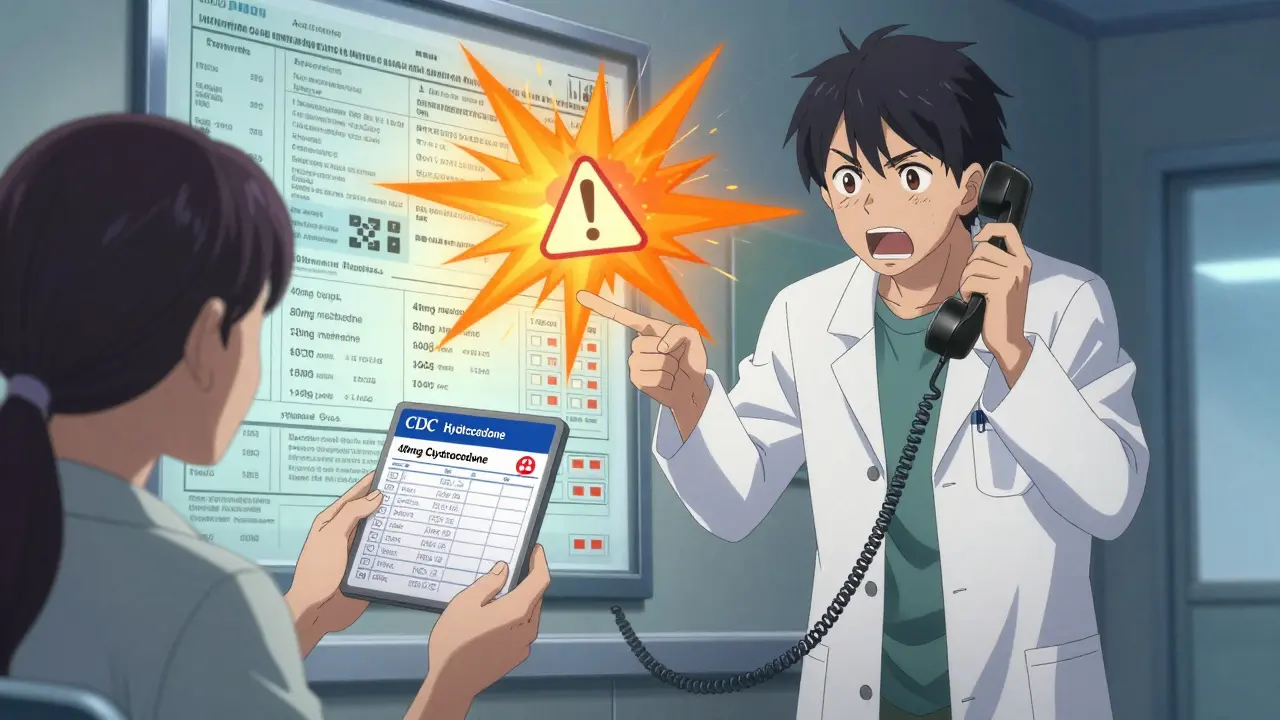
“Take one tablet every 4 hours” sounds harmless. But what if the patient is already on 3 other opioids? What if they’re elderly? What if they have kidney disease?The CDC’s 2022 opioid conversion guidelines aren’t optional reading-they’re clinical tools. Use them.
Here are the key conversion ratios:
- Codeine: 0.15 (10mg codeine = 1.5mg morphine)
- Fentanyl patch (25mcg/hr): 2.4
- Hydrocodone: 1 (10mg = 10mg morphine)
- Hydromorphone: 4 (5mg = 20mg morphine)
- Methadone: 4 (for ≤20mg/day), 8 (21-40mg), 10 (41-60mg), 12 (≥61mg)
When a patient comes in with a new methadone script for 80mg daily and you see they’re already on 40mg of hydrocodone, do the math. 40mg hydrocodone = 40mg morphine. 80mg methadone = 80mg × 8 = 640mg morphine equivalent. That’s a 16-fold increase. That’s dangerous. You must call the prescriber. You must question it. You are not just a dispenser-you’re a safety net.
PDMP Checks: Real-Time or Not?
All 49 states have a Prescription Drug Monitoring Program (PDMP). But not all are equal.In 2024, only 27 states require real-time (under 5 minutes) data submission. In 18, data can be up to 24 hours old. In 4, it’s weekly. That means a patient could get a script in Tennessee, drive to California, and get another before the first one shows up.
Here’s what you must do:
- Check the PDMP before dispensing every controlled substance.
- Look for red flags: multiple prescribers, multiple pharmacies, high daily doses, overlapping scripts.
- Don’t rely on automated alerts. Manually review the history. A 68-year-old patient with 12 prescriptions in 30 days? That’s not normal.
Pharmacists using the NABP’s PMP InterConnect platform report a 37% reduction in verification time. It’s worth the training. And if your state’s PDMP is slow? Document your attempt. Say “PDMP checked, data delayed per state requirement” in your notes. That’s your legal cover.
Electronic Systems vs. Manual Checks
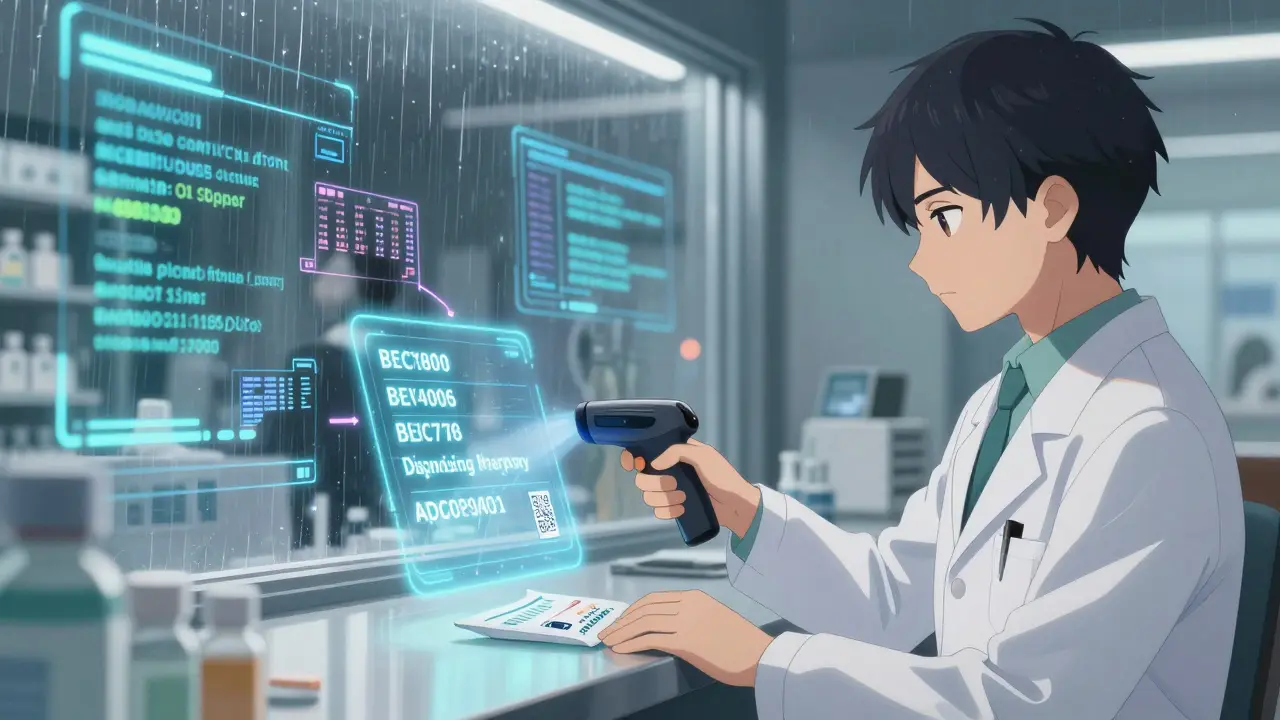
98% of chain pharmacies use electronic verification. Only 42% of independents do. Why? Cost. But the risk isn’t equal.Manual verification has an 18.7% error rate. Electronic systems? 99.2% accuracy. But here’s the catch: electronic systems only work if they’re DSCSA-compliant. That means they must verify the product identifier (GTIN) on the package against the FDA’s National Drug Code database.
If you’re using a manual system, you need a strict double-check protocol:
- Pharmacist checks DEA number, quantity, sig.
- Technician rechecks DEA number, quantity, sig.
- Third person (supervisor) signs off if it’s Schedule II.
That’s not extra work. That’s your liability shield. The DEA doesn’t care if you’re busy. They care if you verified.
When You Must Call the Prescriber
You don’t need to call for every script. But you must call when:- The quantity doesn’t match the written form
- The DEA number fails the math check
- The sig is vague or dangerous (e.g., “take as needed” for methadone)
- The PDMP shows multiple prescribers or high total morphine equivalents
- The prescription is handwritten and illegible (68% of pharmacists say this happens daily)
Don’t hesitate. Call. Record the date, time, name of the person you spoke to, and what they said. That note could save your license.
What’s Changing in 2025-2026
The DEA is rolling out QR code verification on all controlled substance prescriptions by 2026. This will link each package to a digital trail-batch number, expiration, dispensing pharmacy, patient ID. It’s part of the DSCSA package-level tracing system that went live in November 2023.AI-assisted verification pilots are starting in 12 states. These tools flag patterns: prescribers writing 50+ scripts/day, patients getting scripts from 3 different clinics in one week. But the AMA warns: don’t let AI replace human judgment. It’s a tool, not a replacement.
By 2030, the Congressional Budget Office estimates pharmacy verification costs will rise by $4,200 per pharmacy annually. But they’ll prevent $12.7 billion in opioid-related hospitalizations and overdoses.
That’s the bottom line: verification isn’t a cost. It’s a lifesaver.
Training and Resources
You don’t need to learn this alone. Use free tools:- DEA’s OSCAR - Free online module for DEA number and prescription verification. Over 87,000 practitioners completed it in 2023.
- FDA’s DSCSA Implementation Guide (v3.1) - Step-by-step for electronic system setup.
- NABP PMP InterConnect - Best-in-class PDMP access platform. Rated 4.7/5 by pharmacists.
- ASHP 2023 Verification Guidelines - Five-point protocol: DEA, PDMP, form integrity, prescriber contact, clinical appropriateness.
Train your whole team. Make verification part of your daily culture. Not a checklist. A habit.
What happens if I dispense a controlled substance without verifying the quantity?
You risk DEA enforcement action. Penalties include civil fines up to $758,574 per violation, license suspension, or criminal charges. In 2023, quantity mismatches were the second most common reason for pharmacy investigations after forged prescriptions. You are legally responsible-even if the prescriber made the error.
Can I accept a faxed controlled substance prescription?
Yes, for Schedule III-V substances. Schedule II prescriptions must be original, handwritten, or electronically transmitted via DEA-compliant systems. Faxed Schedule II scripts are invalid unless they’re from a long-term care facility or hospice under specific exemptions. Always confirm the source.
How do I verify a methadone prescription when the patient is already on another opioid?
Use the CDC’s methadone conversion ratios. For doses over 60mg/day, use a 12:1 ratio (12mg methadone = 1mg morphine). Add this to all other opioids the patient is taking. If the total morphine equivalent exceeds 90mg/day, you must contact the prescriber. High-dose methadone without clear clinical justification is a major red flag.
Is it okay to fill a prescription if the DEA number looks correct but the prescriber’s name is unfamiliar?
No. Always verify the prescriber’s identity. Call their office using a number from a trusted source (like the state medical board website), not the one printed on the prescription. Fake prescribers are common in diversion cases. If you can’t confirm the prescriber, refuse to fill it.
What should I do if a patient says their prescription was lost and they need a refill early?
Check the PDMP immediately. If they’ve had multiple early refills in the past 30 days, or if the prescriber has issued multiple scripts in a short time, this is a red flag. Do not refill without contacting the prescriber. Document your concern. Many diversion cases start with “I lost my prescription.” Always verify before acting.
 Medications
sue spark
December 15, 2025 AT 20:45Just read this whole thing and honestly? This is the kind of stuff that keeps people alive. No fluff, just facts. Wish more pharmacists treated this like a sacred duty.
Tiffany Machelski
December 16, 2025 AT 14:09i always double check the dea number but i never knew the math trick. this is game changing. thank you for sharing
Dave Alponvyr
December 16, 2025 AT 17:31So let me get this straight. You’re telling me I have to do math on a prescription? In 2025? And if I don’t, someone might die? Cool. Cool cool cool.
Kim Hines
December 17, 2025 AT 11:19I’ve seen so many scripts with ‘Hydro 10’ and just sighed and filled them. Now I feel awful.
Arun ana
December 18, 2025 AT 04:29Love this! 🙌 The PDMP check is my new best friend. Took me 3 weeks to get used to it but now I can’t imagine working without it. Seriously, train your techs too!
Dan Padgett
December 18, 2025 AT 23:45You know, in my village back home, a man died because the medicine was wrong. Not because someone was evil. Just because no one checked. This guide? It’s not paperwork. It’s a prayer. A quiet, careful prayer for people who can’t speak for themselves anymore.
SHAMSHEER SHAIKH
December 19, 2025 AT 20:06As a practicing pharmacist with over two decades of experience, I can unequivocally state that the seven mandatory elements outlined herein are not merely regulatory formalities-they constitute the very bedrock of pharmaceutical integrity. Failure to adhere to these standards, even in the most trivial of instances, represents a fundamental breach of the Hippocratic Oath, as interpreted through the lens of modern pharmacopeia. The DEA number verification protocol, in particular, is an elegant application of mathematical logic to the preservation of human life; it is, in essence, a checksum for conscience. Furthermore, the integration of DSCSA-compliant electronic systems is not a luxury but a moral imperative, given the staggering 18.7% error rate inherent in manual verification. The cultural shift required to institutionalize verification as a habit-not a checklist-is both challenging and noble. I urge every pharmacy owner to mandate weekly training sessions, to incentivize compliance, and to recognize pharmacists who consistently demonstrate vigilance. The cost of inaction is measured not in dollars, but in graves.
Hadi Santoso
December 21, 2025 AT 16:25Man, I just got back from a shift in Philly. Had a guy come in with a scrip for 120 methadone and said he lost his bottle. PDMP showed 4 other scripts in 2 weeks. I called the doc, turns out the guy’s been seeing 3 different pain clinics. We didn’t fill it. He got mad. But I slept fine. This guide? It’s my armor.
Aditya Kumar
December 21, 2025 AT 18:16Too much work. Just fill the script.
Colleen Bigelow
December 22, 2025 AT 15:06They’re using QR codes now? Who’s tracking us? This is how they build the national database. Next they’ll scan your blood type and force you into a ‘opioid risk profile.’ Wake up. This isn’t safety-it’s control. And they’re using ‘patient harm’ as the excuse. Always is.