
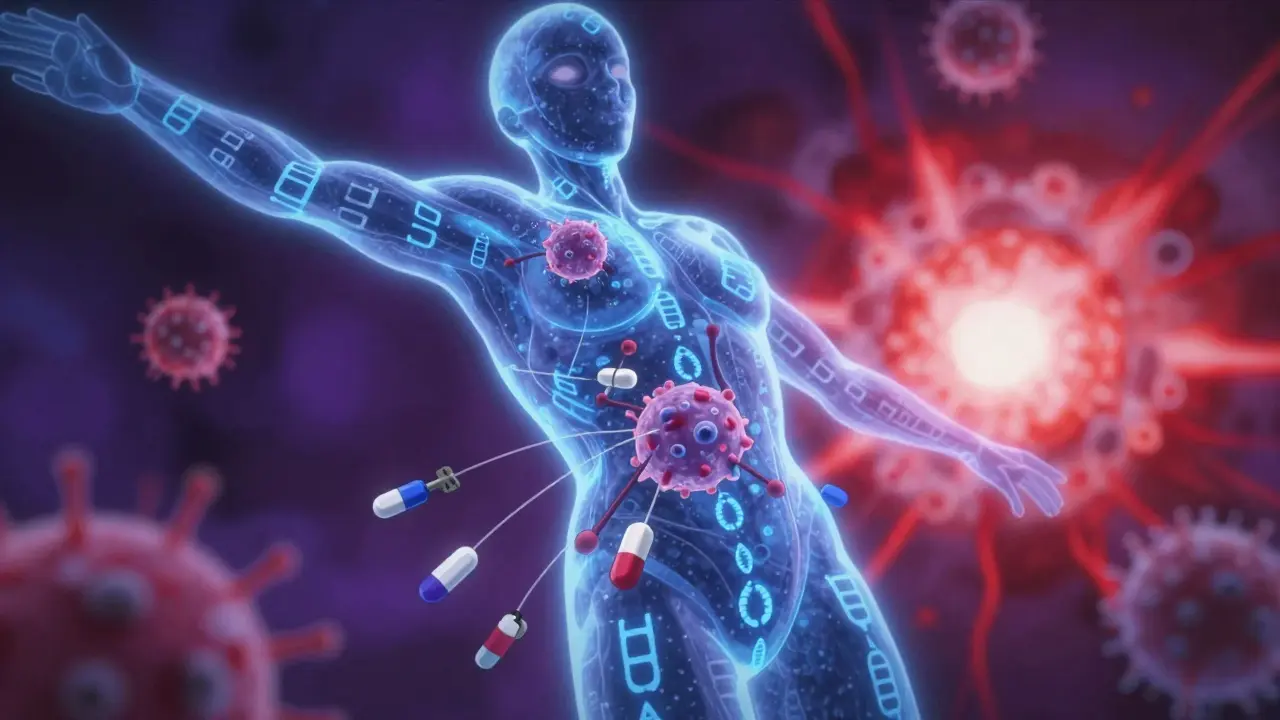
For decades, cancer treatment meant one thing: chemotherapy. Strong drugs that killed fast-growing cells-cancerous or not. Patients lost their hair, felt sick constantly, and spent weeks recovering between rounds. But today, a different kind of treatment is changing the game-not by being stronger, but by being smarter. Targeted therapy doesn’t blast the whole body. It hunts down cancer based on its unique genetic fingerprints. This isn’t science fiction. It’s happening in hospitals right now, from Glasgow to New York, and it’s giving people with advanced cancer new hope.
How Targeted Therapy Works
Every cancer is different-not just by where it starts, but by the specific DNA mistakes inside it. Targeted therapy finds those mistakes and attacks them directly. Think of it like a key fitting into a broken lock. The lock is a mutated gene that’s telling the cancer cell to grow nonstop. The key is a drug designed to block that exact signal.
The first big win came with imatinib (Gleevec) in 2001 for chronic myeloid leukemia. Before that, most patients died within a year. With imatinib, 89% were alive after 12 months. That wasn’t just an improvement-it was a revolution. Today, we have over 68 targeted drugs approved for use across 42 cancer types. And in 2024, 73% of all new cancer drugs approved by the FDA were targeted therapies.
These drugs fall into two main types. Small molecule inhibitors, like osimertinib for lung cancer with EGFR mutations, slip inside cells and shut down faulty signaling pathways. Monoclonal antibodies, like trastuzumab for HER2-positive breast cancer, latch onto proteins on the outside of cancer cells and either block growth signals or mark the cell for destruction by the immune system.
Why Genetics Matter More Than Location
One of the biggest shifts in cancer care is this: it’s not where the tumor is that matters most-it’s what’s happening inside it. A lung tumor and a colon tumor might look identical under a microscope, but if one has an NTRK fusion and the other doesn’t, only the first will respond to larotrectinib. That drug works regardless of where the cancer started. It’s approved for any solid tumor with that specific genetic change.
This is called histology-agnostic treatment. And it’s not rare. Larotrectinib produces a 75% response rate across all tumor types with NTRK fusions. Selpercatinib does the same for RET-mutant lung cancers, with 85% of patients seeing their tumors shrink-compared to just 30-40% with standard chemo.
That’s why testing is no longer optional. If you have advanced cancer, your doctor should be ordering genomic testing. Panels like FoundationOne CDx or MSK-IMPACT scan 300 to 500 cancer-related genes at once. They look for mutations, fusions, and other changes that might make you eligible for a targeted drug. These tests need as little as 20-50 nanograms of tumor DNA and work best when the sample contains at least 20% cancer cells. Turnaround time? Usually two to three weeks.
Who Benefits-and Who Doesn’t
Targeted therapy works best when it’s matched to the right mutation. In EGFR-mutant non-small cell lung cancer, osimertinib extends progression-free survival to nearly 19 months-almost double the 10 months seen with chemo. The risk of cancer worsening drops by more than half.
But here’s the catch: only about 13.8% of cancer patients have a mutation that currently has a matched drug. For most people, targeted therapy won’t help. And if you use it without testing? Response rates drop to just 2-5%. That’s why testing isn’t just recommended-it’s essential.
Even when a match is found, resistance often develops. In 70-90% of cases, the cancer finds a way around the drug within 9 to 14 months. That’s why researchers are now testing combinations-pairing targeted drugs with immunotherapy or other inhibitors-to delay resistance. Liquid biopsies, which check for cancer DNA in the blood, are helping doctors spot resistance early, sometimes months before a scan shows growth.
The Real-World Challenges
Targeted therapy sounds perfect. But reality is messier.
Cost is a huge barrier. A single month of treatment can run $15,000 to $30,000-three to six times more than chemo. Many patients face insurance denials, especially for off-label use. One Reddit user with an NTRK fusion wrote: “My insurance denied larotrectinib because it’s not standard for my cancer type.” But the drug works across types. That’s the system failing the science.
Access isn’t equal. In the U.S., 65% of advanced cancer patients get genomic testing. In Europe, it’s 22%. In parts of Asia, it’s as low as 8%. Even within the U.S., community hospitals often don’t have the labs, pathologists, or molecular tumor boards needed to interpret results. Only 32% of community hospitals have them, compared to 89% of NCI-designated centers.
And then there’s the problem of variants of unknown significance-VUS. About 20-30% of genomic tests turn up changes we don’t yet understand. Is it driving the cancer? Or just noise? Oncologists can’t prescribe a drug based on uncertainty. That leaves patients stuck in limbo.
Quality of Life: The Hidden Benefit
One of the most underrated advantages of targeted therapy? Fewer side effects.
Chemotherapy causes severe nausea, fatigue, low blood counts, and infections. About 50-70% of patients on chemo experience grade 3 or 4 toxicities-life-threatening or requiring hospitalization. With targeted therapy? That number drops to 15-30%.
A patient with stage IV lung cancer on osimertinib told CancerCare: “My tumor shrank 80% in eight weeks. I didn’t lose my hair. I didn’t feel like I was dying between doses. I could walk my dog, cook dinner, go to my granddaughter’s recital.” That’s not just survival. That’s living.
A 2023 survey of 1,200 patients found that 68% on matched targeted therapy reported better symptom control and ability to keep up with daily life-compared to just 42% on chemo. For many, targeted therapy means not just more time, but better time.

What’s Next?
The future of targeted therapy isn’t just about finding more drugs. It’s about fixing the gaps.
Right now, 80% of cancer-driving mutations are in tumor suppressor genes like TP53 or PTEN-genes that normally stop tumors. But we have no drugs that can restore their function. We can block overactive signals, but we can’t fix broken brakes. That’s the next frontier. Researchers at Genentech and Memorial Sloan Kettering are racing to find ways to target these “undruggable” genes.
Artificial intelligence is helping too. IBM Watson for Oncology matched treatment plans to molecular tumor boards with 93% accuracy in a 2024 study. AI can sift through massive genomic data faster than any human, spotting patterns we might miss.
The NCI’s RESPOND initiative is investing $195 million to fix racial disparities in genomic testing. Black and Hispanic patients are far less likely to get tested or matched to therapies-even when they have the same cancer. That’s not just unfair. It’s dangerous.
By 2030, experts predict 40% of cancer patients will receive some form of biomarker-directed therapy. But that won’t happen unless we fix access, affordability, and education. Right now, only 42% of community oncologists have regular access to genomic testing. Training more doctors, expanding testing networks, and pushing insurers to cover these tests are critical steps.
What You Should Ask Your Doctor
If you or someone you love has advanced cancer, here are five questions to ask:
- Has my tumor been tested for genomic mutations?
- What specific mutations were found?
- Is there a targeted therapy approved for that mutation-even if it’s for a different cancer type?
- What are the chances this drug will work for me?
- What are the costs, and will my insurance cover it?
If your doctor says, “We don’t do that here,” ask for a referral to a larger cancer center. Organizations like the Personalized Oncology Alliance offer free molecular tumor board reviews for community practices. You don’t have to go it alone.
Targeted therapy isn’t a cure for all cancers. But for the right person, at the right time, it’s the difference between giving up and moving forward. It’s proof that understanding the enemy’s code changes the battle.
What is targeted therapy in cancer treatment?
Targeted therapy is a type of cancer treatment that uses drugs to block specific molecules involved in cancer growth. Unlike chemotherapy, which kills fast-dividing cells broadly, targeted therapy focuses on genetic changes unique to a patient’s tumor-like mutations in EGFR, ALK, or BRAF genes. These drugs interfere with signals that make cancer cells grow and spread, while largely sparing healthy tissue.
How is targeted therapy different from chemotherapy?
Chemotherapy attacks all rapidly dividing cells-cancerous and healthy-leading to side effects like hair loss, nausea, and low blood counts. Targeted therapy only affects cancer cells with specific genetic mutations. As a result, patients often experience fewer and less severe side effects. For example, grade 3-4 toxicities occur in 15-30% of patients on targeted therapy, compared to 50-70% on chemotherapy.
Do I need genetic testing to get targeted therapy?
Yes. Targeted therapies only work if your tumor has the specific mutation the drug is designed to block. Testing through next-generation sequencing (NGS) panels like FoundationOne CDx or MSK-IMPACT analyzes hundreds of cancer-related genes to find actionable targets. Without testing, targeted therapy has less than a 5% chance of working. Testing is now considered standard of care for most advanced cancers.
Why do some patients respond well and others don’t?
Response depends on whether the tumor has a “druggable” mutation and whether the drug can reach and block it effectively. About 13.8% of cancer patients have mutations with approved targeted therapies. Even then, resistance often develops within a year due to new mutations or tumor heterogeneity. Some tumors have multiple clones with different mutations, making them harder to fully control.
Is targeted therapy available to everyone?
No. Access is limited by cost, location, and healthcare infrastructure. In the U.S., 65% of advanced cancer patients get genomic testing; in Europe, it’s 22%. Many insurance plans deny coverage for testing or off-label drug use. Community hospitals often lack molecular tumor boards and genetic counselors. Patients in rural or low-income areas face the biggest barriers, even when a match exists.
What are the most common targeted therapy drugs?
Common drugs include osimertinib (for EGFR-mutant lung cancer), trastuzumab (for HER2-positive breast cancer), imatinib (for CML), selpercatinib (for RET-mutant cancers), and larotrectinib (for NTRK-fusion tumors). Each targets a specific genetic alteration. New drugs are approved every year-over 68 are currently in clinical use across 42 cancer types.
Can targeted therapy cure cancer?
For most patients, targeted therapy doesn’t cure cancer-but it can turn it into a chronic condition. In some cases, like chronic myeloid leukemia with imatinib, patients live for decades with near-normal life expectancy. In others, like advanced lung or melanoma with BRAF mutations, tumors shrink dramatically and remain controlled for years. But resistance usually develops. The goal is long-term control, not always eradication.
How long does it take to get results from genetic testing?
Most commercial and academic genomic tests take 14 to 21 days to return results. Some faster tests, like liquid biopsies, can deliver preliminary results in 7-10 days. Delays often happen due to insurance pre-authorization or insufficient tumor sample quality. Patients should ask their oncologist to start the process as soon as a diagnosis of advanced cancer is confirmed.
 Medications
Dev Sawner
December 19, 2025 AT 13:56While the article presents targeted therapy as a panacea, it conspicuously omits the fact that 86.2% of cancer patients lack actionable mutations. This isn't progress-it's statistical theater. The entire paradigm hinges on a minority of cases, yet healthcare systems are being restructured around it. The cost-to-benefit ratio is indefensible when 70% of patients still receive palliative care with no targeted option. Genomic testing is not a cure-it's a lottery ticket with terrible odds.
Moses Odumbe
December 20, 2025 AT 22:41Bro. Targeted therapy is literally magic 🧙♂️✨ I had a cousin on osimertinib-no hair loss, went to her daughter’s soccer games, lived 4 years with stage 4. Chemo was a death sentence. This isn’t science fiction-it’s science. 💪🩺 #CancerIsNotAFate
Jedidiah Massey
December 22, 2025 AT 00:26The article exhibits a superficial engagement with the pharmacoeconomic architecture of precision oncology. One must interrogate the heterogeneity of tumor clonality and the emergent resistance mechanisms mediated by bypass signaling pathways-particularly MAPK reactivation in EGFR-mutant NSCLC. The current cohort of TKIs is fundamentally palliative, not curative, and the marginal survival benefit is attenuated by the high incidence of VUS findings in NGS panels, which render clinical decision-making epistemologically unstable. Moreover, the implicit assumption that genomic testing is universally accessible ignores the structural inequities embedded within the U.S. healthcare industrial complex.
Allison Pannabekcer
December 22, 2025 AT 18:44I’ve seen both sides-my mom on chemo, my friend on targeted therapy. The difference isn’t just survival-it’s dignity. You can still be a parent, a partner, a person. I wish everyone had access to this. But the real tragedy isn’t the cost-it’s the silence. So many people don’t even know to ask for testing. If you’re reading this and someone you love has advanced cancer, please, just ask. ‘Has my tumor been tested?’ It’s the most important question you’ll ever ask.
Sarah McQuillan
December 23, 2025 AT 01:59Why are we letting big pharma dictate cancer treatment? In the 90s, we didn’t have this fancy genetic nonsense-and people still lived. Now we’re spending $30K a month on a pill while the VA cuts mental health services. This isn’t medicine. It’s capitalism with a stethoscope. And don’t get me started on ‘histology-agnostic’-that’s just corporate speak for ‘we found one weird trick that works on a few rare tumors.’
Mark Able
December 24, 2025 AT 08:52Wait so if I have colon cancer but my tumor has an NTRK fusion, I can take larotrectinib even though it’s for ‘lung’ cancer? That’s wild. But my uncle’s oncologist said no because ‘it’s not FDA-approved for colon.’ Why do doctors still think like this? I’m gonna send him this article. He needs to wake up.
William Storrs
December 24, 2025 AT 14:23You got this. Seriously. Whether you're the patient, the caregiver, or just someone trying to understand-this is a new chapter. It’s not perfect, but it’s better. And you’re not alone. There are people out there fighting this fight with you. Keep asking questions. Keep pushing for testing. Your voice matters more than you know.
James Stearns
December 24, 2025 AT 17:02It is regrettable that the article fails to adequately contextualize the ethical implications of off-label prescribing within the framework of regulatory compliance. The FDA approval paradigm exists for a reason. To circumvent it under the banner of ‘personalized medicine’ is to engage in a dangerous form of therapeutic exceptionalism. Furthermore, the suggestion that community hospitals should replicate NCI-tier infrastructure is not merely impractical-it is financially reckless. The infrastructure required for molecular tumor boards demands specialized personnel, bioinformaticians, and continuous quality assurance protocols that are incompatible with resource-constrained environments.
Guillaume VanderEst
December 25, 2025 AT 14:37My cousin in Quebec got tested through a provincial program-no cost, got a match in 18 days. Here in Ontario? Waited 6 months, insurance denied, had to go private. We’re all in the same country. Why does access depend on where you live? This isn’t medicine. It’s a postcode lottery.
Nina Stacey
December 27, 2025 AT 11:55just wanted to say thank you for writing this i had no idea any of this was happening my aunt just got diagnosed and i was so scared but now i know to ask about testing and im not so scared anymore i dont know much about genes or anything but i know if she can walk her dog and go to grandkids events thats worth everything i love you all
Dominic Suyo
December 28, 2025 AT 22:41Targeted therapy? More like targeted capitalism. They took the most vulnerable people in the world-cancer patients-and turned their suffering into a premium subscription service. $30k/month? That’s not a drug, that’s a luxury tax on mortality. And don’t get me started on the ‘73% of new drugs’ stat-that’s just pharma rebranding old drugs with new labels and slapping ‘targeted’ on them. It’s the same old game, just with more jargon and fewer patients actually benefiting.
Kevin Motta Top
December 30, 2025 AT 06:13My dad’s in Nigeria. He’s got lung cancer. No testing. No targeted drugs. Just chemo and prayer. This article? It’s beautiful. But it’s not for him. And that’s the real story.