
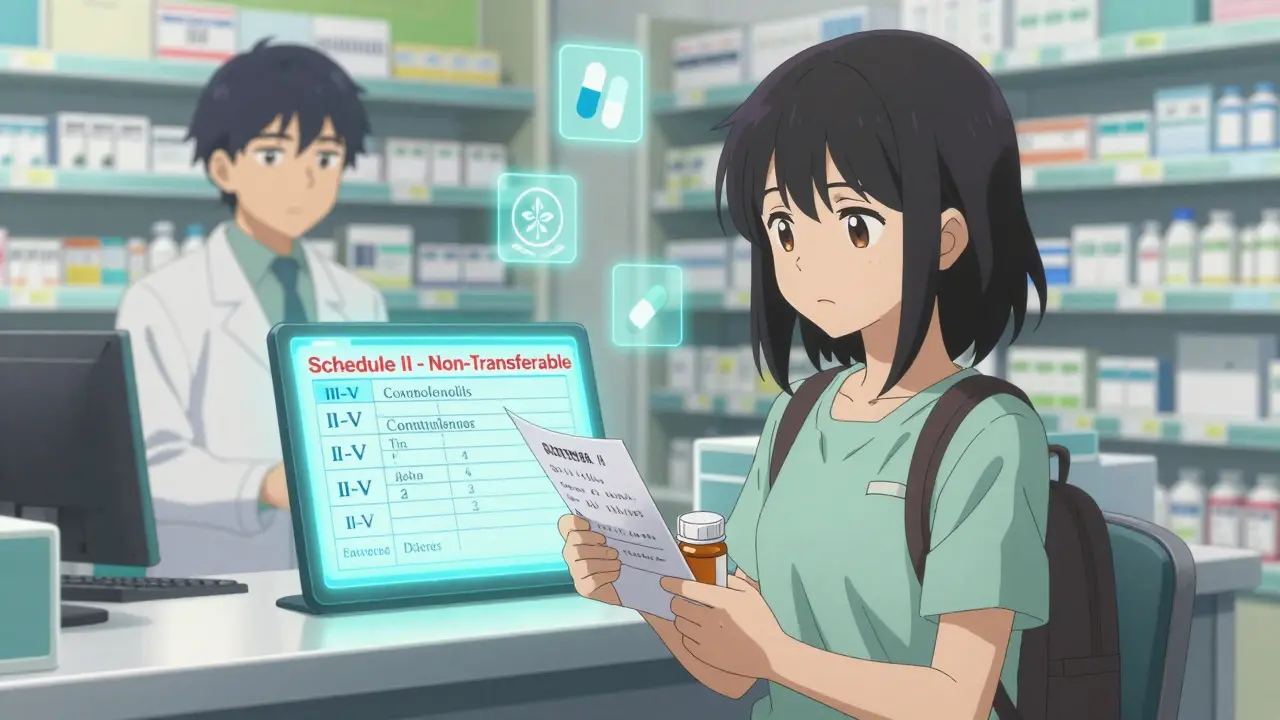
Prescription Transfer Eligibility Checker
This tool helps you determine if your prescription can be transferred to a new pharmacy based on the medication type and current status. Know exactly what information you need to provide before visiting your new pharmacy.
Changing pharmacies isn’t as simple as walking in and asking for your meds. If you’re on any kind of prescription-especially for controlled substances-you need to know exactly what info to give, what’s allowed, and what could delay your transfer. The rules changed in August 2023, and if you don’t know them, you could be stuck without your medication for days, or worse, have your transfer denied outright.
What You Must Give the New Pharmacy
When you walk into a new pharmacy to transfer your prescriptions, you’re not just handing over a list. You need to give them four key pieces of personal info: your full legal name, your date of birth, your current address, and your phone number. This isn’t just for ID-it’s how the pharmacy matches your record to your prescription history. Without this, they can’t even start the process.Next, you need the name of the medication, the strength, how often you take it, and the name of your prescriber. If you have the original prescription bottle, bring it. The barcode and label have the exact details the pharmacy needs. If you don’t have it, write it down clearly. Guessing won’t work. Pharmacists don’t guess-they verify.
For controlled substances, you also need to know the schedule. That’s not something most patients think about, but it’s critical. Schedule II drugs like oxycodone or Adderall cannot be transferred at all. If you’re switching and you’re on one of these, you must go back to your doctor for a new prescription. No exceptions. Schedule III to V drugs-like some painkillers, ADHD meds, or certain antidepressants-can be transferred, but only once. After that, if you need more refills, you have to go back to your doctor again.
Controlled vs. Non-Controlled: The Big Difference
The rules split everything into two buckets: controlled and non-controlled. Non-controlled meds-like blood pressure pills, statins, or thyroid meds-can be transferred as many times as you want, as long as refills are left. The pharmacy just calls the old one, confirms the details, and downloads the prescription. It usually takes less than 24 hours.Controlled substances are a different story. Since August 2023, the DEA only allows one-time electronic transfers for Schedule III-V drugs. That means if you transfer your Adderall prescription to a new pharmacy, you can’t move it again later-even if you move houses or switch to a different chain. The original prescription gets marked as transferred and locked. No second chances. This rule was made to stop people from doctor-shopping or getting the same drug from multiple pharmacies.
And here’s the catch: if your prescription has no refills left, you can’t transfer it at all. You have to get a new one from your doctor. No pharmacy can refill a prescription that’s already used up its refills, even if you just ran out yesterday. The system doesn’t allow it.
How the Transfer Actually Works
The process sounds simple: you tell the new pharmacy your old one’s name, and they call. But behind the scenes, it’s tightly controlled. The transfer must happen electronically between two licensed pharmacists. No faxes, no emails, no patient-held files. The prescription data must stay intact-no edits, no screenshots, no manual entry. If the old pharmacy doesn’t have an electronic system, the transfer can’t happen. That’s why some rural or small pharmacies still struggle with this.When the transfer is complete, the receiving pharmacy must add the word “transfer” to the prescription record. They also have to write down the name and DEA number of the pharmacist who sent it, the date of the transfer, and the original prescription number. The old pharmacy must mark the original as “VOID” in their system and keep a copy of the transfer record for two years. If either side messes this up, the transfer can be flagged or rejected.
It’s not just paperwork. Pharmacists are trained to spot red flags. If you’re transferring a Schedule IV benzodiazepine from five different pharmacies in six months, they’ll ask questions. That’s not you being paranoid-it’s the system working as intended.
What Can Go Wrong (And How to Fix It)
Most transfer problems come down to three things: missing info, state laws, or system errors.Missing info is the biggest one. If you don’t give the new pharmacy your exact date of birth or the prescriber’s full name, they can’t match your record. I’ve seen people lose three days because they wrote “Dr. Smith” instead of “Dr. Sarah E. Smith, MD.” One letter off, and the system blocks it.
State laws vary. Even though the DEA set a federal rule, individual states can add stricter limits. For example, in California and New York, some pharmacies require a signed patient consent form before transferring controlled substances. In Texas, transfers between pharmacies owned by the same company are still treated as separate entities-so even if you switch from one CVS to another across town, it still counts as a one-time transfer. Always call ahead and ask if your state has extra rules.
System errors happen too. If the old pharmacy’s software is outdated, or if the new one doesn’t support the same electronic format, the transfer fails. You’ll get a call saying “We couldn’t retrieve your prescription.” Don’t panic. Ask them to try again with a different method-sometimes switching from direct EHR to secure fax works. If it still fails, ask for a written explanation. You have the right to one under federal law.
Timing: How Long Does It Take?
For non-controlled meds, expect 24 hours. Most transfers are done by the next business day if you start before 3 p.m. Controlled substances take longer-usually 48 to 72 hours. Why? Because each transfer has to be manually verified by a pharmacist. They have to confirm the DEA number, check for duplicate prescriptions, and ensure the transfer is legal under both federal and state law.If you’re transferring five prescriptions at once, plan for a week. Don’t wait until your last pill is gone. Start the process at least five days before you run out. And if you’re switching pharmacies because you’re moving to a new city, don’t wait until you arrive. Call ahead. Ask if they accept transfers. Ask if they’re set up for electronic transfers. Most chain pharmacies (CVS, Walgreens, Rite Aid) are fully compliant. Independent pharmacies? Not always.
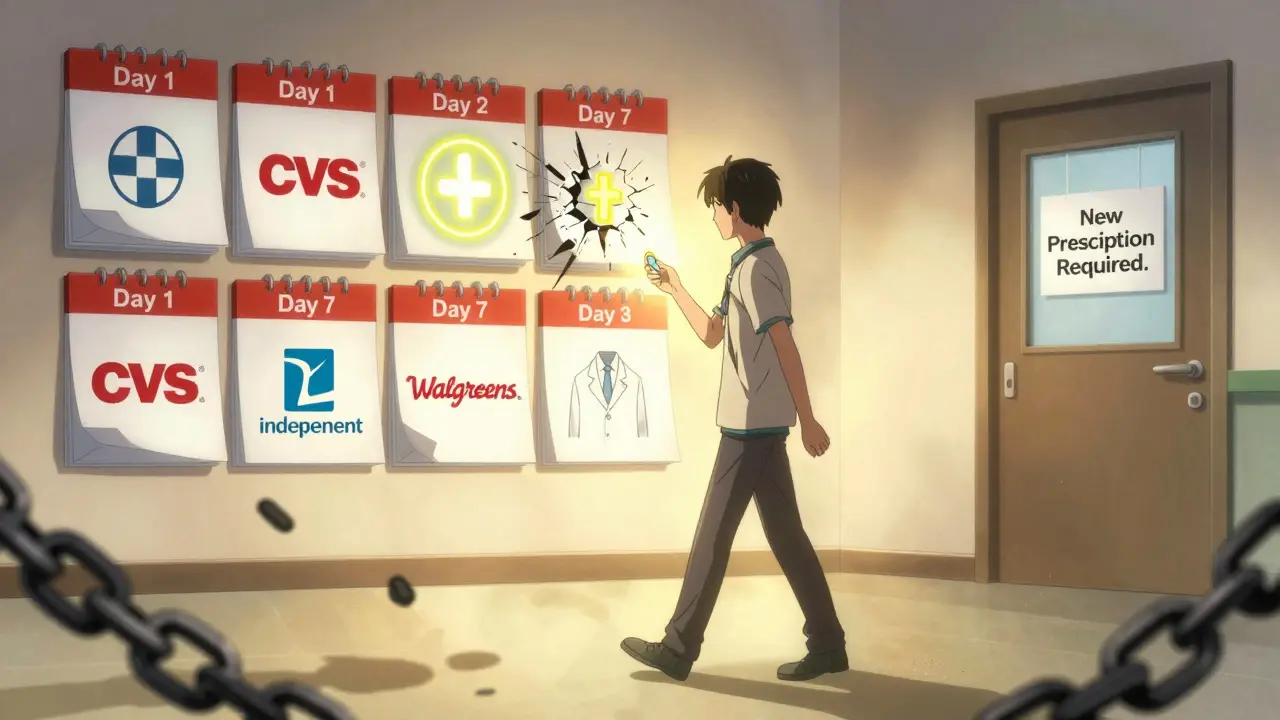
What to Do If Your Transfer Is Denied
If your transfer gets denied, don’t just walk away. Ask for the reason in writing. Pharmacies are required to give you one. Common reasons include:- Prescription has no refills left
- Controlled substance is Schedule II (non-transferable)
- Prescription information doesn’t match your profile
- Old pharmacy didn’t respond within 48 hours
- State law prohibits the transfer
If the reason is “state law,” ask them to show you the specific regulation. Most pharmacists won’t know it offhand, but they can look it up. If they can’t, they’re probably just being cautious. Push back politely. You have rights.
If the issue is a technical glitch, ask if they can request the prescription manually via fax or phone. While the DEA prefers electronic transfers, they still allow phone or fax transfers if the system fails. Just make sure the pharmacist documents it correctly.
Pro Tips to Avoid Delays
- Always bring your prescription bottle or a photo of it to the new pharmacy.
- Call your old pharmacy first and ask them to confirm your current refills and the prescriber’s DEA number.
- If you’re on multiple controlled substances, transfer them one at a time. Don’t overload the system.
- Ask the new pharmacy to call your old one on your behalf. You don’t have to do the legwork.
- Keep a printed list of all your meds, dosages, and prescribers in your wallet. It saves time and prevents mistakes.
And remember: if you’re switching because your current pharmacy ran out of stock or gave you bad service, don’t wait. Start the transfer early. Your health isn’t worth the risk of a gap in medication.
Can I transfer a Schedule II controlled substance like oxycodone to a new pharmacy?
No. Schedule II controlled substances, including oxycodone, fentanyl, Adderall, and methadone, cannot be transferred between pharmacies under any circumstances. You must get a new prescription from your prescriber. This rule is strict and enforced by the DEA to prevent misuse and diversion.
How many times can I transfer a Schedule III or IV prescription?
Only once. As of August 2023, the DEA allows a one-time electronic transfer for Schedule III to V controlled substances. After that, even if you have refills left, you cannot move the prescription again. You’ll need a new prescription from your doctor for any future transfers.
What if my prescription has no refills left?
You cannot transfer a prescription with no refills remaining. The pharmacy will tell you it’s “exhausted.” You must contact your prescriber to get a new prescription before you can refill or transfer. This applies to all medications, controlled or not.
Can I transfer prescriptions across state lines?
Yes, but it’s complicated. Federal law allows interstate transfers, but individual states can block them. Some states have reciprocity agreements with others; some don’t. If you’re moving to a new state, call the new pharmacy first and ask if they accept transfers from your current state. Be prepared to get a new prescription if needed.
How long does a prescription transfer take?
Non-controlled prescriptions usually take 24 hours. Controlled substances take 48 to 72 hours because they require extra verification. If you’re transferring multiple prescriptions, plan for 1-3 business days per prescription. Start early-don’t wait until you’re out of meds.
Do I need to tell my doctor I’m switching pharmacies?
No, you don’t have to. The pharmacy handles the transfer directly. But it’s a good idea to inform your doctor, especially if you’re on multiple controlled substances. It helps them track your care and avoid prescribing duplicates. Some doctors even update your profile with your new pharmacy’s info.
What if the new pharmacy says they can’t transfer my prescription?
Ask for the reason in writing. Under federal law, pharmacies must provide a valid explanation. Common reasons include no refills, Schedule II status, or state law restrictions. If you believe it’s a mistake, ask them to try again or contact the old pharmacy directly. If they still refuse, go to another pharmacy-they’re not obligated to accept every transfer, but others might.
What Comes Next
The DEA is watching how this new rule plays out. They’re collecting data on transfer rates, denials, and misuse patterns. By late 2024, they’ll decide whether to allow multiple transfers for controlled substances. For now, the one-time rule stands. The system is better than it was-patients don’t have to beg their doctors to reissue prescriptions-but it’s still not perfect.Know your meds. Know your rights. And don’t wait until the last minute to switch. A little preparation saves you a lot of stress-and keeps you healthy.
 Medications
Cara Hritz
December 23, 2025 AT 09:09ok so i just tried to transfer my adderall and the pharmacy said ‘nope’ and i was like wait what? i had 3 refills left?? turns out it’s a ONE TIME TRANSFER now?? like bro i just moved across town not to another country. this is so dumb. i had to call my dr at 8pm on a tuesday. they were like ‘yeah we know’ and i was like why didn’t anyone tell me??
Candy Cotton
December 24, 2025 AT 03:37It is profoundly concerning that the Department of Justice has allowed the erosion of pharmaceutical autonomy under the guise of ‘control.’ This one-time transfer mandate is not a public health safeguard-it is bureaucratic overreach disguised as regulation. The patient’s right to continuity of care is being systematically dismantled by federal red tape, and the consequences are being borne by the most vulnerable among us. This is not progress. This is control.
Aliyu Sani
December 26, 2025 AT 01:47yo i been on gabapentin for nerve pain and tried to switch from walmart to rite aid. they said ‘can’t transfer, no refills left’-but i had 2 left! turned out the old pharmacy’s system glitched and didn’t update. i had to send a pic of the bottle to the new one and beg them to call the old one on the phone. pharmacists be like ‘we don’t do faxes’ but then they did it anyway after i cried. y’all gotta keep receipts. literally.
Kiranjit Kaur
December 26, 2025 AT 02:41thank you for this!! 🙏 i was about to panic when my meds ran out next week 😭 i just called my new pharmacy and they walked me through it step by step. brought my bottle, gave them my dr’s full name (finally learned to spell ‘Dr. Chen’ right lol), and they said it’ll be done by tomorrow! you’re a lifesaver 🌸
Jim Brown
December 27, 2025 AT 06:40There exists within this system a quiet tragedy: the patient who, having adhered to every rule, every regulation, every bureaucratic decree, is still denied continuity-not because of negligence, but because the architecture of care has been rendered rigid, brittle, and incapable of human nuance. The DEA did not design this to protect; it designed this to control. And in doing so, it has weaponized compliance against the sick.
Art Van Gelder
December 28, 2025 AT 21:59Let me tell you something about this from a global perspective. I just moved from Canada to Texas last month. My pain meds? Transferred fine. But my anxiety med? Nope. ‘Schedule IV, one-time transfer only.’ I’m sitting here with 3 pills left wondering if I’m gonna be a zombie by Friday. In Canada, you just call your pharmacy and it’s done. Here? You need a lawyer, a notary, and a signed affidavit from your priest. This isn’t healthcare. This is performance art.
Sai Keerthan Reddy Proddatoori
December 29, 2025 AT 05:38They don’t want you to have your meds. That’s the truth. This ‘one-time transfer’ rule? It’s a government scam to make you dependent on doctors who get paid by Big Pharma. They want you coming back every month. They want you scared. They want you paying for new scripts instead of just moving your prescription. Wake up. This isn’t about safety. It’s about profit.
Gabriella da Silva Mendes
December 31, 2025 AT 00:22ugh i just spent 45 minutes on hold with walgreens because they ‘couldn’t verify my prescriber’s DEA number’ and then i found out my dr changed his office address last year and the system had the old one. so now i have to get a new script for my thyroid med because they ‘can’t match the profile’ and i’m like lady i’ve been taking this for 7 years and you’re telling me you can’t find me in your database?? i’m literally crying in my car. this system is designed to fail you. 🤡
Nader Bsyouni
December 31, 2025 AT 22:40Why are we even pretending this is about safety when it’s clearly about control? The DEA doesn’t care if you get your meds. They care if you obey. If you can’t transfer your prescription without begging, then you’re properly subjugated. The fact that you need a doctor’s signature just to move your pills across town? That’s not healthcare. That’s feudalism with a pharmacy logo
Jeremy Hendriks
January 1, 2026 AT 06:41Think about this: a person on chronic pain meds, moving from one city to another, is told they can’t take their medicine with them unless they beg a doctor to write a new one. That doctor might be weeks away. That person might go without for days. That’s not regulation. That’s punishment disguised as policy. We say we value autonomy, but we’ve built a system that strips it away in the name of fear. What are we afraid of? That someone might get their medicine? Or that someone might realize they’ve been treated like a problem to be managed, not a person to be healed?