

When a doctor writes a prescription, they’re not just picking a medicine-they’re making a decision that affects your health, your wallet, and their own bottom line. In the U.S., generic prescribing incentives are quietly reshaping how doctors choose medications. These aren’t just about saving money. They’re about systems, pressures, and unintended consequences that play out in exam rooms across the country.
Why Generic Prescribing Incentives Exist
The math is simple: generic drugs cost a fraction of brand-name versions. In 2023, generics made up 90% of all prescriptions filled in the U.S., but only 23% of total drug spending. That’s a $1.7 trillion savings over the last decade, according to the Congressional Budget Office. But savings don’t happen automatically. Doctors need a reason to choose generics-even when they’re clinically identical. That’s where incentives come in. Starting in the mid-2000s, insurers and government programs began testing ways to nudge providers toward lower-cost options. The goal wasn’t to cut corners-it was to stop paying for expensive brand-name drugs when a generic worked just as well. By 2023, 89% of U.S. health plans had some kind of provider incentive tied to generic prescribing.How These Incentives Actually Work
There are two main types: financial and non-financial. Financial incentives are direct. Some Blue Cross plans pay physicians $5 to $15 for each generic prescription in targeted categories like blood pressure or cholesterol meds. Top performers can earn up to $5,000 a year extra. UnitedHealthcare’s Value-Based Prescribing Program gives bonuses based on how often doctors choose generics over brands in their patient panels. Non-financial perks matter too. Providers who consistently use generics get faster prior authorizations, priority scheduling for patient appointments, or even public recognition in internal newsletters. Some EHR systems now default to generic alternatives when a doctor starts typing a prescription. One 2020 study found that just changing the default setting boosted generic prescribing by over 22 percentage points. The Centers for Medicare & Medicaid Services tested a $2 Drug List in 2021-making essential generics cost just $2 for patients. Result? Generic use jumped 17.3% among Medicare beneficiaries. That’s not magic. It’s behavior change through structure.What Works-and What Doesn’t
Not all incentive models are equal. Formulary tiering-where generics are placed in the lowest-cost insurance tier-is common, but weak. It mainly affects patients, not doctors. Studies show it only increases generic use by 8-12%. Direct provider payments, on the other hand, move the needle harder. UnitedHealthcare’s program drove a 24.7% increase in generic prescribing among primary care doctors. But here’s the twist: some systems accidentally reward the opposite. Doctors who work in clinics covered by the 340B Drug Pricing Program-meant to help safety-net providers-actually prescribed generics 6.8% less often than others. Why? Because 340B lets them buy brand-name drugs at deep discounts. So if they’re getting a cut from those purchases, there’s less incentive to switch to generics. Even more troubling: research shows physicians who receive payments from drug companies-gifts, meals, travel-are 37% less likely to prescribe generics, especially in the first year after a generic hits the market. That’s not conspiracy. It’s human psychology. Relationships matter. Small favors create subconscious loyalty.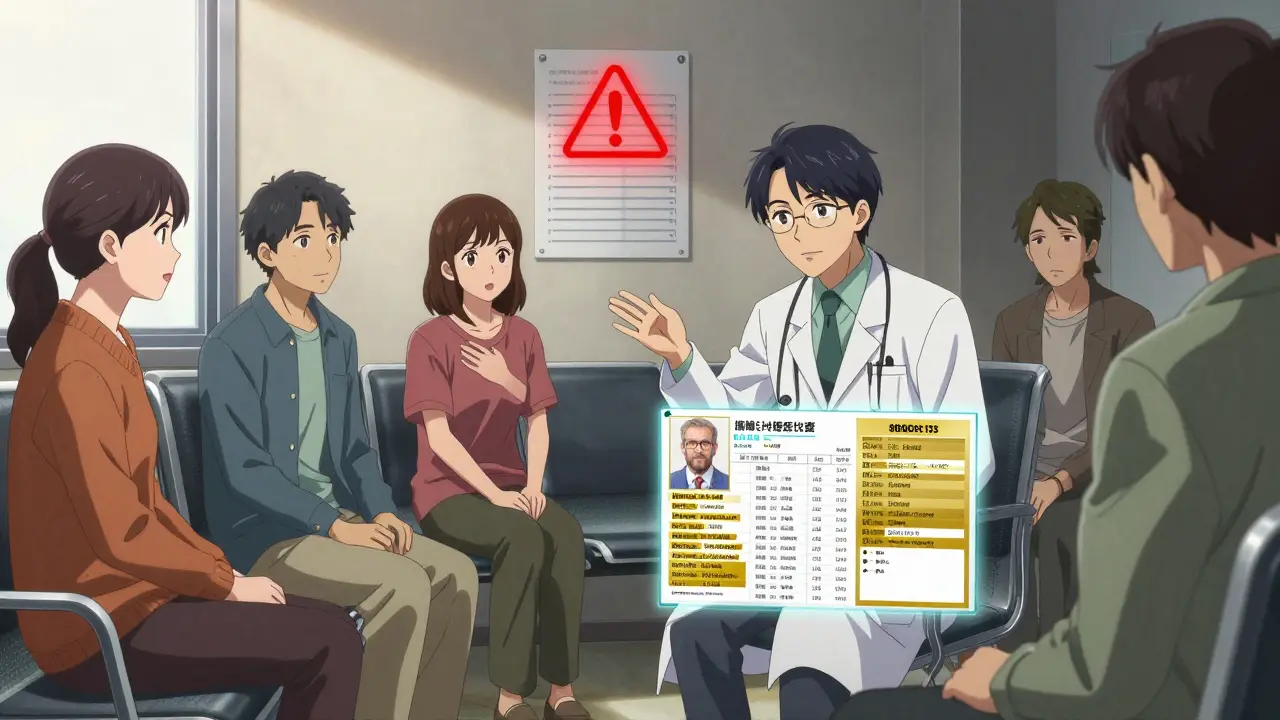
Provider Voices: The Real Experience
On Sermo, a doctor-only social network, Dr. Michael Chen in California said his UnitedHealthcare incentive added $2,800 to his income with almost no extra work. He called it a win. But Dr. Sarah Williams in Texas didn’t feel the same. In a Medscape survey, she said some programs felt coercive. "I have a patient with severe allergies. The generic works for most people-but not her. When the system pushes me to pick the cheapest option, I feel like I’m being forced to gamble with her health." Reddit threads echo this. One user, MedDoc2020, wrote: "Generic incentives work great for simple cases-diabetes, hypertension. But when someone’s on five meds, has kidney issues, and takes supplements? One-size-fits-all doesn’t cut it." A 2021 MGMA survey found 63% of providers liked these programs if they were voluntary and tied to quality, not just cost. But 78% worried that if patients found out their doctor was being paid to prescribe generics, trust would erode.The Hidden Costs
There’s a reason Germany hits 93% generic use while the U.S. sits at 85%. Germany uses reference pricing: if you want a brand-name drug, you pay the difference. No reward for the doctor. No bonus. Just clear rules. In the U.S., we’ve layered complexity on top of complexity. EHR systems alert doctors about alternatives-but too often, they alert for everything. That’s alert fatigue. Doctors start ignoring them. One study found that 68% of clinics struggled with EHR interoperability when rolling out incentive programs. Another 52% said provider resistance came from feeling like their clinical judgment was being overridden. And then there’s the risk of therapeutic substitution errors. A patient on a specific brand because of a rare side effect? If the system pushes the generic without checking, something can go wrong. That’s not cost-saving. That’s malpractice waiting to happen.What Makes a Good Incentive Program
The American College of Physicians laid out clear guidelines in 2015: incentives should be transparent, avoid forcing choices in complex cases, and align with quality-not just cost. The best programs do three things:- They exclude drugs where brand is medically necessary-like certain seizure meds or thyroid drugs where tiny differences matter.
- They use clinical decision support that only pops up when a generic is truly equivalent.
- They tie rewards to outcomes, not just prescriptions. Did the patient’s blood pressure drop? Did they refill their meds? That’s better than counting pills.
Where This Is Headed
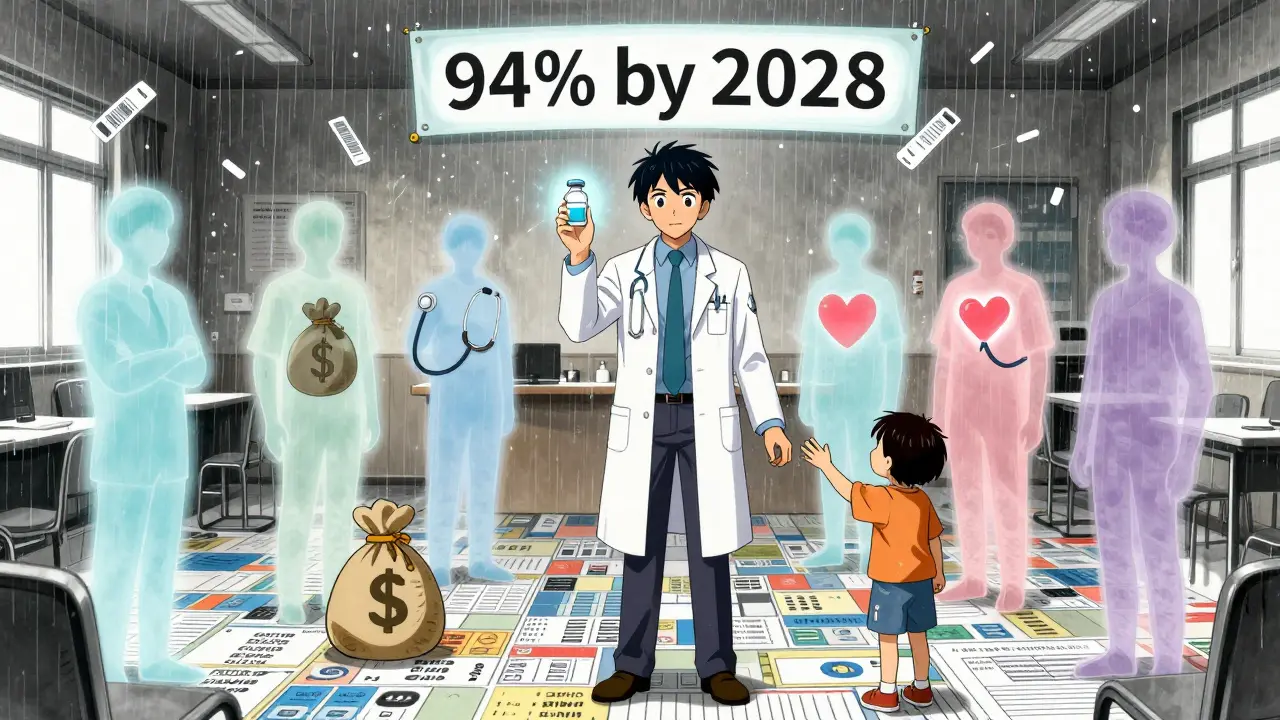
The future isn’t just about paying doctors more to write generics. It’s about smarter systems. UnitedHealthcare’s 2024 rollout of value-based prescribing contracts will tie payments to both cost savings and clinical outcomes. CMS is expanding its $2 generic list to more Medicare Advantage plans. The Inflation Reduction Act is cracking down on drug patents, which could push generic use up another 5-7% by 2027. By 2028, experts predict 94% of prescriptions will be generic. That’s not because doctors are being bribed. It’s because the system is finally aligning with what science already knows: generics are safe, effective, and cheaper. But the real challenge isn’t technical. It’s cultural. Can we build systems that save money without making doctors feel like they’re choosing between their paycheck and their patients’ trust? That’s the question no incentive program has fully answered yet.What Providers Need to Know
If you’re a clinician: understand how your plan’s incentives work. Ask for training. Push back when the system ignores nuance. Know which drugs are exceptions. Document why you chose a brand when you did. If you’re a patient: ask if a generic is an option. But don’t assume it’s always the best one. If your doctor says no, ask why. Trust isn’t broken by incentives-it’s broken when decisions are hidden.Final Thought
Generic prescribing incentives aren’t good or bad. They’re tools. And like any tool, they can build or break. Used right, they cut waste without compromising care. Used wrong, they turn medicine into a spreadsheet. The difference? Intent. Transparency. And respect for the doctor-patient relationship.Do generic prescribing incentives affect patient care?
Yes-when designed well, they improve access and reduce costs without lowering quality. But if they’re too rigid, they can lead to inappropriate substitutions, especially for patients with complex conditions. The key is clinical flexibility. Programs that allow exceptions for medical necessity work better than those that force one-size-fits-all choices.
Are doctors getting paid to prescribe generics?
In some cases, yes. Some health plans pay providers bonuses based on how often they prescribe generics, usually $5-$15 per prescription, with annual caps up to $5,000. But many programs are non-financial-faster authorizations, priority scheduling, or recognition. The goal isn’t to pay doctors to cut corners, but to reward efficient, evidence-based prescribing.
Why do some doctors resist generic prescribing incentives?
Many feel it undermines their clinical judgment. A patient with multiple conditions might need a specific brand because of allergies, absorption issues, or side effects. When systems push generics without considering individual needs, doctors feel pressured to make unsafe choices. Others worry about patient trust-if patients find out their doctor is being paid to pick cheaper drugs, they may question whether the decision was truly medical.
Are generic drugs really as effective as brand-name drugs?
Yes, by law. The FDA requires generics to have the same active ingredient, strength, dosage form, and route of administration as the brand. They must also prove they work the same way in the body. While some patients report differences-often due to inactive ingredients or placebo effects-large studies consistently show no meaningful difference in effectiveness for the vast majority of medications.
How do pharmacy benefit managers (PBMs) influence generic prescribing?
PBMs like CVS Caremark and Express Scripts control most U.S. drug formularies. They decide which drugs are covered, at what tier, and under what conditions. They often design the incentive structures that pay providers for prescribing generics. Their contracts with insurers and providers shape what doctors see in their EHRs and what gets approved. In effect, PBMs are the hidden architects of many prescribing incentives.
What’s the difference between formulary tiering and direct provider incentives?
Formulary tiering affects patients, not providers. It makes generics cheaper for the patient, hoping they’ll choose them. But doctors aren’t rewarded. Direct provider incentives pay the doctor directly-for example, a bonus per generic script. Studies show direct incentives change prescribing behavior more than tiering alone, because they align the doctor’s financial interest with the goal of cost savings.
Can generic prescribing incentives lead to medication errors?
Potentially, yes. If a system pushes a generic without checking for medical exceptions-like a patient who can’t tolerate a certain filler-it can cause harm. That’s why the best programs include clinical decision support that only suggests alternatives when they’re truly equivalent. Alerts should be smart, not loud. And doctors should always have the ability to override with a clear reason.
Are there any countries doing this better than the U.S.?
Germany’s reference pricing system is often cited as a model. Instead of paying doctors to prescribe generics, it sets a standard reimbursement price for a drug class. If a patient wants a brand-name drug, they pay the difference out-of-pocket. This removes financial incentives from the provider’s side and puts the choice squarely on the patient. It’s led to 93% generic use for off-patent drugs-higher than the U.S. average.
Do these incentives work for all types of medications?
No. For many chronic conditions-like hypertension, diabetes, or high cholesterol-generics are nearly always appropriate. But for drugs where bioavailability matters-like levothyroxine, warfarin, or certain epilepsy meds-even small differences in formulation can affect outcomes. Incentive programs that don’t exclude these exceptions risk harming patients. Best practices require clear, evidence-based exclusions.
What’s the future of generic prescribing incentives?
The trend is moving toward value-based contracts that reward both cost savings and clinical outcomes. Instead of just paying for prescribing generics, systems will pay for patients staying on therapy, avoiding hospitalizations, or reaching health goals. The goal is to stop treating prescribing as a cost-cutting metric and start treating it as part of overall care quality. That shift could make these programs more sustainable-and more ethical.
 Medications
Robert Cardoso
January 27, 2026 AT 07:48The entire system is a fucking circus. Doctors aren't being paid to prescribe generics-they're being punished for thinking. The FDA says generics are equivalent, but anyone who's actually treated patients knows bioequivalence doesn't mean clinical equivalence. Levothyroxine? Warfarin? Don't even get me started. This isn't cost-saving-it's algorithmic arrogance wrapped in a white coat.
And don't tell me about 'clinical decision support.' I've seen EHRs that pop up 17 alerts for every prescription. By the third week, you're just clicking 'continue' like a goddamn vending machine. That's not evidence-based medicine. That's behavioral engineering with a side of malpractice risk.
Meanwhile, PBMs are the real puppet masters. They control formularies, negotiate rebates, and get paid based on volume. They don't care if you prescribe the right drug-they care if you prescribe the drug that gives them the biggest kickback. The doctor gets $5 for a generic? The PBM gets $47 for the brand. Who's really winning here?
And let's not pretend this is about patient care. It's about balance sheets. If you think Medicare Advantage plans care about your kidney function, you've never read their contracts. They care about one thing: reducing spend per member per month. Everything else is marketing fluff.
Germany's reference pricing works because it removes the incentive from the provider entirely. You want the brand? Pay the difference. No bonus. No pressure. Just honesty. Why can't we do that here? Because someone's making money off the confusion.
So no, I'm not 'resisting innovation.' I'm resisting a system that treats human beings like data points and prescribes compliance over care.
James Dwyer
January 27, 2026 AT 11:11I get where you're coming from, but I’ve seen firsthand how these programs help people who can’t afford meds. I had a diabetic patient who skipped doses because the brand insulin cost $500 a month. Switched her to generic-now she’s stable, no hospital visits, and she can pay her rent. That’s not a spreadsheet win. That’s a life saved.
Yes, there are edge cases. But the system doesn’t force you to ignore them. If your patient needs the brand, you override it. The tools are there. It’s about using them.
And honestly? If you’re getting paid $5 per script to do what you should’ve been doing anyway-prescribing the best, cheapest option-then maybe you’re not the problem. The problem is the system that made you feel guilty for doing the right thing.
jonathan soba
January 29, 2026 AT 10:07Interesting how the piece conveniently omits the fact that 83% of generic manufacturers are owned by the same five multinational conglomerates that produce the brand-name drugs. The 'cost savings' are largely illusionary-just a redistribution of profits from one arm of the pharmaceutical complex to another.
Also worth noting: the $2 drug list? It only applies to a handful of medications. The rest? Still priced like luxury handbags. This isn't reform. It's branding.
matthew martin
January 31, 2026 AT 05:27Man, this whole thing is a mess wrapped in a spreadsheet. I’ve been in clinics where the EHR auto-populates generics like it’s playing a game of medical bingo. One day I’m prescribing metformin for a guy with Type 2, next thing I know, he’s got a rash because he’s allergic to the dye in that particular generic batch. Not the drug-the filler.
And yeah, some docs get a bonus. Big whoop. $2,800 a year? That’s less than a new laptop. Meanwhile, the real winners? The PBMs. They’re the ones quietly siphoning off billions while we’re busy arguing about whether $5 per script is ethical.
But here’s the thing-I’m not mad at the doctors. I’m mad at the system that turns medicine into a game of financial Tetris. We need transparency. Not just ‘here’s your bonus,’ but ‘here’s where the money actually goes.’
And patients? They need to know their doc isn’t being paid to cut corners-they’re being paid to make smart choices. That’s the trust we’re supposed to be protecting, not eroding.
Chris Urdilas
February 1, 2026 AT 08:48So let me get this straight-we’re paying doctors to do what they’re supposed to do anyway, and somehow that’s a scandal? If I hired a plumber to fix my sink and he used a cheaper part that worked just as well, I’d throw him a party. But in medicine? Suddenly it’s ‘ethically sketchy.’
Also, the ‘trust erosion’ argument? If your patient doesn’t trust you because you picked a cheaper drug that worked, maybe you’ve got bigger problems than incentives.
And for the record-90% of prescriptions are generics. That’s not because doctors are bribed. It’s because they’re not stupid. They know what works. The system just finally caught up.
Jeffrey Carroll
February 2, 2026 AT 21:01While the financial incentives for generic prescribing are a notable development, one must consider the broader implications within the context of value-based care delivery. The alignment of provider remuneration with cost-efficiency may, in theory, reduce systemic waste. However, the absence of standardized metrics for clinical outcomes, coupled with the potential for unintended consequences in complex patient populations, necessitates rigorous oversight and continuous evaluation. The ethical imperative to preserve clinical autonomy must remain paramount in the design of such programs.
Phil Davis
February 3, 2026 AT 16:24Let’s be real-the real villain here isn’t the $5 bonus. It’s the fact that we’ve turned prescribing into a bureaucratic obstacle course. Doctors used to have the freedom to pick what they thought was best. Now? We’ve got EHRs screaming at us, PBMs pulling strings, and patients asking if we’re getting paid to pick the cheap stuff.
And the worst part? We’re the ones who have to explain why we didn’t pick the generic. Not the system. Not the insurer. Us.
So yeah, I get the logic. But the emotional toll? That’s the hidden cost nobody’s counting.
Irebami Soyinka
February 4, 2026 AT 04:45USA still thinking money solves everything. In Nigeria, we don’t pay doctors to prescribe generics-we just make sure generics are available and affordable. No bonuses. No EHR alerts. No drama. Just medicine.
You want to fix this? Stop paying doctors. Start paying for supply chains. Stop making doctors the middlemen in a profit game. We don’t need incentives-we need access.
And stop pretending this is about ethics. It’s about greed. Always has been.
doug b
February 5, 2026 AT 12:25Look. If you’re a doc and you’re getting paid a few bucks to write a script that’s just as good and saves the patient hundreds? Do it. No guilt. No drama.
But if your patient has a history of reacting to fillers? Don’t use the generic. That’s not resistance. That’s medicine.
The system isn’t broken. It’s just being used wrong. Fix the alerts. Train the docs. Let the exceptions breathe. Simple.
Mel MJPS
February 6, 2026 AT 03:13I’m a nurse, and I’ve seen patients cry because they couldn’t afford their meds. Then we switched them to generics-and they cried again, but this time because they could finally take their pills every day.
Yeah, there are exceptions. But most of the time? The generic works. And that’s not a bad thing. It’s a win.
Katie Mccreary
February 7, 2026 AT 16:36SRI GUNTORO
February 9, 2026 AT 05:36This is the natural consequence of allowing capitalism to dictate healthcare. In India, we don’t have these incentive programs because we don’t let corporations control medicine. Generics are the norm-not because someone got a bonus, but because they’re the only option that makes sense.
Stop romanticizing American innovation. This isn’t progress. It’s damage control.
Kevin Kennett
February 9, 2026 AT 20:43I’ve been in this game 20 years. I’ve seen the good, the bad, and the ugly. These incentives? They’re not perfect. But they’re better than the alternative-where patients skip meds because they cost more than their rent.
Yes, I override the system when needed. I document it. I explain it. That’s my job.
But here’s the truth: most of the time, the generic is fine. And if we can help 90% of patients get their meds without financial ruin, why are we still arguing about the other 10%?
Stop making doctors the bad guys. We’re just trying to do our jobs in a broken system.
Jess Bevis
February 11, 2026 AT 17:33Rose Palmer
February 11, 2026 AT 23:30While the implementation of financial incentives for generic prescribing represents a potentially efficacious strategy for cost containment, it is imperative that such mechanisms be subjected to rigorous ethical scrutiny and longitudinal outcome assessment. The preservation of clinical discretion, patient autonomy, and therapeutic integrity must remain non-negotiable pillars in the evolution of value-based prescribing frameworks. Further, transparency in incentive structures and robust patient education are essential to mitigate perceptions of conflict of interest and maintain the foundational trust inherent in the physician-patient relationship.