
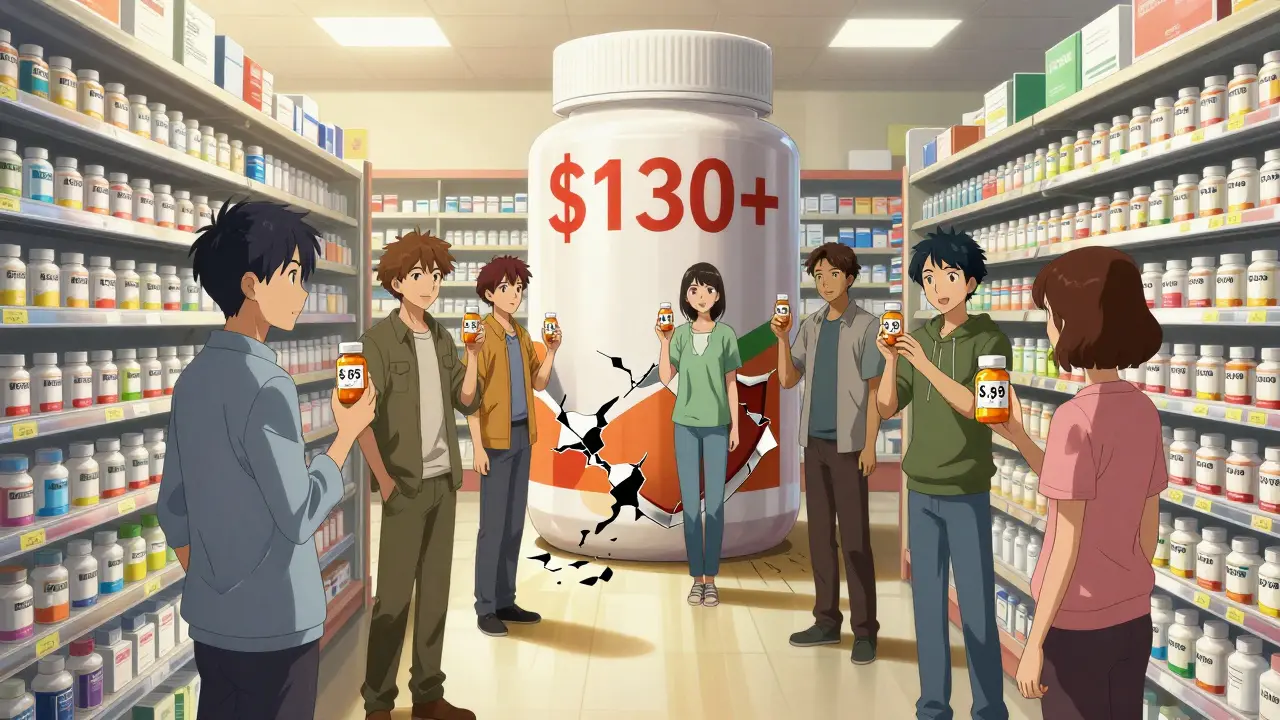
When you pick up a prescription at the pharmacy, you might not realize you’re saving money just by choosing a generic drug. But the numbers don’t lie-generic drugs are the single biggest reason prescription costs haven’t exploded in the U.S. Despite making up 90% of all prescriptions filled in 2024, they accounted for just 12% of total drug spending. That’s the power of competition, and it’s saving Americans hundreds of billions every year.
How Much Are Generic Drugs Actually Saving?
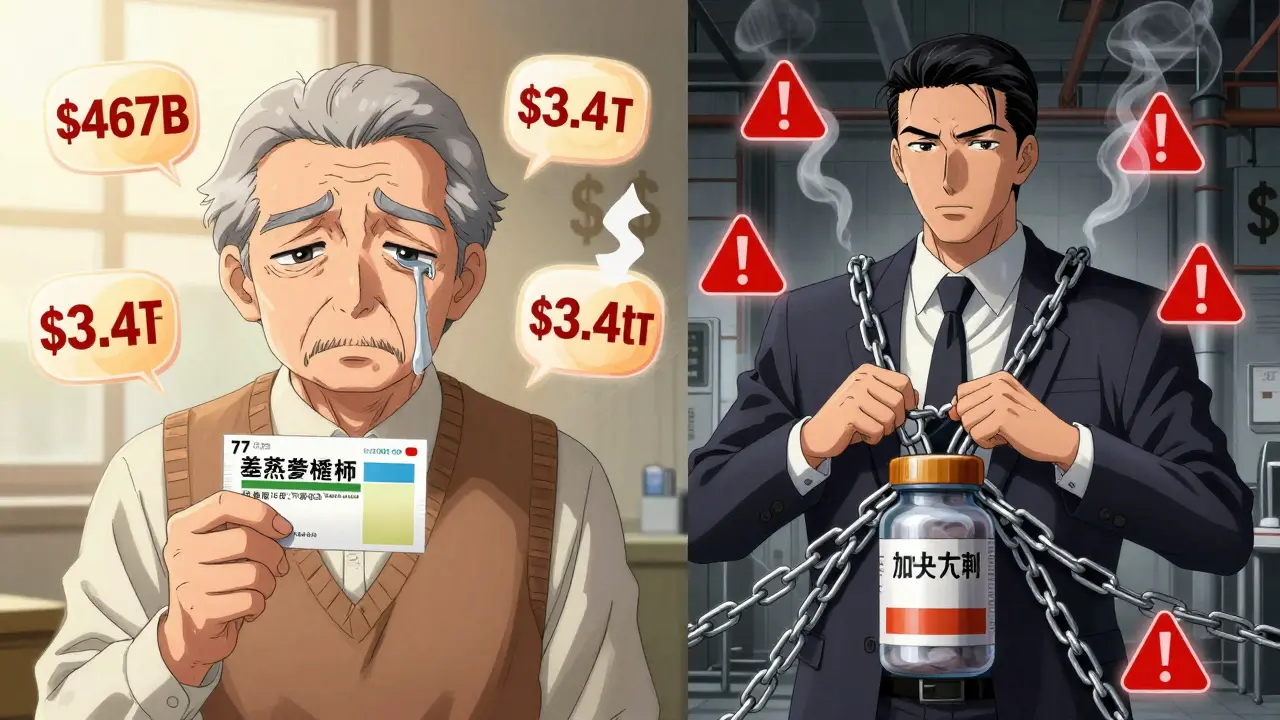
In 2024 alone, generic and biosimilar medicines saved the U.S. healthcare system $467 billion. That’s not a guess. It’s from the 2025 U.S. Generic & Biosimilar Medicines Savings Report, backed by the Association for Accessible Medicines and IQVIA. Over the last decade, those savings have added up to more than $3.4 trillion. To put that in perspective, that’s more than the entire annual GDP of countries like Sweden or Belgium.
Let’s break it down by cost. The average out-of-pocket price for a generic prescription in 2024 was $6.95. For a brand-name drug? $28.69. That’s almost five times more. For people without insurance, the gap is even wider. Brand-name drugs cost an average of $130.18 per prescription-up 50% since 2019. Meanwhile, generic prices dropped by 6% over the same period, falling to $6.95. That’s not a fluke. It’s the result of multiple manufacturers competing to produce the same medicine.
Why Do Generics Cost So Much Less?
Generic drugs aren’t cheaper because they’re lower quality. They contain the exact same active ingredients as brand-name drugs, work the same way, and go through the same FDA safety checks. The difference is in the research and marketing costs.
Brand-name companies spend billions developing a new drug-testing it for years, running clinical trials, and lobbying for patents. Once the patent expires, other companies can make the same drug without those upfront costs. They don’t need to advertise. They don’t need to pay for expensive sales reps. So they can sell it for pennies on the dollar.
The volume of generic pills produced in the U.S. has grown from 167 billion in 2015 to 197 billion in 2024. That’s a 15% increase in usage. Yet total spending on generics has actually gone down by $6.4 billion since 2019. That’s right-more people are using generics, and they’re paying less. That’s deflation in action. No other sector of the economy does that consistently.
Biosimilars: The New Wave of Savings
Biosimilars are the next frontier. These are cheaper versions of complex biologic drugs-medicines made from living cells, like those used for cancer, rheumatoid arthritis, or diabetes. They’re harder to copy than regular pills, so they took longer to enter the market. But now they’re accelerating.
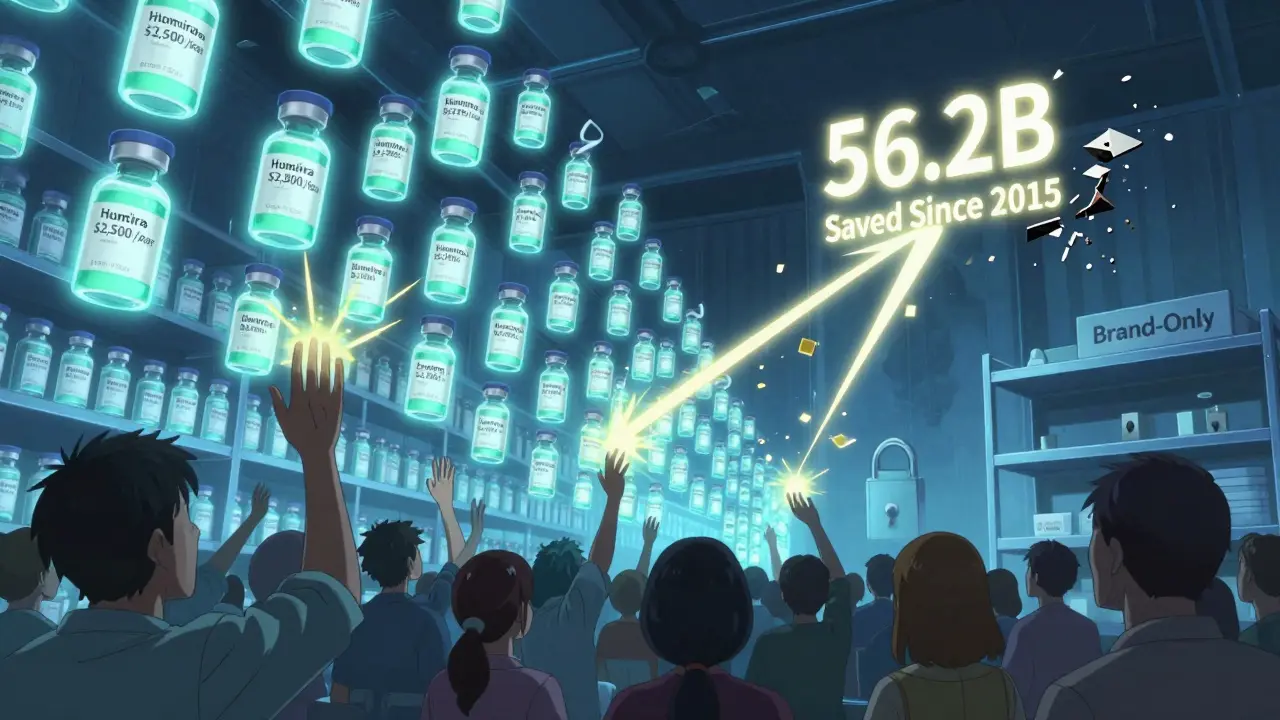
In 2024, biosimilars saved $20.2 billion, nearly double what they saved the year before. Since their debut in 2015, they’ve saved the system $56.2 billion. About 60% of that happened in just the last two years. That means adoption is speeding up. And the data shows no safety issues. Over 3.3 billion days of patient therapy have been covered by biosimilars with no unique side effects reported.
Take Humira, for example. For years, it was one of the most expensive drugs in the country, costing over $70,000 a year. Now, biosimilar versions are available for less than half that price. Patients who need it long-term are seeing their monthly bills drop from $6,000 to $2,500-or even lower.
What’s Driving Up Brand-Name Prices?
While generics keep getting cheaper, brand-name drugs keep getting more expensive. In January 2025, major pharmaceutical companies raised prices on 250 drugs by a median of 4.5%. That’s nearly double the U.S. inflation rate. Some drugs saw hikes of 10%, 20%, even 50% in a single year.
One reason? Patent tricks. Companies file dozens of minor patents on a drug-changing the pill shape, the coating, the delivery method-to delay generics from entering the market. This is called “patent thicketing.” The Congressional Budget Office estimates ending this practice could save $1.8 billion over 10 years.
Another tactic? “Product hopping.” A company slightly modifies a drug, pushes patients to the new version, then pulls the old one off the market. That shuts out generics. Ending this alone could save $1.1 billion over a decade.
And then there’s pay-for-delay. Sometimes, brand-name companies pay generic makers to delay launching their cheaper version. A 2025 study found this practice adds $12 billion to drug costs every year-$3 billion of that paid by Medicare. Banning these deals could save $45 billion over 10 years.
Medicare and the Real Impact on Patients
Medicare saved $142 billion in 2024 thanks to generic drugs. That’s $2,643 saved per beneficiary. For seniors on fixed incomes, that’s not just money-it’s access to medicine. Without generics, many would skip doses or go without.
At hospitals, outpatient generic drug spending is projected to drop from $19.8 billion to $10.2 billion by 2025. That’s nearly $10 billion in annual savings just in hospital settings. Over 10 years, that adds up to $144 billion.
But here’s the catch: those savings are under threat. Generic manufacturers are struggling to stay profitable. With prices dropping so fast, some companies are leaving the market. Others are cutting production. The Biosimilars Council warns this could lead to shortages. If a drug is made by only one or two companies and they stop making it, patients can suddenly lose access-even if the drug is generic.
What’s Next? The Fragile Balance
The system works because generics compete fiercely. But when profits shrink too much, companies leave. And when companies leave, supply chains break. We’ve seen this happen with antibiotics, injectables, and even basic painkillers. In 2024, over 200 drugs had shortages in the U.S.-many of them generics.
Policy changes could help. The Department of Health and Human Services is pushing “Most-Favored-Nation” pricing, which would tie U.S. drug prices to what other countries pay. Right now, Americans pay three to five times more than people in Canada, Germany, or the UK. That’s not fair. And it’s not sustainable.
But the real solution is simple: protect the market for generics. Don’t let patent abuse block competition. Don’t let middlemen like pharmacy benefit managers (PBMs) block access. Don’t let price controls hurt manufacturers so badly they shut down.
Because here’s the truth: without generics, healthcare in America would be unaffordable. The numbers prove it. $467 billion saved in one year. $3.4 trillion over ten. That’s not a policy win. That’s a lifeline.
What You Can Do
If you’re on a prescription, ask your pharmacist: “Is there a generic version?” Always. Even if your doctor didn’t prescribe it, generics are often just as effective and far cheaper.
Use mail-order pharmacies. They often have lower prices on generics. Check GoodRx or SingleCare for coupons-many generics cost under $5 with a coupon.
Speak up. If your insurance denies a generic, file an appeal. If your pharmacy won’t stock it, ask why. Demand transparency. The system works best when patients push back.
Generic drugs aren’t a loophole. They’re the reason millions can afford their medicine. And they’re the only part of the pharmaceutical industry that’s consistently making things cheaper-not more expensive.
Are generic drugs as safe and effective as brand-name drugs?
Yes. The FDA requires generic drugs to have the same active ingredients, strength, dosage form, and route of administration as the brand-name version. They must also meet the same strict manufacturing standards. Bioequivalence studies prove they work the same way in the body. Millions of patients use generics every day with the same results as brand-name drugs.
Why do some generic drugs cost more than others?
Price differences come down to competition. If only one company makes a generic, it can charge more. But if five or six companies are producing it, prices drop fast. For example, metformin, a common diabetes drug, costs under $5 because dozens of manufacturers make it. But a less common generic with only two producers might cost $20 or more. The more competition, the lower the price.
Can I trust generic drugs from other countries?
Only if they’re sold through U.S.-approved pharmacies. The FDA doesn’t regulate drugs imported from other countries, so there’s no guarantee they’re safe or genuine. Stick to U.S.-licensed pharmacies-even if the price is higher. Buying from unverified online sellers risks counterfeit or contaminated medication.
Why do some pharmacies charge more for generics than others?
Pharmacies negotiate different prices with suppliers and PBMs. Big chains may have better deals than small local pharmacies. Mail-order pharmacies often offer the lowest prices because they buy in bulk. Always compare prices using tools like GoodRx. A generic that costs $15 at one pharmacy might be $3 at another.
Are there any drugs that don’t have generics?
Yes. Some drugs are still under patent, especially newer biologics or complex formulations. But most common medications-antibiotics, blood pressure pills, antidepressants, statins-have generics. Check with your pharmacist or use the FDA’s online database to see if a generic exists for your prescription.
What’s the difference between a generic and a biosimilar?
Generics are exact copies of small-molecule drugs-like pills and tablets. Biosimilars are highly similar versions of complex biologic drugs made from living cells, like insulin or cancer treatments. They’re not identical, but they’re proven to work the same way. Biosimilars are harder and more expensive to develop, which is why they entered the market later. But they’re now driving major savings, especially for chronic conditions.
 Medications
McCarthy Halverson
January 9, 2026 AT 03:58neeraj maor
January 10, 2026 AT 04:54Ritwik Bose
January 10, 2026 AT 12:25Jaqueline santos bau
January 10, 2026 AT 22:00Kunal Majumder
January 12, 2026 AT 19:36chandra tan
January 14, 2026 AT 06:11Dwayne Dickson
January 15, 2026 AT 05:27Ted Conerly
January 17, 2026 AT 01:34Faith Edwards
January 18, 2026 AT 19:15Saumya Roy Chaudhuri
January 18, 2026 AT 22:27anthony martinez
January 20, 2026 AT 01:07Mario Bros
January 20, 2026 AT 15:18Jake Kelly
January 22, 2026 AT 02:37