
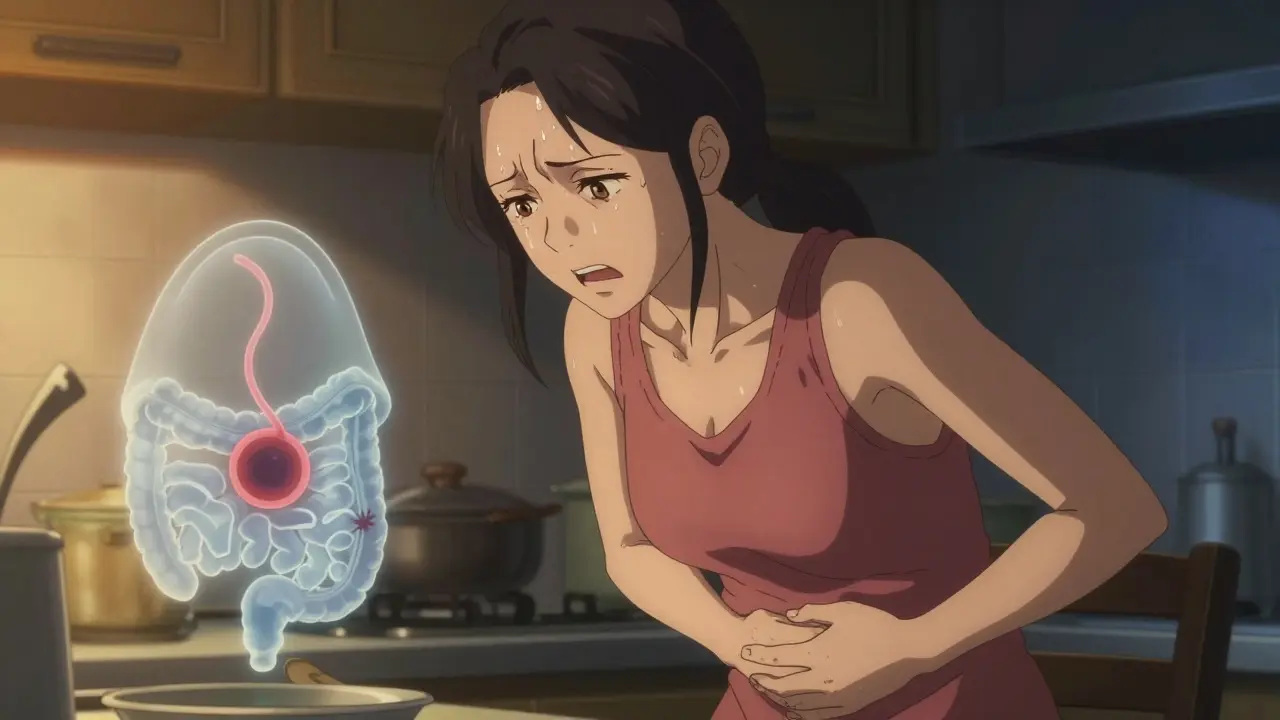
When your stomach hurts so badly you can’t sit still, and the pain stays locked in your right side for hours, it’s not just indigestion. For millions of people, this is the reality of gallstones - and what follows isn’t just discomfort, it’s a chain reaction that can lead to emergency rooms, surgery, and life-changing recovery. The good news? We know exactly how to stop it. The bad news? Many wait too long to act.
What Happens When Gallstones Block the Flow
Gallstones aren’t like kidney stones that you pass and forget. They’re hard deposits formed inside your gallbladder - a small organ tucked under your liver that stores bile to help digest fats. Most are made of cholesterol (80% in Western countries), and the rest are pigment stones from excess bilirubin. But here’s the twist: 80% of people with gallstones never feel a thing. The problem starts when one of these stones gets stuck.
That’s when biliary colic kicks in. It’s not cramps. It’s not gas. It’s a sudden, steady, intense pain in the upper right abdomen or just below your breastbone. It hits fast, peaks within an hour, and lasts 1 to 5 hours - sometimes longer. You can’t relieve it by vomiting, burping, or pooping. It doesn’t come and go like a stomach bug. It’s a direct result of the gallbladder squeezing hard against a stone blocking the cystic duct. When the stone finally shifts, the pain fades… but it will come back. Studies show over 90% of people who have one episode will have another within 10 years, and two-thirds will see it again in just two years.
When Pain Turns to Inflammation - Cholecystitis
Left unchecked, biliary colic can turn into acute cholecystitis. That’s when the gallbladder gets inflamed because the stone stays stuck for more than a few hours. Bile builds up, pressure rises, and the tissue starts to swell and get infected. This isn’t a minor upgrade - it’s a medical emergency. Symptoms include fever, nausea, vomiting, and pain that doesn’t let up. The area becomes tender to touch, and you might even turn yellow (jaundice) if the stone moves into the common bile duct.
Here’s the scary part: about 20% of people who have biliary colic will develop cholecystitis. And if you don’t get treated? The NHS reports that 20-30% of untreated symptomatic gallstone cases lead to emergency hospitalization within five years. That’s not a small risk - that’s a ticking clock.
The Gold Standard: Laparoscopic Cholecystectomy
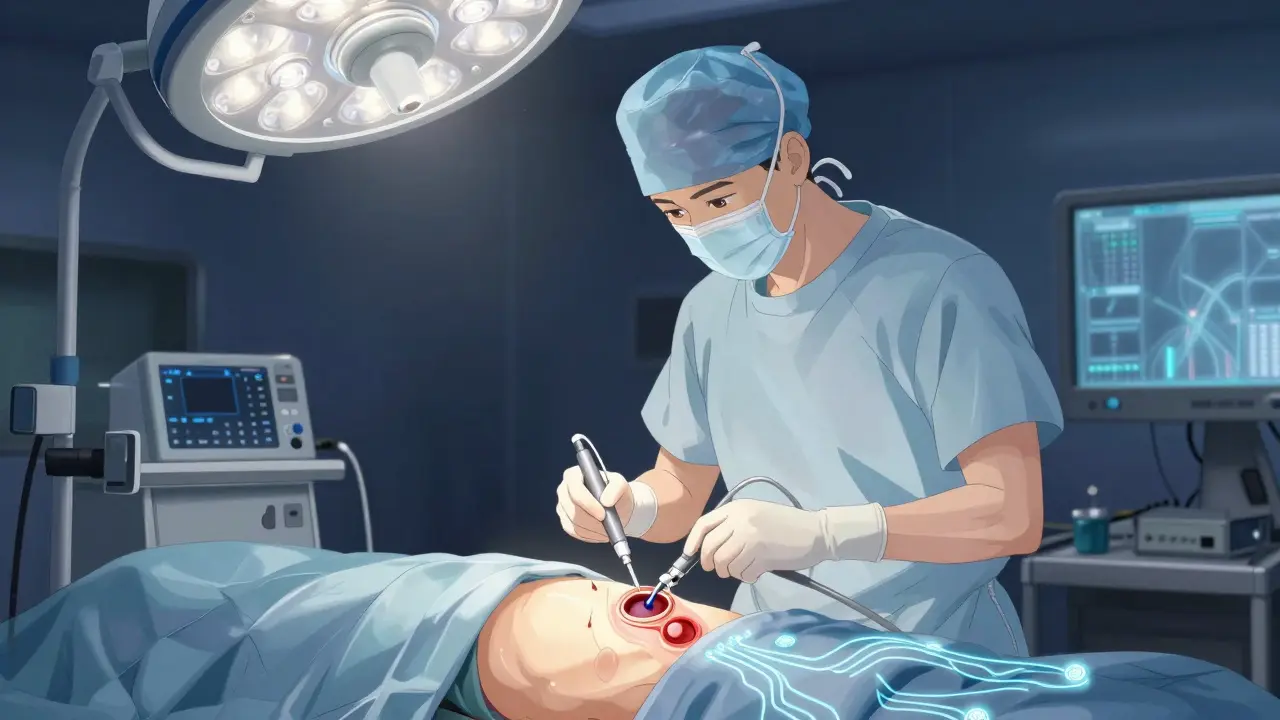
There’s only one treatment that reliably stops the cycle: removing the gallbladder. And the way we do it today is nothing like the old open surgeries of the 1980s. Today, over 90% of gallbladder removals in the U.S. are done laparoscopically - through four tiny cuts, a camera, and long tools. The procedure takes about 45 to 60 minutes. Most people go home the same day or the next. Recovery? You’re back to light activity in a week, full activity in a month. Compare that to open surgery, where hospital stays were nearly five days and recovery took up to 30 days.
Success rates are high. Dr. David Flum from the University of Washington says patient satisfaction after laparoscopic cholecystectomy is 95%. Complication rates? Below 2% in experienced hands. And the data backs it up: a 2022 survey of over 1,200 patients found 78% chose surgery after just three episodes of pain. Most said the deciding factor was emergency care - they’d had enough.
What About Non-Surgical Options?
You might hear about pills or shock waves. Ursodeoxycholic acid can dissolve small cholesterol stones - but only in 30-50% of cases, and it takes 6 to 24 months. Even then, half the people who get rid of the stones with pills get them back within five years. Shock-wave lithotripsy breaks stones apart, but it’s rarely used now because of high recurrence and the need for multiple sessions. Neither option prevents future inflammation or pancreatitis. They’re temporary fixes for a permanent problem.
And here’s the hard truth: if you’re having symptoms, waiting to see if it goes away is a gamble. A 2014 AAFP study followed 69 people who tried to avoid surgery. Sixty-four percent ended up having the operation within 5.6 years anyway. Why wait? Why risk cholecystitis? Why risk pancreatitis - a condition that can kill?
Who Should Think Twice About Surgery?
Surgery isn’t risk-free, especially for older adults or those with serious health problems. Dr. Emily Finlayson at UCSF points out that for patients over 75 with three or more chronic conditions, the 30-day mortality risk jumps from 0.1% in healthy people to 2.8%. That’s why surgeons now take time to optimize high-risk patients - control diabetes, lose weight, manage heart issues - before operating. It’s not about avoiding surgery. It’s about doing it safely.
And for those who can’t have surgery? A 2023 FDA-approved technique called endoscopic ultrasound-guided gallbladder drainage is helping. It drains the gallbladder through the stomach using a tiny tube - a bridge to stabilize patients until they’re ready for removal. It’s not a cure, but it’s a life-saver in emergencies.

What Happens After the Gallbladder Is Gone?
People worry: "What if I can’t digest fat?" The truth? Your liver still makes bile. It just flows directly into your small intestine instead of being stored. Most people adjust within weeks. Some get more frequent bowel movements - especially after fatty meals. That’s normal. A small number (6%) develop post-cholecystectomy syndrome - ongoing pain, bloating, or diarrhea. But that’s rare. And in most cases, it’s not from the surgery. It’s from another issue that was masked by the gallstone pain.
One patient from Cleveland Clinic had 17 episodes over 18 months. After surgery, her pain vanished in 10 days. She was back to hiking and cooking within two weeks. That’s the outcome most people get.
Why Do So Many People Delay?
Survey data tells a troubling story. Over 40% of patients saw three or more doctors before getting the right diagnosis. Pain gets written off as "just acid reflux" or "stress." Emergency rooms often give painkillers and send people home without imaging. A Healthline survey found nearly 30% felt their pain wasn’t taken seriously during acute episodes. That delay is dangerous. Every hour the stone is stuck increases the chance of infection.
And then there’s the cost. In the U.S., over 700,000 gallbladder removals are done each year - costing $6.2 billion. Globally, the market is growing as obesity rates climb. But the real cost isn’t money. It’s time lost, sleep stolen, and the fear of the next attack.
The Bottom Line
If you’ve had one episode of biliary colic, you’re at high risk for more - and for complications. The best solution isn’t waiting. It’s not pills. It’s not hoping. It’s surgery - and it’s safer now than ever. Laparoscopic cholecystectomy is fast, effective, and backed by decades of data. For most people, it’s the difference between living in fear and living without pain.
Don’t wait for the next attack. Don’t wait until you’re in the ER. Talk to your doctor. Get an ultrasound. If gallstones are confirmed and you’ve had symptoms - surgery isn’t just an option. It’s the smartest choice you’ll make for your health.
Can gallstones go away on their own?
No, gallstones don’t dissolve or pass on their own in most cases. While some small stones may move into the intestine without causing harm, the majority remain in the gallbladder and can cause repeated episodes of pain or lead to serious complications like cholecystitis or pancreatitis. Even if symptoms temporarily disappear, the stones are still there - and the risk of future problems remains high.
Is it safe to remove the gallbladder?
Yes, laparoscopic cholecystectomy is one of the safest common surgeries performed today. Complication rates are below 2% in experienced hands, and over 95% of patients report high satisfaction. The gallbladder isn’t essential - your liver continues to produce bile, which flows directly into the small intestine. Most people adjust quickly, with no long-term dietary restrictions.
What are the risks of not removing a gallbladder with stones?
Ignoring symptomatic gallstones carries serious risks: recurrent biliary colic, acute cholecystitis (infection and inflammation), bile duct obstruction leading to jaundice, and acute pancreatitis - which can be life-threatening. Studies show 20-30% of untreated cases result in emergency hospitalization within five years. The longer you wait, the higher the chance of complications that require urgent, complex surgery.
How long does recovery take after gallbladder surgery?
Recovery from laparoscopic cholecystectomy is typically fast. Most patients go home the same day or the next. Light activities can resume within a few days, and full recovery - including returning to work and exercise - usually takes 1 to 2 weeks. This is dramatically faster than open surgery, which required 4 to 6 weeks of recovery.
Do I need to change my diet after gallbladder removal?
You don’t need a strict diet, but some people notice looser stools or more frequent bowel movements after eating fatty meals. This happens because bile flows continuously instead of being stored and released in large amounts. Most people adapt within weeks. Eating smaller meals and avoiding large amounts of fried or greasy food at once can help. Long-term, there’s no evidence that gallbladder removal causes nutritional deficiencies.
 Medications