
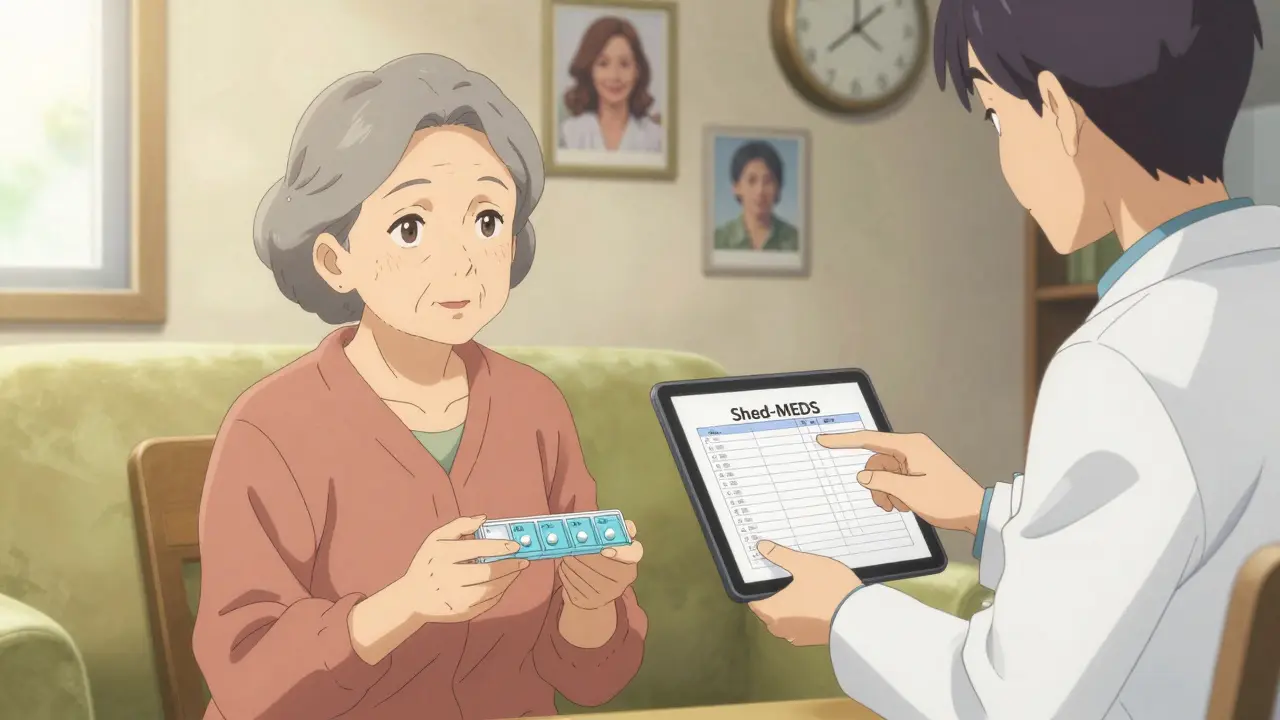
Medication Safety Assessment Tool
Your Medication Review
This tool helps you identify medications that may be candidates for safe deprescribing based on the latest evidence for older adults. Remember: Never stop medications without consulting your healthcare provider.
Deprescribing Assessment Results
Every year, millions of older adults take more medications than they need. Some have been on the same pills for decades - a daily statin, a nighttime sleep aid, a stomach acid reducer - not because they still help, but because no one ever asked if they still mattered. This isn’t laziness. It’s inertia. And it’s dangerous.
Deprescribing isn’t about stopping meds because they’re expensive or inconvenient. It’s about stopping them because they’re doing more harm than good. The goal? Reduce side effects, lower the risk of falls, avoid hospital trips, and give people back their quality of life. And there’s a clear, step-by-step way to do it - called a deprescribing framework.
What Exactly Is Deprescribing?
Deprescribing means carefully and systematically cutting back or stopping medications that may no longer be helping - or are now causing more problems than they solve. It’s not just "going off drugs." It’s a clinical process, like prescribing, but in reverse. You don’t just pull the plug. You plan it. You monitor it. You listen to the patient.
It’s especially important for people over 65. According to the World Health Organization, about 40% of older adults worldwide take five or more medications at once - a situation called polypharmacy. That number jumps even higher in nursing homes or after hospital stays. And guess what? One in three hospital admissions for people over 65 is linked to medication side effects. That’s not a coincidence. It’s a system failure.
Deprescribing frameworks fix that. They give doctors, pharmacists, and nurses a roadmap. Not guesswork. Not opinion. Evidence-based steps.
The Five Key Medication Classes That Need Deprescribing
Not all drugs are equal when it comes to risk. Some are more likely to cause harm than others - especially in older bodies. The most common culprits? Five classes with clear, validated deprescribing guidelines:
- Proton-pump inhibitors (PPIs) - These are stomach acid blockers like omeprazole. Many take them for heartburn, but most don’t need them long-term. After 4-8 weeks, the body adjusts. Staying on them increases risk of bone fractures, kidney damage, and gut infections.
- Benzodiazepines and sleep aids - Drugs like lorazepam or zolpidem. They help with anxiety or insomnia short-term. Long-term? They increase fall risk by 50%, worsen memory, and can cause dependence. Tapering them slowly cuts these risks without triggering seizures or rebound insomnia.
- Antipsychotics - Prescribed for dementia-related agitation? That’s off-label. And dangerous. These drugs raise stroke risk by 2-3 times in older adults with dementia. Deprescribing here can mean fewer hospitalizations and better behavior without drugs.
- Antihyperglycemics - Blood sugar drugs like sulfonylureas. Tight control in older adults with limited life expectancy doesn’t extend life - it just causes dangerous lows. Deprescribing can prevent hypoglycemic episodes that lead to falls, confusion, or ER visits.
- Opioid analgesics - Painkillers like oxycodone. Long-term use for chronic pain rarely improves function. But it does increase drowsiness, constipation, and overdose risk. Deprescribing here means switching to non-drug options like physical therapy or mindfulness.
Each of these has a published guideline. For example, the PPI deprescribing protocol is four steps: 1) Check if the original reason still exists, 2) Evaluate if the benefit outweighs the risk, 3) Taper slowly over 4-8 weeks, 4) Watch for return of symptoms. No rush. No guesswork.
The Shed-MEDS Framework: A Proven Method
One of the most tested deprescribing frameworks is called Shed-MEDS. It stands for:
- Search - Get the full list of every medication the patient takes, including supplements and OTC pills.
- Hold - Pause all non-essential meds temporarily. Don’t stop yet. Just pause.
- Evaluate - Review each one. Is it still needed? Is it safe? Is it helping?
- Deprescribe - Decide what to stop, in what order, and how fast.
- Synthesize - Document the plan. Share it. Monitor.
A 2023 study in JAMA Internal Medicine followed 372 older adults in post-acute care. Those using Shed-MEDS had their medication count drop from 11.3 to 9.5 on average. At 90 days, it was still down by 1.6 drugs. And here’s the kicker: no increase in falls, hospitalizations, or deaths. The group that didn’t deprescribe? Same safety outcomes - but with 2 more pills daily.

Who Does It Best? Pharmacists.
Deprescribing doesn’t work well in a 7-minute doctor visit. It needs time. It needs expertise. And it needs someone who knows every drug interaction, every withdrawal symptom, every alternative.
That’s where pharmacists come in. Studies show that when pharmacists lead deprescribing efforts, success rates jump by 35-40%. Why? Because they’re trained in medication therapy management - a 150+ hour certification that teaches them how to untangle complex regimens.
In Canada, where the Deprescribing Guidelines in the Elderly (DIGE) program is nationally adopted, pharmacists review all prescriptions for seniors on public drug plans. Result? A 25% drop in inappropriate prescribing in just three years.
But in the U.S., only 32% of clinicians feel their electronic health record (EHR) system supports deprescribing. Most EHRs are built to encourage prescribing - not stopping. A pill gets added with one click. Stopping one? You have to hunt through menus, write notes, justify it. No wonder it doesn’t happen.
Why Don’t More Doctors Do It?
It’s not that they don’t want to. It’s that they’re stuck.
A primary care physician in the U.S. spends an average of 7.2 minutes per patient visit. That’s not enough to review 10 medications, discuss goals of care, check for drug interactions, explain why stopping a pill won’t kill them, and get consent.
Plus, guidelines are fragmented. Out of 3,569 evidence-based recommendations in clinical guidelines, only 7% mention deprescribing. Compare that to prescribing - 93% of guidelines tell you what to start. Almost none tell you what to stop.
And fear plays a role. Patients are scared. "I’ve taken this for 20 years - what if I get sick?" Doctors are scared too. "What if I stop this and they end up in the ER?"
But the data says otherwise. In the same 2023 study, only 15.8% of patients who deprescribed had adverse events - compared to 16.2% in the control group. No difference. That’s not luck. That’s science.
What Patients Really Think
When patients are involved, they usually agree - if they understand why.
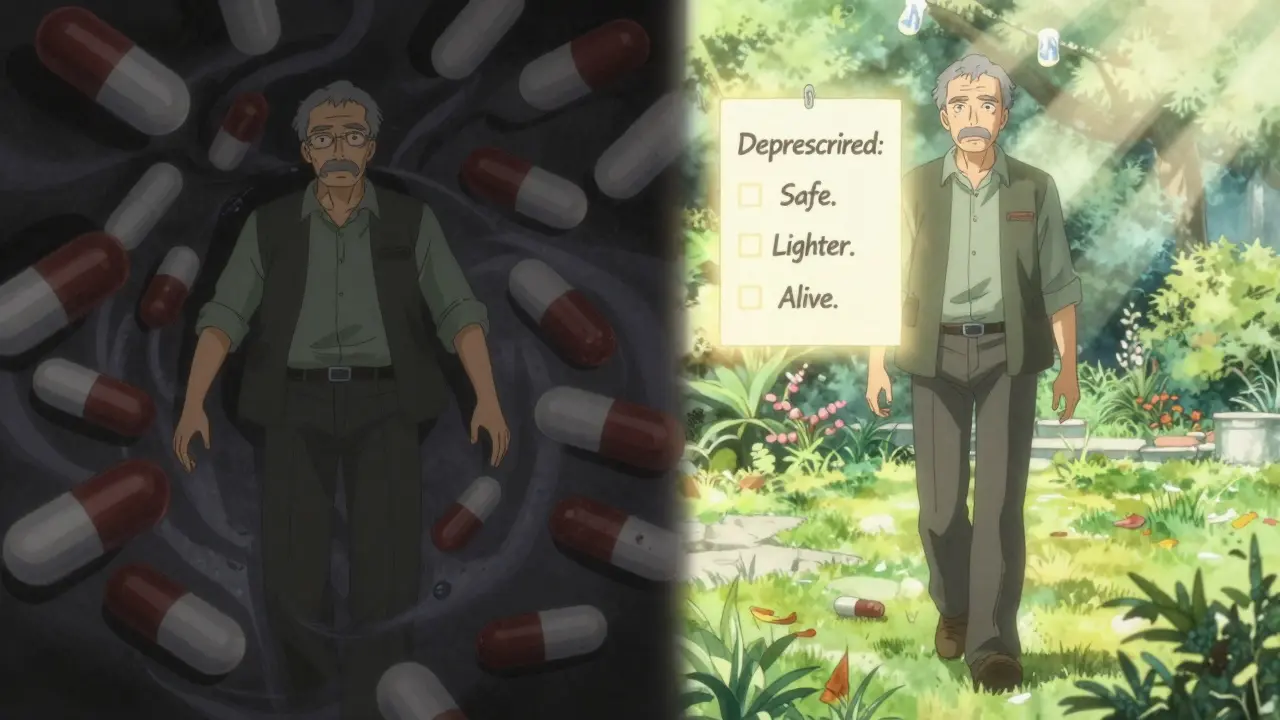
A 2022 study found 65% of older adults felt relieved when they stopped unnecessary pills. "I don’t have to swallow 15 tablets every morning," one said. "I feel lighter."
But 22% were anxious. One woman cried when her doctor suggested stopping her long-term blood pressure pill. "My husband died because he stopped his meds too soon," she said. She didn’t know he had heart failure - and his meds were lifesaving. Her fear was real.
That’s why education matters. Not just about the drug - but about the goal. "We’re not trying to make you healthier by adding more pills. We’re trying to make you feel better by removing the ones that aren’t helping."
The Future Is Here - But Slowly
Change is coming. In June 2024, the American Medical Association passed its first policy requiring physicians to routinely review all medications. In February 2024, Medicare announced it will start measuring deprescribing rates in 2026 - and tie payments to performance.
AI tools are being built to flag high-risk combinations in EHRs. New guidelines are in development for antidepressants, anticoagulants, and other classes. The global deprescribing market is projected to hit $1.2 billion by 2028.
But real progress won’t come from technology alone. It comes from doctors who have time. Pharmacists who are part of the team. Patients who are heard.
By 2030, experts predict deprescribing assessments will be as routine as checking blood pressure. And that’s a good thing. Because sometimes, the best medicine is the one you don’t take anymore.
Is deprescribing safe for older adults?
Yes - when done properly. A 2023 randomized trial of 372 older adults showed no increase in hospitalizations, falls, or deaths after deprescribing, even though patients stopped an average of 1.8 medications. Safety depends on careful planning, slow tapering, and monitoring. Stopping abruptly or without evaluation is risky. But structured deprescribing reduces harm.
Can I stop my medications on my own?
No. Never stop a medication without talking to your doctor or pharmacist. Some drugs - like blood pressure pills, antidepressants, or seizure medications - can cause serious withdrawal symptoms if stopped suddenly. Even if you think a pill isn’t helping, your body may have adapted to it. A professional can guide you through a safe, step-by-step plan.
What if I’m afraid to stop a medication I’ve taken for years?
That fear is normal. Many people worry that stopping a pill will make them sick - especially if they’ve taken it for decades. But often, the body adjusts over time, and the original reason for the drug no longer applies. A deprescribing framework helps by testing whether the drug is still needed, not just assuming it is. Talking through your concerns with a pharmacist or trusted clinician can ease anxiety.
Do I need to see a specialist to deprescribe?
Not necessarily. While specialists help with complex cases, deprescribing can be done in primary care - especially if a pharmacist is involved. In fact, studies show pharmacist-led deprescribing is more effective than doctor-only efforts. Ask your primary care provider if they work with a medication therapy management pharmacist. Many clinics now offer this service.
What tools or resources can help me start deprescribing?
Start with deprescribing.org - it offers free, evidence-based guidelines for five major drug classes. Also use the STOPP/START criteria (version 3, 2021) and the American Geriatrics Society’s Beers Criteria (2023 update). These tools help identify potentially inappropriate medications. Bring them to your next appointment. Ask: "Which of my meds might I be able to reduce?"
 Medications
phyllis bourassa
March 5, 2026 AT 14:22Oh honey, I’ve been saying this for years. My mom was on 17 pills-17!-and she’d just stare at her pill organizer like it was a math problem she forgot how to solve. One day I sat down with her pharmacist, and we cut it down to 5. She stopped falling, stopped napping at 2 p.m., and started gardening again. I swear, she’s 82 and looks 65 now. It’s not magic. It’s just common sense. Why do we treat aging like a disease to be medicated into submission?
And don’t even get me started on PPIs. My neighbor’s been on omeprazole since 2008. For heartburn? She hasn’t eaten spicy food since the Clinton administration. She’s got osteoporosis now. Coincidence? I think not.
Pharmacists should be leading this. Not GPs who are rushing between 12 patients an hour. We need a system that rewards stopping meds, not just adding them. Canada’s doing it right. Why can’t we?
Also-why are we still using paper scripts? Everything’s digital. Why can’t my EHR just yell at me: ‘HEY, THIS PERSON IS ON 11 DRUGS AND HAS A 70% CHANCE OF FALLING’? Because profit > safety. Always has been.
Adebayo Muhammad
March 6, 2026 AT 15:15Let us not confuse deprescribing with negligence; rather, let us recognize it as a form of epistemic humility-yes, humility!-in the face of medical hubris. We have elevated the pill to the status of a sacrament: a ritual of consumption, a liturgy of compliance. But what if the cure was never the problem? What if the illness was the assumption that more is better?
The body is not a machine to be calibrated with pharmacological screws. It is a dynamic, adaptive, living system-capable, when left alone, of self-regulation. We intervene, not because we understand, but because we fear the silence of not-doing.
And yet-the data speaks. No increase in hospitalizations. No spike in mortality. Just… fewer pills. And more life. Is it not then, dear reader, the most radical act of care to remove what does not serve? To let the body breathe again?
Aaron Pace
March 7, 2026 AT 19:40THIS. SO. MUCH. 🙌
I’ve been telling my dad for YEARS to get off that zolpidem. He’s 78, takes it every night, wakes up groggy, stumbles in the hallway, says ‘I’m fine!’
Finally, last month, his pharmacist sat down with him-no pressure, just questions. ‘What’s the last thing you remember doing before sleep?’ Dad said, ‘Reading.’ ‘What’s the last thing you remember doing after sleep?’ ‘Nothing.’ 😅
They tapered him over 6 weeks. He sleeps worse? Nope. He sleeps BETTER. Woke up without that ‘cotton mouth’ feeling. Started making coffee again. Took his grandkids to the park. He’s like a new man.
Stop the pills. Start the life. 💪❤️
Joey Pearson
March 8, 2026 AT 05:12This is the most important thing we’re not talking about. And honestly? It’s embarrassing. We’ve got entire departments devoted to prescribing, but zero support for stopping. No training. No templates. No reimbursement.
I’m a nurse. I’ve seen old folks on 12 meds, confused, constipated, falling. And every time I ask, ‘Can we try cutting one?’ I get ‘We’ll see.’
Let’s make deprescribing a standard part of care. Like blood pressure checks. Like flu shots. We don’t need a specialist. We need a system that says: ‘It’s okay to stop.’
And we need to listen to patients when they say, ‘I just want to feel like me again.’
Roland Silber
March 9, 2026 AT 13:51Let me add something practical: the real barrier isn’t fear-it’s documentation. In my clinic, we use the Shed-MEDS framework, but our EHR doesn’t have a ‘deprescribing’ checkbox. So I have to write a 300-word note in ‘Medication Review’ and justify why I removed a drug that was prescribed 15 years ago.
Meanwhile, adding a new med? One click. Auto-populated. Done.
It’s like the system was designed to make stopping harder than starting. And that’s not an accident. It’s a financial incentive: more prescriptions = more revenue.
But here’s the good news: when we do it right, patients report better sleep, better balance, better mood. One guy stopped his statin and said, ‘I didn’t realize I was tired all the time because I was on it.’
Pharmacists are the unsung heroes here. They’re the ones who catch the interactions, the duplications, the drugs that make zero sense for someone with a 5-year life expectancy.
Let’s fund their time. Let’s train GPs. Let’s change the EHRs. It’s not rocket science. It’s just… human.
Patrick Jackson
March 10, 2026 AT 19:10I cried reading this.
My grandma took 14 pills a day. She didn’t complain. She just… smiled and swallowed. I thought she was strong. Turns out she was exhausted.
When her pharmacist sat down with her-not the doctor, the pharmacist-and said, ‘Let’s try removing one. Just one. And see how you feel,’ she started crying. Not because she was scared. Because someone finally asked.
They stopped the sleeping pill first. She started waking up at 6 a.m. on her own. Said she could hear the birds again.
Then the acid reducer. Then the antihistamine she’d been taking since 1998 for ‘allergies’-but she hadn’t been outside in 10 years.
Now she’s on 6. And she’s knitting again. And she says, ‘I feel like I got my life back.’
It’s not about drugs. It’s about dignity.
And we’ve been so focused on treating disease, we forgot to treat people.
Thank you for writing this.
😭❤️
Pranay Roy
March 10, 2026 AT 21:58Wait. Let me ask you something. Who really benefits from deprescribing? The patient? Or the insurance company? Because let’s be real-pharmaceutical companies make billions off long-term prescriptions. Who’s pushing this ‘deprescribing’ agenda? Is it really about health? Or cost-cutting? And who’s auditing the data? Are these studies funded by the same folks who sell the EHR systems that don’t support deprescribing?
I’m not saying it’s bad. I’m saying: question the source. The WHO says 40% of seniors are on 5+ meds. But who counted them? What if the real problem is underdiagnosis? What if these ‘unnecessary’ meds are actually preventing strokes we don’t know about?
And what if the ‘16.2% hospitalization rate’ in the control group includes people who were quietly dying from undiagnosed conditions because their meds were masking symptoms?
Just saying… don’t let them gaslight you into thinking less medicine = better health. Sometimes, less medicine = less monitoring.
Stay vigilant. Always.
Joe Prism
March 11, 2026 AT 05:29As a Nigerian-American, I’ve seen both sides. In Lagos, my auntie takes herbs, tea, and one blood pressure pill-and she’s 80 and walks 5 miles a day. In Ohio, my cousin is on 11 pills, can’t get out of bed, and says, ‘It’s just what I’m supposed to do.’
We’ve turned medicine into a ritual, not a tool. In the West, we treat the body like a car that needs constant tuning. In many cultures, we treat it like a garden-water it, give it sun, let it heal.
Deprescribing isn’t anti-medicine. It’s pro-wisdom.
Maybe the answer isn’t more guidelines. Maybe it’s less noise. Less fear. More listening.
And maybe, just maybe, the best doctor isn’t the one who prescribes the most-but the one who dares to say, ‘You don’t need this anymore.’