
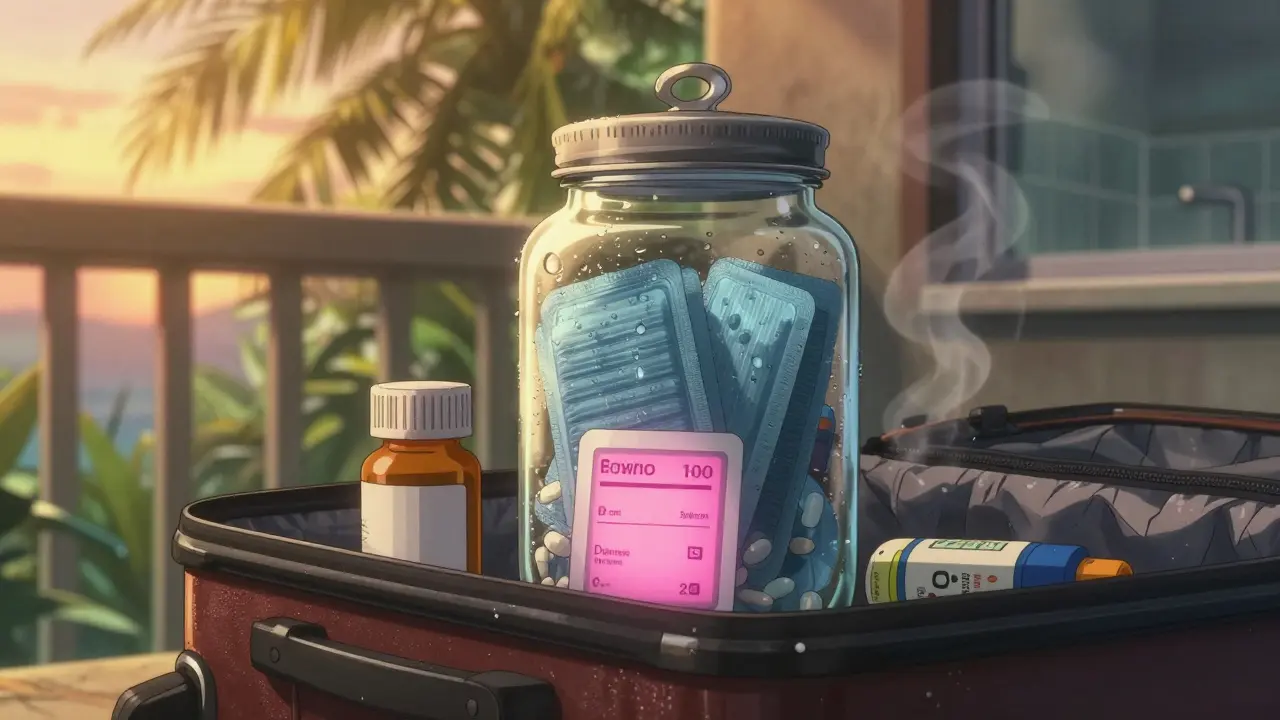
When you're traveling to a tropical destination, the last thing you want is for your meds to go bad before you even use them. High heat and thick, wet air don't just make you uncomfortable-they can wreck your pills, capsules, and inhalers. You might think your medicine is safe in a ziplock bag or a bathroom cabinet, but in places where humidity hits 80% or more, that’s like leaving your drugs out in a steam room. The science is clear: medication degradation in tropical humidity isn't rare-it's common, and it’s dangerous.
What Happens When Medicines Get Wet
Medicines aren’t just chemicals in a bottle. They’re carefully engineered to stay stable under specific conditions. When humidity climbs above 60%, water starts sneaking into the packaging. Once inside, it doesn’t just sit there-it attacks. The biggest culprit? Hydrolysis. That’s just a fancy word for water breaking chemical bonds in the active ingredients. For drugs like amoxicillin or lamotrigine, this can slash potency by half in under a month. A 2022 study showed that lamotrigine tablets stored at 75% humidity lost 22-38% of their ability to release the drug properly after just four weeks. That’s not a small drop. That’s the difference between a treatment working and failing. It’s not just chemistry. Physical damage matters too. Tablets get sticky and crack. Capsules soften and leak. Powder inhalers clump up so badly they won’t deliver the right dose. Freeze-dried vaccines? They turn useless if humidity goes above 20%. And don’t forget mold. Fungi like Aspergillus and Penicillium can grow on pills in as little as 72 hours in tropical conditions. That’s not just a quality issue-it’s a health risk.Which Medications Are Most at Risk
Not all drugs break down the same way. Some are way more sensitive than others. Antibiotics like tetracycline and amoxicillin are especially vulnerable. Tetracycline can degrade 3.5 times faster at 75% humidity than at 40%. You’ll even see color changes-yellowing or darkening-within two weeks. Antifungals, pediatric syrups, and orally disintegrating tablets (ODTs) also struggle. ODTs are designed to dissolve fast on your tongue, but in high humidity, they turn into glue. One study found exposure to 80% humidity for seven days made them take 300-500% longer to break down. That means you’re not getting the full dose. Dry powder inhalers (DPIs) are another big concern. If moisture gets in, the tiny particles stick together. That cuts the amount of medicine that reaches your lungs by 15-25%. For someone with asthma or COPD, that could mean a trip to the ER. Even common pain relievers like ibuprofen can lose effectiveness if stored too long in damp conditions. The WHO estimates that 30% of medicines in tropical regions lose potency before reaching patients. That’s not a glitch-it’s a systemic problem.What’s the Right Storage Environment?
The sweet spot for keeping meds stable is 30-45% relative humidity and 15-25°C. Anything above 60% RH and 30°C starts accelerating degradation. Every 10°C increase above 25°C doubles the rate of chemical breakdown. That’s why storing medicine in a bathroom or kitchen is a bad idea. Showers, boiling pots, and sinks all pump out moisture. Even a window sill in a humid climate can be worse than leaving your meds in a car. The World Health Organization says ‘controlled room temperature’ means below 30°C and 65% RH. But even that’s too loose for long-term safety. For refrigerated meds-like insulin or certain vaccines-the rule is 2-8°C with humidity below 60% RH. Condensation forms if it’s too humid, and that’s just as damaging as direct exposure.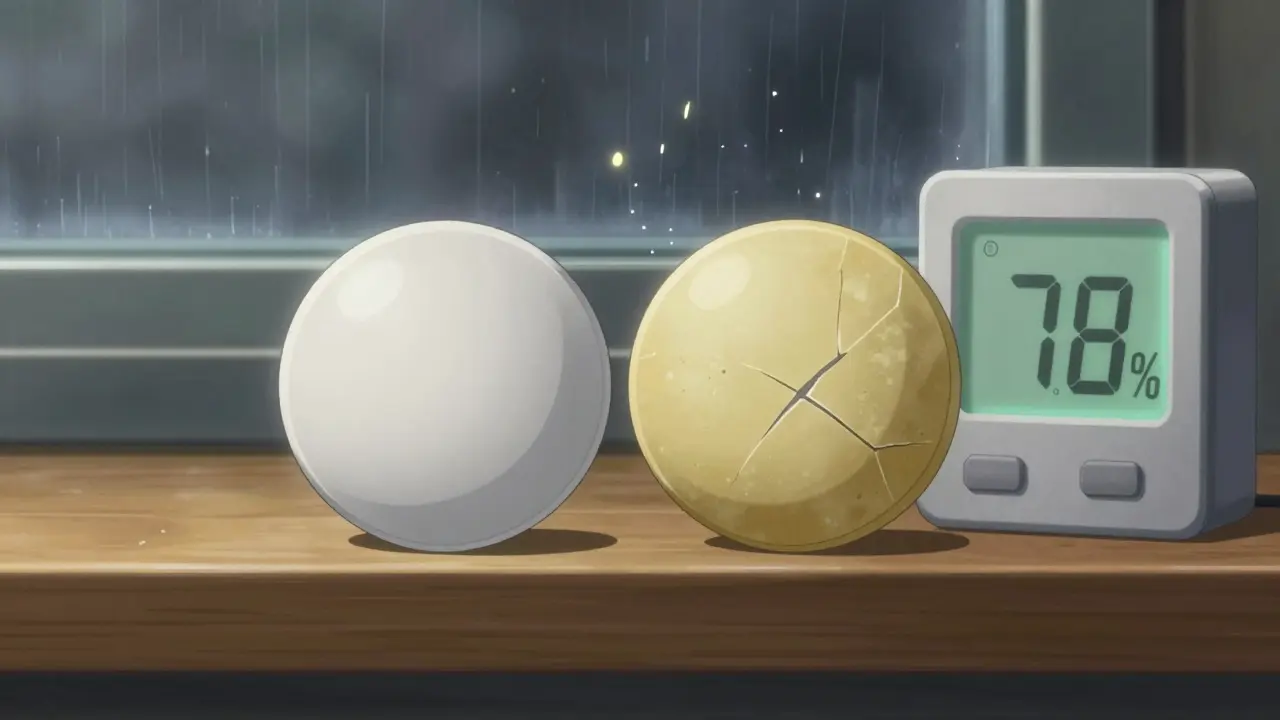
How to Protect Your Medications
You don’t need a lab to keep your drugs safe. Here’s what actually works:- Use airtight containers-glass jars with rubber seals or hard plastic boxes with locking lids. Avoid flimsy pill organizers.
- Add desiccants-silica gel packs are cheap and effective. Put one or two inside your storage container. Replace them every 30 days in high humidity. Some packs change color when they’re full-blue to pink-so you know when to swap them.
- Avoid bathrooms and kitchens-these are the worst places. Store meds in a bedroom closet, on a shelf away from windows, or in a drawer with a tight door.
- Use humidity indicator cards-these cost less than $1 and show you when moisture levels cross 40-55%. If it turns pink, your meds are at risk.
- Don’t transfer pills to unmarked containers-original blister packs are designed with moisture barriers. Once you pop them out, you lose that protection.
Advanced Solutions for Travelers and Clinics
For people who live in or frequently visit tropical zones, there are smarter tools. Companies like Aptar and Multisorb now make blister packs with built-in moisture-scavenging layers. These don’t need separate desiccants-they absorb humidity right inside the packaging. The Gates Foundation has distributed over 500 million of these packs across Africa since 2021, cutting degradation by 58%. For clinics and pharmacies in remote areas, the WHO’s PharmaSeal system uses reusable desiccant canisters that maintain humidity below 35% RH for six months. Each unit costs less than a dollar. In Uganda, health workers built simple ‘desiccant closets’-metal cabinets with 5kg of silica gel inside-that cut spoilage by 70%. For travelers carrying expensive or sensitive meds (like biologics or insulin), portable dry cabinets like the SMT DryBox are game-changers. They maintain humidity at 5-15% RH and temperature within ±0.5°C. They cost $2,500-$15,000, but for someone relying on life-saving drugs, it’s worth it.What Happens If You Ignore This
Ignoring humidity isn’t just about wasted pills. It’s about real danger. A 2020 recall of Novartis’ anti-malarial drug Coartem in Nigeria affected 15,000 units. Patients got less medicine than they needed. Some got sick. Others didn’t recover. The FDA says drug recalls due to storage failures cost $5-10 million each. In low-income countries, the annual cost of degraded medicines is $1.2 billion. That’s not just money-it’s lives. The American Association of Pharmaceutical Scientists says there’s no one-size-fits-all fix. But they agree on one thing: you can’t trust ambient conditions. If you’re in a humid zone, you need to take control.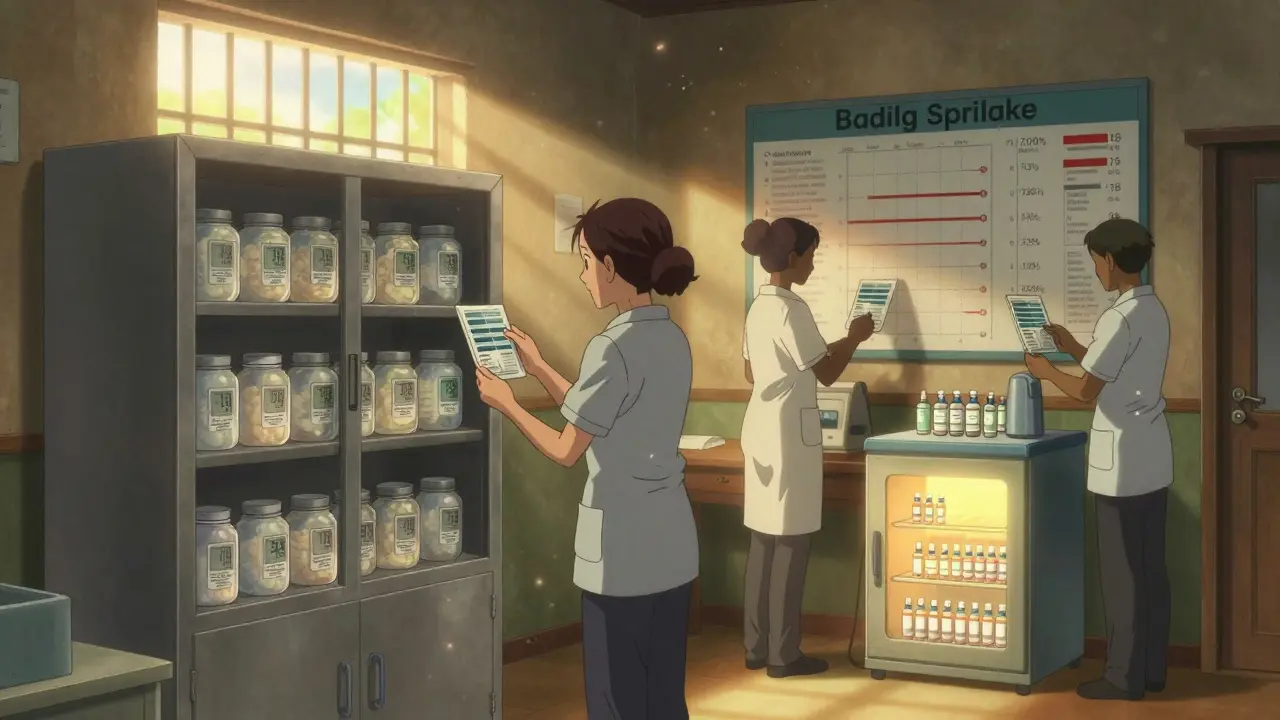
Monitoring and Proof
You can’t guess whether your meds are safe. You need to know. Wireless data loggers like the TL-4RH record temperature and humidity every 15 minutes. They’re used by the FDA and hospitals. For less technical users, humidity indicator cards are a simple, visual way to check. If the card turns pink, it’s time to act. A 2022 field trial in the Philippines tested the WHO’s ‘30-30 Rule’: replace desiccants every 30 days when temperature exceeds 30°C. It reduced spoilage by 47% across 15,000 patients. That’s not theory-it’s proof.What’s Next
New tech is coming. Researchers at MIT have developed graphene oxide coatings that block 99.7% of moisture-far better than aluminum foil. These could be in pill bottles within five years. The ICH is also working on new guidelines (Q1H) expected in 2025 that will force drugmakers to prove their products survive tropical conditions before they’re sold there. Until then, the tools we have now are good enough. Desiccants, airtight containers, and smart storage habits can protect your meds. You don’t need expensive gear. You just need to know the risks-and act on them.Can I store my pills in the fridge to avoid humidity?
It depends. If your medication is labeled for refrigeration (2-8°C), then yes. But if it’s meant for room temperature, putting it in the fridge can cause condensation. When you take it out, moisture forms on the surface and gets inside the container. This can be worse than leaving it in humid air. Always check the label or ask your pharmacist.
Are silica gel packs safe if they come in contact with pills?
Yes, as long as they’re sealed in their own packet. Silica gel is non-toxic and inert. It doesn’t react with drugs. The only risk is if the packet breaks and the beads spill out-then you’d need to discard the pills. Always keep desiccants in their original packaging and don’t open them.
How do I know if my medication has degraded?
Look for changes in color, texture, or smell. Tablets might darken, crack, or become sticky. Capsules can soften, leak, or smell musty. Powders clump. If your inhaler doesn’t spray properly, or if a liquid looks cloudy or has particles, stop using it. When in doubt, replace it. You can’t tell potency by sight alone, but visible damage means the drug is compromised.
Do travel-sized pill cases protect against humidity?
Most don’t. Plastic pill organizers are great for portability but offer zero moisture protection. They’re like a screen door on a hurricane. If you’re traveling to a humid place, use a hard, sealed container with desiccants instead. You can still use the organizer for daily doses, but keep your bulk supply in a better-protected container.
Is it okay to carry meds in checked luggage?
It’s risky. Airplane cargo holds can get very hot and humid, especially on long flights to tropical destinations. The temperature can spike above 40°C. Always carry medications in your carry-on. Keep them in a sealed container with desiccants. If you must check them, use a hard-shell case with silica gel and label it as ‘Medication - Keep Dry’.
 Medications