
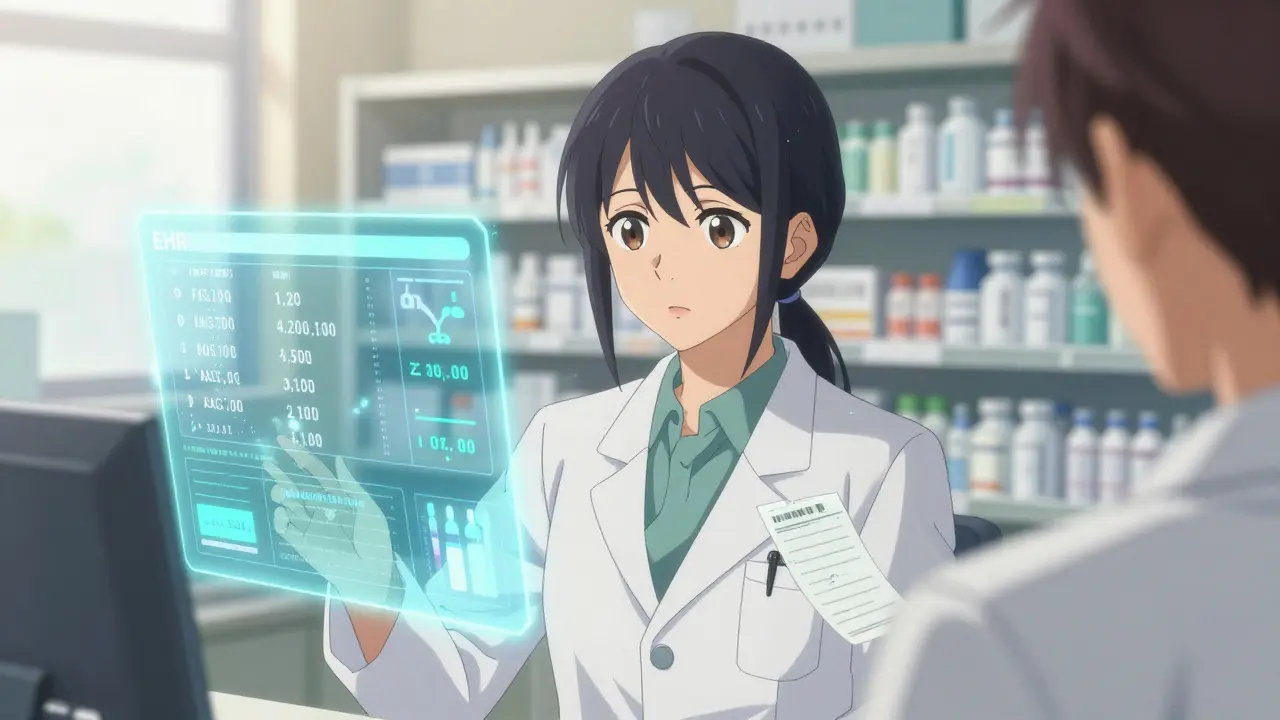
When a doctor writes a prescription, it should be clear, accurate, and safe. But too often, the information gets lost in translation between the clinic and the pharmacy. A patient might be on five medications, but the pharmacist only sees three. A lab result showing kidney trouble? Missed. A dangerous drug interaction? Overlooked. This isn’t rare-it’s the norm in many places. That’s where EHR integration changes everything.
What EHR Integration Actually Does for Prescriptions
EHR integration connects a provider’s electronic health record system directly with a pharmacy’s management system. It’s not just about sending a prescription electronically. It’s about sharing the full picture: allergies, recent lab results, other medications, past hospitalizations, even notes from a specialist. When this happens, pharmacists don’t just fill bottles-they become active members of the care team.
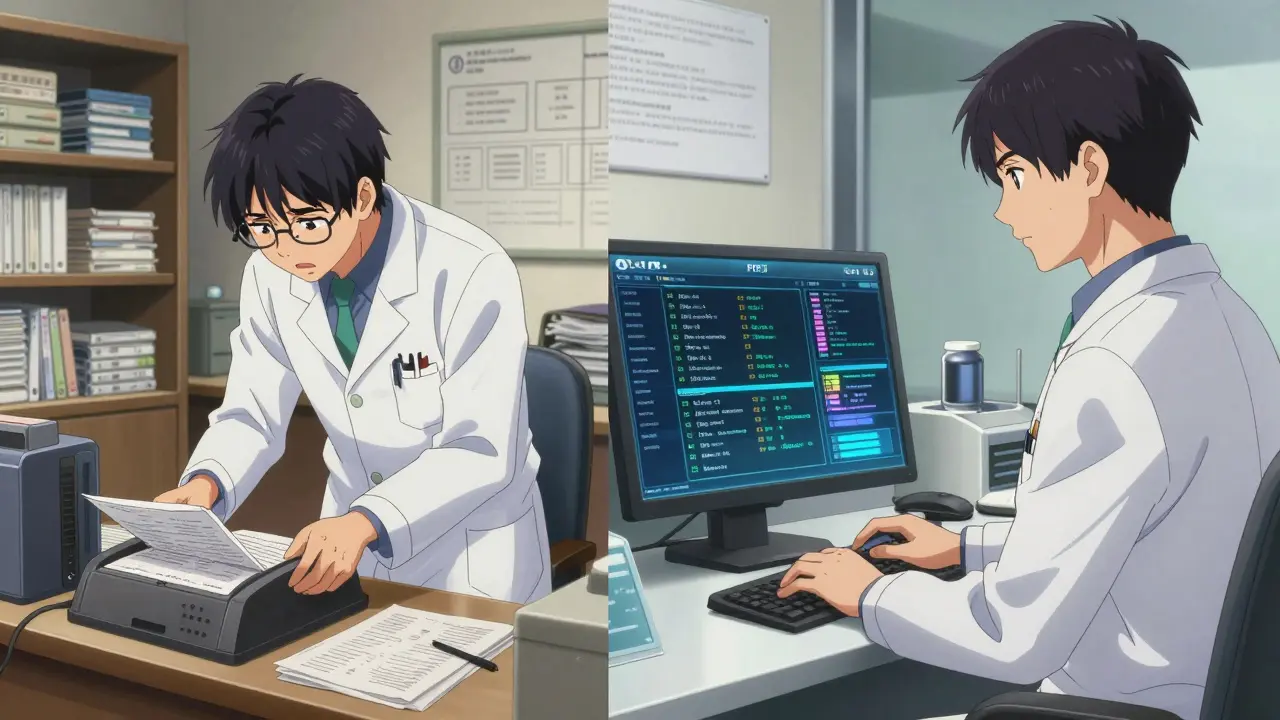
Before integration, a pharmacist might spend 15 minutes just verifying a prescription: calling the doctor’s office, checking old records, waiting for a fax. Now, with bidirectional EHR integration, that same task takes under six minutes. A 2022 study from EnlivenHealth® showed a 63% reduction in processing time across 12 independent pharmacies. That’s 9 minutes saved per prescription. Multiply that by 200 prescriptions a day? That’s over 30 hours a week reclaimed for patient care.
How It Works: Standards That Make It Real
This isn’t magic. It’s built on clear technical standards. The backbone is the NCPDP SCRIPT standard (version 2017071), which handles the actual transmission of prescriptions. But that’s just the start. For deeper integration, systems use HL7 FHIR Release 4-a modern framework that lets different software talk to each other using common data formats.
For example, if a patient’s blood pressure spikes and their doctor updates the EHR, that change instantly appears in the pharmacy’s system. If a new medication is added, the pharmacist sees it before the patient even walks in. The Pharmacist eCare Plan (PeCP), built on FHIR, lets pharmacists document their interventions-like adjusting doses or catching interactions-and send those notes back to the provider. It turns the pharmacy into a two-way street.
Security is built in too. All data moves over encrypted channels (TLS 1.2+), stored with AES-256 encryption, and every access is logged. This isn’t optional-it’s required under the 21st Century Cures Act. If a system blocks data flow, it’s a violation.
The Real Benefits: Numbers That Matter
Let’s talk outcomes. A 2022 study published in PMC found that patients with integrated EHR-pharmacy systems had a 23% higher rate of medication adherence. That’s not a guess-it’s measured. Another study from the University of Tennessee showed a 31% drop in medication-related hospital readmissions. For a system managing thousands of patients, that’s hundreds of avoidable hospital stays.
Pharmacists with full EHR access identify 4.2 medication-related problems per patient visit. Without it? Just 1.7. That’s more than double the number of issues caught before they become emergencies. One pharmacist in East Tennessee caught a dangerous interaction between a new antidepressant and a heart medication-saved the patient from a possible stroke. That’s not luck. It’s data.
Cost savings are real too. Research from the American Pharmacists Association estimates an average of $1,250 saved per patient per year through better medication management. That includes fewer ER visits, fewer hospitalizations, and fewer duplicate tests. For Medicare, that adds up to billions.
Who’s Using It? The Divide Between Big and Small
Here’s the truth: EHR integration isn’t equal. Health systems like Kaiser or Mayo Clinic? Nearly all of them have it. Their pharmacies are part of the same network, same EHR, same workflow. But independent pharmacies? Only about 12% have full bidirectional integration, according to NCPA’s 2023 report.
Why? Cost. Setting up integration can run $15,000 to $50,000 upfront for a small pharmacy. Then $5,000 to $15,000 a year just to keep it running. For a single-owner shop, that’s more than half their annual tech budget. And it’s not just money. Time is the bigger barrier. Pharmacists spend an average of 2.1 minutes per patient interaction. There’s no time to dig through EHR data if it’s not right there in front of them.
Even when they get it, the data doesn’t always line up. There are over 120 different EHR systems and 50 pharmacy software platforms in the U.S. Mapping data between them? Often a nightmare. One pharmacy owner on Reddit reported $18,500 in unexpected costs and a seven-month rollout because the EHR didn’t recognize their pharmacy’s coding system. That’s not a glitch-it’s the system.
The Tools That Make It Possible
Several platforms are making this easier:
- Surescripts processes 22 billion transactions a year. Their Medication History tool gives pharmacists access to 97% of U.S. pharmacies’ prescribing data. It’s not free-$0.03 to $0.05 per transaction-but it’s the most widely used.
- SmartClinix offers pharmacy-specific EMR software starting at $199/month, with built-in integration to Epic and Cerner. Users rate it 4.6/5 for seamless connections.
- DocStation focuses on provider networks and billing, helping pharmacies get paid for clinical services. Its integration with insurance systems is strong, but it lacks features for specialty pharmacy.
- UpToDate doesn’t run pharmacy systems, but it integrates directly into EHRs like Epic and Meditech, giving providers real-time drug info at the point of care-reducing errors before a prescription is even written.
None of these are perfect. But they’re moving the needle.
The Biggest Hurdle: Payment
Here’s the quiet crisis: Pharmacists are doing more work than ever-but they’re not getting paid for it. In 48 states, pharmacists can prescribe. In only 19 states can they get reimbursed for the time they spend reviewing EHR data, adjusting doses, or coordinating care.
Without payment, integration becomes a luxury. A 2023 blog from the American Association of Colleges of Pharmacy put it bluntly: “Without sustainable payment models, EHR integration will remain a luxury rather than a standard of care.”
That’s changing slowly. CMS now requires Medicare Part D plans to integrate medication therapy management by 2025. California’s SB 1115 mandates EHR integration for MTM by 2026. But until pharmacists can bill for their clinical time, many won’t bother.
What’s Next? AI and Patient-Controlled Data
The next wave is already here. CVS Health and Walgreens are testing AI tools that scan integrated EHR-pharmacy data to flag high-risk patients before problems arise. Early results show a 37% improvement in identifying medication issues.
And patients are getting involved. The CARIN Blue Button 2.0 system, launched in January 2024, lets people download their own medication history and send it directly to their pharmacy. No more waiting for a fax. No more calling the doctor. Just a secure file, sent in seconds.
The NCPDP is working on PeCP Version 2.0, set for release in late 2024, with smarter clinical decision support. The Office of the National Coordinator for Health IT wants 50% of community pharmacies integrated by 2027. That’s ambitious-but possible.
Why This Matters More Than Ever
People are taking more medications than ever. The average American over 65 takes four prescriptions. One in five takes ten or more. With that complexity, mistakes aren’t just possible-they’re inevitable without help.
EHR integration isn’t about technology. It’s about trust. It’s about giving pharmacists the full story so they can protect patients. It’s about letting providers know what’s really happening at the pharmacy, not what’s assumed.
This isn’t a future goal. It’s a present necessity. The data is there. The standards exist. The results are proven. What’s missing is the will-and the payment-to make it universal.
 Medications
Harriot Rockey
February 4, 2026 AT 00:20Love this breakdown! 🙌 Finally, someone put into words what I’ve been seeing in my pharmacy every day. That 63% time reduction? Yeah, we’re living it. I used to spend half my shift on phone calls-now I’m actually talking to patients. It’s not just tech-it’s dignity. 💯
Alec Stewart Stewart
February 5, 2026 AT 23:01My grandpa’s on 7 meds. Used to be a nightmare. Now his pharmacist knows what he’s taking before he even walks in. That’s peace of mind right there. 😌
Geri Rogers
February 5, 2026 AT 23:0312% integration for independents? That’s a crime. 😤 I work at a small pharmacy-we spent $42k on integration last year. Zero help from vendors. Zero reimbursement. And now we’re supposed to be grateful? Nah. This isn’t innovation-it’s exploitation dressed up as progress. If you want pharmacists to be clinicians, PAY US. Stop asking us to work for free while you profit off our labor. #PayPharmacists
Samuel Bradway
February 6, 2026 AT 13:11Been in this game 18 years. Used to fax prescriptions. Now I get real-time alerts when someone’s on a new beta-blocker. Feels like I’m actually helping. Not just filling bottles. Small wins add up. Still wish we got paid for the extra time, though.
Katherine Urbahn
February 7, 2026 AT 14:44While the data presented is statistically compelling, one must consider the underlying structural inefficiencies inherent in the current healthcare reimbursement paradigm. The reliance upon technological interoperability without concurrent legislative reform regarding professional compensation is not merely suboptimal-it is fundamentally unsustainable. Furthermore, the assertion that EHR integration is ‘not a future goal’ is empirically unsupported, as evidenced by persistent disparities in adoption rates across rural versus urban practices.
Joseph Cooksey
February 8, 2026 AT 14:49You know what’s wild? We’ve got the tech. We’ve got the standards. We’ve got the proof. But the real villain? The people who sit in boardrooms in Chicago or Atlanta, looking at spreadsheets and saying, ‘Hmm, this doesn’t show a 30% ROI in Year One.’ So they kill it. Pharmacists aren’t just ‘filling scripts’-they’re the last line of defense. And instead of lifting them up, we’ve built a system where they have to beg for recognition. It’s not broken. It’s designed this way. And it’s cruel.
Justin Fauth
February 9, 2026 AT 23:26Let’s be real-this whole EHR thing is just another way for Big Pharma and Silicon Valley to lock us into their ecosystem. You think Surescripts gives a damn about your grandpa? Nah. They care about transaction fees. $0.05 per script? Multiply that by 22 billion. That’s over a BILLION dollars a year. And we’re supposed to cheer? This isn’t healthcare. It’s a subscription service for pills.
Meenal Khurana
February 11, 2026 AT 15:44Integration helps. But payment matters more.
Joy Johnston
February 13, 2026 AT 15:21Thank you for highlighting the PeCP framework. As a clinical pharmacist with over a decade in integrated care settings, I can confirm that bidirectional communication has reduced adverse drug events by 41% in our cohort. The real game-changer is not the software-it’s the documentation. When pharmacists are formally recognized as providers within the care record, liability shifts, collaboration deepens, and outcomes improve. This is not anecdotal-it is evidence-based, peer-reviewed, and replicable.
Coy Huffman
February 15, 2026 AT 10:49Y’all keep talkin’ ‘bout tech and standards… but have y’all met the average EHR vendor? I swear, half the time the system don’t even know what ‘ibuprofen’ means unless it’s spelled ‘Ibuprofen 200mg Tab’ with the exact brand name. And don’t get me started on how ‘as needed’ turns into ‘q4h’ in the pharmacy system. 😅
Keith Harris
February 17, 2026 AT 07:00Oh wow, another ‘revolutionary’ tech solution that only helps the rich. Let me guess-Kaiser’s got it. Mayo’s got it. Your local independent pharmacy? Screwed. And now we’re supposed to pat ourselves on the back because ‘data is there’? The data’s there for people who can afford $50K to install it. Meanwhile, the rest of us are still faxing and hoping. This isn’t progress. It’s a class divide with a firewall.